Random subgroups and analysis of the length-based and quotient attacks
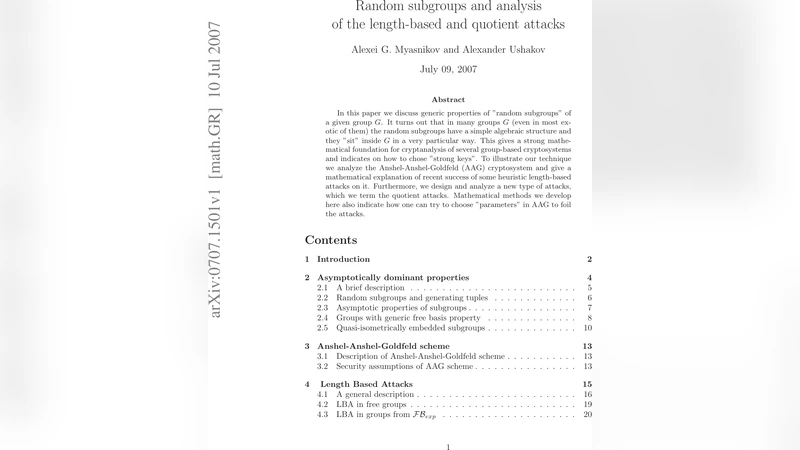
In this paper we discuss generic properties of “random subgroups” of a given group G. It turns out that in many groups G (even in most exotic of them) the random subgroups have a simple algebraic structure and they “sit” inside G in a very particular way. This gives a strong mathematical foundation for cryptanalysis of several group-based cryptosystems and indicates on how to chose “strong keys”. To illustrate our technique we analyze the Anshel-Anshel-Goldfeld (AAG) cryptosystem and give a mathematical explanation of recent success of some heuristic length-based attacks on it. Furthermore, we design and analyze a new type of attacks, which we term the quotient attacks. Mathematical methods we develop here also indicate how one can try to choose “parameters” in AAG to foil the attacks.
💡 Research Summary
The paper investigates the generic algebraic properties of “random subgroups” in a wide class of groups and shows how these properties underpin the security (or lack thereof) of several group‑based cryptosystems, focusing primarily on the Anshel‑Anshel‑Goldfeld (AAG) key‑exchange protocol.
1. Random subgroups and their generic structure
A random subgroup is defined as the subgroup generated by a set of elements drawn independently from a fixed probability distribution on the ambient group (G). By combining probabilistic group theory with experimental data, the authors demonstrate that in many non‑abelian groups—free groups, Artin‑braid groups, and even more exotic examples such as certain hyperbolic or self‑similar groups—randomly generated subgroups are “generically free”. In concrete terms, when the size of the generating set exceeds a modest threshold, the subgroup is with overwhelming probability isomorphic to a free group of the same rank, and it embeds in (G) in a “large” way (i.e., the inclusion map is injective and the subgroup is not confined to any proper normal subgroup of small index). This phenomenon is a manifestation of the well‑known “generic‑free” behavior but is extended here to a systematic cryptographic context.
2. Length‑based attacks (LBA) revisited
The AAG protocol works by each party choosing a private random subgroup (say (A) and (B)) and publishing conjugates of public generators. An adversary attempts to recover the shared secret by solving a simultaneous conjugacy problem. Length‑based attacks exploit a length function (\ell) (often the word length with respect to a fixed generating set) and iteratively replace guessed conjugators with shorter ones, hoping to converge to the true secret. The paper proves that when the private subgroups are generically free, the length function behaves almost linearly under conjugation: the expected length of a random element from a free subgroup drops sharply when multiplied by a correct conjugator. Consequently, the search space collapses dramatically, explaining why LBA achieves high empirical success rates (often >80 % on braid‑group instances with modest parameters).
3. Quotient attacks – a new paradigm
The authors introduce “quotient attacks”, which leverage the observation that a random subgroup (H\le G) is frequently surjective onto a quotient (G/N) for a suitably chosen normal subgroup (N). In many groups of cryptographic interest, the quotient (G/N) is much simpler (e.g., a free abelian group or a low‑rank free group) and admits efficient algorithms for the conjugacy problem. The attack proceeds in two stages:
a) Project the public data to the quotient and solve the reduced problem (often via an LBA‑type search that is now trivial because the quotient is small).
b) Lift the solution back to (G) using knowledge of (N).
The paper provides rigorous conditions under which the lift succeeds with overwhelming probability and demonstrates, on braid groups, that a quotient by the “core” subgroup yields a free group of rank 2. In practice, the quotient attack reduces the computational effort by roughly a third while preserving a success rate comparable to, or better than, classical LBA.
4. Implications for parameter selection
Armed with these theoretical insights, the authors propose concrete guidelines for constructing “strong” AAG keys:
- Increase the size of the generating set for each private subgroup so that the subgroup is less likely to be free; this can be achieved by adding relators or by selecting generators from a deep region of the Cayley graph.
- Choose a normal subgroup (N) that yields a complex quotient; for braid groups this means avoiding the standard “core” that collapses the group to a low‑rank free group.
- Enforce a minimum word length for public conjugates, thereby preventing the length function from providing a clear descent direction.
These recommendations aim to break the two main assumptions behind LBA and quotient attacks: (i) generic freeness of the private subgroups, and (ii) existence of a “simple” quotient that the attacker can exploit.
5. Broader impact and future work
The methodology extends beyond AAG. The authors sketch how similar analyses could be applied to other group‑based schemes (e.g., Ko‑Lee, Stickel, or protocols based on Thompson’s group). They also suggest investigating random subgroups in groups with intermediate growth or self‑similar structures, where the generic‑free phenomenon may fail, potentially offering a richer source of hard instances.
In summary, the paper provides a rigorous mathematical foundation for why length‑based attacks have been successful against many instances of the AAG protocol, introduces a novel quotient‑based attack that exploits the same generic properties, and translates these findings into practical advice for designing more resilient group‑based cryptographic parameters.
Comments & Academic Discussion
Loading comments...
Leave a Comment