On strict inclusions in hierarchies of convex bodies
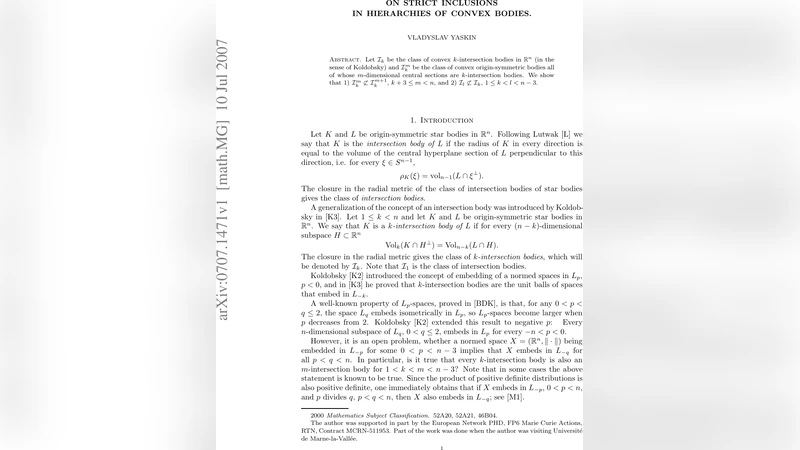
Let $\mathcal I_k$ be the class of convex $k$-intersection bodies in $\mathbb{R}^n$ (in the sense of Koldobsky) and $\mathcal I_k^m$ be the class of convex origin-symmetric bodies all of whose $m$-dimensional central sections are $k$-intersection bodies. We show that 1) $\mathcal I_k^m\not\subset \mathcal I_k^{m+1}$, $k+3\le m<n$, and 2) $\mathcal I_l \not\subset \mathcal I_k$, $1\le k<l < n-3$.
💡 Research Summary
The paper investigates the hierarchy of convex $k$‑intersection bodies in Euclidean space $\mathbb R^{n}$, a concept introduced by Koldobsky through Fourier analysis. For a fixed integer $k$ ( $1\le k\le n-1$ ) the class $\mathcal I_{k}$ consists of all origin‑symmetric convex bodies $K$ whose radial function $|x|{K}^{-k}$ has a non‑negative Fourier transform; equivalently, $K$ is a $k$‑intersection body. For an integer $m$ with $1\le m\le n-1$, the subclass $\mathcal I{k}^{m}$ is defined as the set of convex bodies whose every $m$‑dimensional central section is a $k$‑intersection body. The main goal is to determine whether these families are strictly nested.
Two strict‑inclusion results are proved:
-
Theorem 1. If $k+3\le m<n$, then $\mathcal I_{k}^{m}\not\subset\mathcal I_{k}^{m+1}$. In other words, there exist convex bodies $K$ such that every $m$‑dimensional central section of $K$ is a $k$‑intersection body, while at least one $(m+1)$‑dimensional central section fails to be a $k$‑intersection body.
-
Theorem 2. If $1\le k<l<n-3$, then $\mathcal I_{l}\not\subset\mathcal I_{k}$. Thus a convex body can be an $l$‑intersection body without being a $k$‑intersection body for any smaller $k$.
The proofs rely on explicit counter‑examples constructed by perturbing the Euclidean unit ball $B_{2}^{n}$. The perturbation is performed via a spherical harmonic $\Phi$ (or $\Psi$) of sufficiently high degree. The radial function of the perturbed body $K$ is taken as \
Comments & Academic Discussion
Loading comments...
Leave a Comment