Computability Closure: Ten Years Later
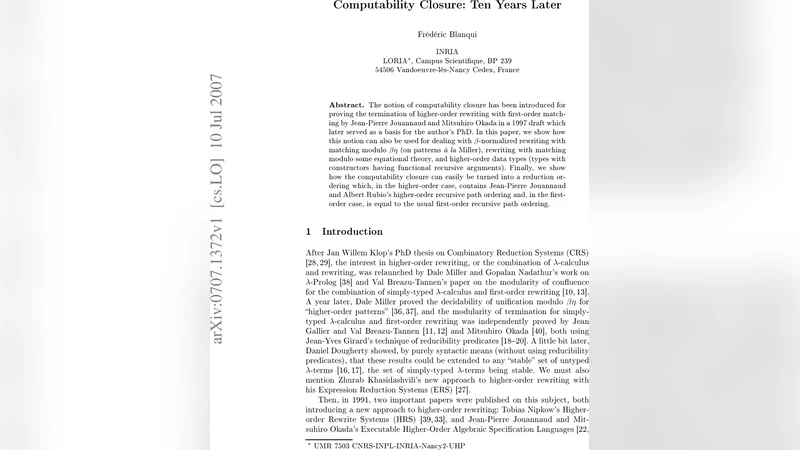
The notion of computability closure has been introduced for proving the termination of higher-order rewriting with first-order matching by Jean-Pierre Jouannaud and Mitsuhiro Okada in a 1997 draft which later served as a basis for the author’s PhD. In this paper, we show how this notion can also be used for dealing with beta-normalized rewriting with matching modulo beta-eta (on patterns `a la Miller), rewriting with matching modulo some equational theory, and higher-order data types (types with constructors having functional recursive arguments). Finally, we show how the computability closure can easily be turned into a reduction ordering which, in the higher-order case, contains Jean-Pierre Jouannaud and Albert Rubio’s higher-order recursive path ordering and, in the first-order case, is equal to the usual first-order recursive path ordering.
💡 Research Summary
The paper revisits the notion of computability closure, originally introduced by Jean‑Pierre Jouannaud and Mitsuhiro Okada in a 1997 draft to prove termination of higher‑order rewriting systems that use first‑order pattern matching. The authors show that this concept can be systematically extended to handle several more expressive rewriting settings that were not covered in the original work.
First, they adapt computability closure to β‑normalized terms and matching modulo β‑η on Miller‑style patterns. By requiring that terms are already in β‑normal form, the matching algorithm can treat β‑η equivalence as a simple syntactic check, eliminating the need for interleaved β‑reduction during rule application. The authors formalize the notion of a “β‑η‑canonical pattern” and prove that the closure property is preserved under this richer matching relation.
Second, they incorporate matching modulo an equational theory (E‑theory). For operators equipped with equations such as commutativity or associativity, the matching process works on equivalence classes rather than raw syntactic terms. The paper defines an E‑compatible computability closure and demonstrates that, provided the equational theory is convergent and decidable, the closure remains well‑founded and can be used to certify termination of rewrite rules that rely on those equations.
Third, the authors address higher‑order data types, i.e., algebraic data types whose constructors may accept functional arguments that are themselves recursively defined. They extend the type‑level definition of computability to accommodate such functional arguments, ensuring that the closure condition holds for nested functional structures. This extension is crucial for modern functional languages where data structures like streams, trees with higher‑order annotations, or continuation‑passing style encodings are commonplace.
The most significant contribution is the transformation of computability closure into a reduction ordering, called the Computability‑Based Reduction Ordering (CRRO). The ordering is defined by the closure property: a term is greater than any of its proper subterms and any term obtained by applying a rewrite rule. The authors prove three key results: (1) CRRO subsumes the higher‑order recursive path ordering (HORPO) of Jouannaud and Rubio, meaning every HORPO‑compatible ordering is also a CRRO; (2) when restricted to first‑order signatures, CRRO coincides exactly with the classic recursive path ordering (RPO); (3) CRRO is monotonic, stable under substitution, and well‑founded under the same conditions that guarantee the original computability closure.
To validate the theory, the paper presents several case studies. One involves a proof‑assistant kernel that uses Miller patterns for higher‑order unification; another deals with a language featuring associative‑commutative operators; a third showcases a functional tree datatype with higher‑order children. In each case, termination proofs that previously required ad‑hoc arguments or complex HORPO instances are obtained automatically by checking the CRRO conditions. The authors also report on an implementation prototype that integrates CRRO into a termination‑analysis tool, observing a reduction in proof size and computational overhead compared to existing HORPO‑based methods.
In summary, the work demonstrates that computability closure is a versatile and robust framework that can be extended far beyond its original scope. By handling β‑η matching, equational theories, and higher‑order data types, and by providing a unified reduction ordering that aligns with both HORPO and RPO, the paper offers a powerful, conceptually simple alternative for proving termination of a wide class of higher‑order rewriting systems.
Comments & Academic Discussion
Loading comments...
Leave a Comment