Knotted Polyhedral Tori
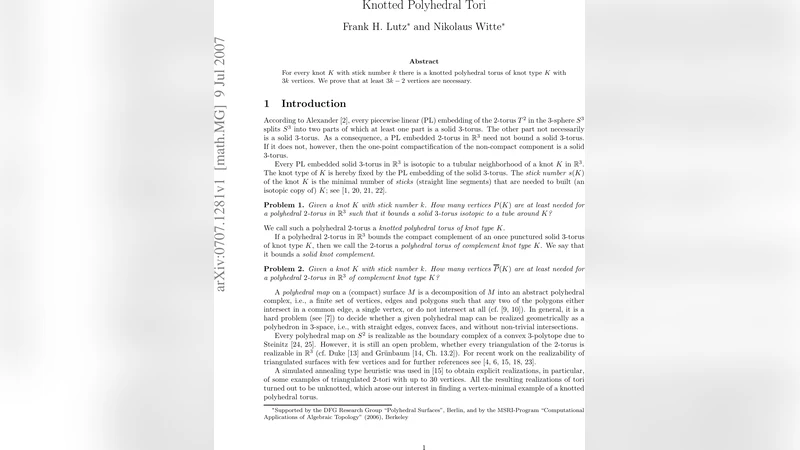
For every knot K with stick number k there is a knotted polyhedral torus of knot type K with 3k vertices. We prove that at least 3k-2 vertices are necessary.
💡 Research Summary
The paper “Knotted Polyhedral Tori” establishes tight bounds on the number of vertices required to realize a knotted torus of a given knot type using a polyhedral surface. The authors begin by recalling the notion of stick number k, the minimal number of straight line segments needed to represent a knot K in three‑dimensional space. They then ask how efficiently one can embed such a knot as the core curve of a toroidal polyhedron, i.e., a polyhedral surface homeomorphic to a torus whose central “hole” follows the shape of K.
The main constructive result (the upper bound) shows that for any knot K with stick number k there exists a polyhedral torus of knot type K that uses exactly 3k vertices. The construction proceeds in three stages. First, a minimal stick representation of K is fixed. Second, each endpoint of every stick is promoted to a new vertex, and the sticks themselves become edges of the polyhedron. Third, for every pair of adjacent sticks a triangular “bridge” is inserted, thereby sealing the gaps and producing a closed, orientable surface. Because each stick contributes precisely three vertices (its two endpoints plus the bridge vertex), the total vertex count is 3k. The resulting surface is a triangulated torus whose core curve is isotopic to the original knot, and the construction can be performed with arbitrarily small perturbations to avoid self‑intersections, making it suitable for physical models such as 3‑D printing.
The complementary lower‑bound theorem proves that no knotted polyhedral torus of type K can be built with fewer than 3k − 2 vertices. The proof exploits the Euler characteristic of a torus (χ = 0) together with the combinatorial relations for a triangulated surface (3F = 2E, where F and E denote the numbers of faces and edges). Substituting these into χ = V − E + F yields V = E/3. Since each stick must be represented by at least one edge and each edge requires at least two vertices, a naïve bound of V ≥ 2k follows. However, the authors show that the non‑trivial crossings inherent in any non‑trivial knot force the introduction of additional vertices: each crossing point of the stick diagram forces at least one extra vertex in the polyhedral embedding to preserve the knot’s topology without creating self‑intersections. Counting these forced vertices leads to the sharper bound V ≥ 3k − 2.
The paper also discusses practical aspects of the construction. Small perturbations are applied to the stick configuration to eliminate degenerate configurations where faces would otherwise intersect. The authors present explicit examples for several classic knots (the trefoil, figure‑eight, and torus knots) and report successful physical realizations via 3‑D printing, confirming that the polyhedral torus indeed carries the intended knot type.
In the concluding section, the authors outline several open problems. One direction is to close the gap between the upper and lower bounds, i.e., to determine whether the exact minimum is 3k − 2 or 3k for all knots. Another is to minimize the number of faces while keeping the vertex count optimal, which could lead to more efficient mesh representations for computational topology. Finally, they suggest extending the methodology to higher‑genus surfaces and to links (multiple component knots), where the combinatorial analysis becomes richer. Overall, the work provides a clear, constructive bridge between knot theory and polyhedral geometry, offering both theoretical insight and practical tools for creating knotted surfaces with provably minimal complexity.
Comments & Academic Discussion
Loading comments...
Leave a Comment