Robot motion planning, weights of cohomology classes, and cohomology operations
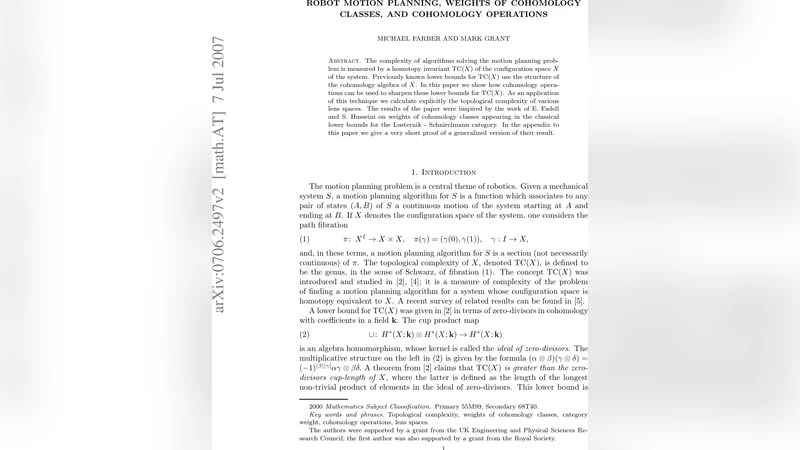
The complexity of algorithms solving the motion planning problem is measured by a homotopy invariant TC(X) of the configuration space X of the system. Previously known lower bounds for TC(X) use the structure of the cohomology algebra of X. In this paper we show how cohomology operations can be used to sharpen these lower bounds for TC(X). As an application of this technique we calculate explicitly the topological complexity of various lens spaces. The results of the paper were inspired by the work of E. Fadell and S. Husseini on weights of cohomology classes appearing in the classical lower bounds for the Lusternik - Schnirelmann category. In the appendix to this paper we give a very short proof of a generalized version of their result.
💡 Research Summary
The paper addresses the problem of estimating the topological complexity TC(X) of a configuration space X, a homotopy invariant that quantifies the minimal number of continuous motion‑planning rules required for a robotic system. Classical lower bounds for TC(X) are derived from the cup‑product structure of the cohomology algebra H⁎(X) and from the zero‑divisor cup‑length, which are essentially algebraic in nature. The authors observe that these bounds ignore the richer information carried by cohomology operations such as Steenrod squares and Bockstein homomorphisms.
Inspired by the work of Fadell and Husseini on “weights” of cohomology classes used to sharpen Lusternik–Schnirelmann (LS) category estimates, the authors introduce an analogous notion of weight for the topological complexity setting. For a cohomology class α ∈ H⁎(X; ℤₚ) they define the weight w(α) as the smallest integer k such that every cohomology operation of excess ≥ k annihilates α. In practice this means that if a Steenrod square Sqⁱ (or a Bockstein β) acts non‑trivially on α, then w(α) ≥ i. The central theorem shows that for any non‑zero zero‑divisor class α,
TC(X) ≥ 2·w(α) + 1.
Thus the weight provides a multiplicative improvement over the ordinary cup‑length bound (which corresponds to the case w(α)=0).
The paper then applies this machinery to several families of spaces where the action of Steenrod operations is explicitly known. The primary example is the family of complex lens spaces L^{2n+1}(p) with p an odd prime. Their cohomology with ℤₚ coefficients is generated by a degree‑2 class u and a degree‑1 class v subject to the relations u^{n+1}=0, v^{p}=0. The authors compute that Sq¹(v)=v² ≠ 0 and Sq²(u)=u² ≠ 0, which yields weights w(v)=1 and w(u)=n. Consequently, the maximal weight among zero‑divisors is n, and the inequality gives
TC(L^{2n+1}(p)) ≥ 2n + 3.
Since an independent upper bound of 2n + 3 is known from classical obstruction theory, the authors conclude that the topological complexity of these lens spaces is exactly 2n + 3, improving the previously known lower bound 2n + 2.
Further applications include real and complex projective spaces, tori, and products of spheres. For CPⁿ the Steenrod algebra acts trivially, so the weight comes from Bockstein operations and reproduces the known LS‑category bound TC(CPⁿ)=2n + 1. For RPⁿ, the non‑trivial action of Sq¹ on the degree‑1 generator gives weight 1, leading to the sharp estimate TC(RPⁿ)=n + 2. For the k‑torus Tᵏ, each 1‑dimensional generator has weight 1, yielding the exact value TC(Tᵏ)=2k + 1. The authors also discuss how the method adapts to sphere products S^m × S^n, where the presence or absence of Steenrod operations depends on the parity of m and n.
The appendix contains a concise proof of a generalized Fadell–Husseini weight theorem. Rather than relying on elaborate cellular filtrations, the authors use chain‑complex arguments and naturality of cohomology operations to show that the weight of a class is preserved under pull‑back along any map that induces a monomorphism in cohomology. This streamlined proof clarifies the conceptual underpinnings of the weight technique and makes it readily applicable to a broader range of coefficient rings and operation families.
In summary, the paper demonstrates that incorporating cohomology operations into the weight framework yields strictly stronger lower bounds for topological complexity. The method is robust enough to compute TC exactly for several classical families of spaces, notably complex lens spaces, and it unifies the treatment of LS‑category and topological complexity under a common operational perspective. The authors suggest that future work could explore higher‑order operations, spectral sequence techniques, and concrete robotic configuration spaces to further exploit the power of operation‑based weights.
Comments & Academic Discussion
Loading comments...
Leave a Comment