Deformation theory of representations of prop(erad)s
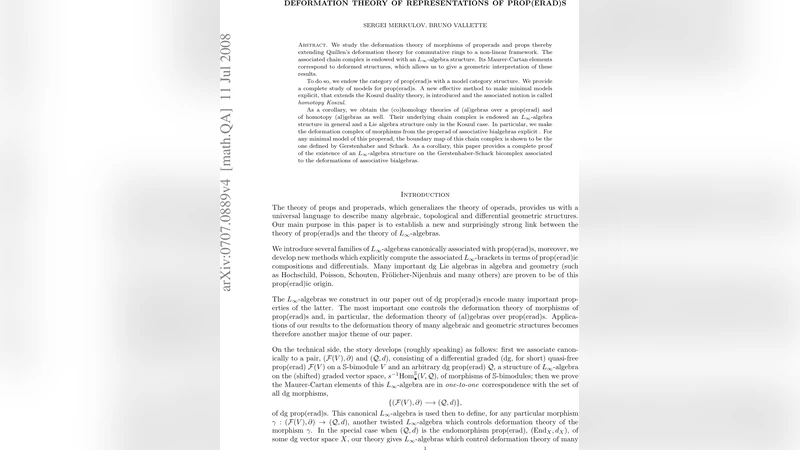
We study the deformation theory of morphisms of properads and props thereby extending to a non-linear framework Quillen’s deformation theory for commutative rings. The associated chain complex is endowed with a Lie algebra up to homotopy structure. Its Maurer-Cartan elements correspond to deformed structures, which allows us to give a geometric interpretation of these results. To do so, we endow the category of prop(erad)s with a model category structure. We provide a complete study of models for prop(erad)s. A new effective method to make minimal models explicit, that extends Koszul duality theory, is introduced and the associated notion is called homotopy Koszul. As a corollary, we obtain the (co)homology theories of (al)gebras over a prop(erad) and of homotopy (al)gebras as well. Their underlying chain complex is endowed with a canonical Lie algebra up to homotopy structure in general and a Lie algebra structure only in the Koszul case. In particular, we explicit the deformation complex of morphisms from the properad of associative bialgebras. For any minimal model of this properad, the boundary map of this chain complex is shown to be the one defined by Gerstenhaber and Schack. As a corollary, this paper provides a complete proof of the existence of a Lie algebra up to homotopy structure on the Gerstenhaber-Schack bicomplex associated to the deformations of associative bialgebras.
💡 Research Summary
The paper develops a comprehensive deformation theory for morphisms between properads and props, extending Quillen’s deformation theory for commutative rings to a highly non‑linear setting. The authors first endow the category of prop(erad)s with a cofibrantly generated model structure. Weak equivalences are taken to be morphisms that induce quasi‑isomorphisms on underlying chain complexes, while fibrations are defined via a lifting property against a set of generating cofibrations built from free prop(erad) constructions. This model structure guarantees the existence of cofibrant replacements and makes homotopical arguments possible throughout the paper.
Having a model category at hand, the authors turn to the construction of minimal models. Classical Koszul duality provides minimal models for quadratic operads, but properads and props often involve higher‑arity and non‑quadratic relations. To overcome this, the authors introduce the notion of a “homotopy Koszul” properad. A homotopy Koszul properad admits a filtered resolution whose associated graded is a Koszul properad; the filtration encodes higher‑order homotopies that correct the failure of strict Koszulness. Using this framework they give an explicit algorithm for constructing minimal models: start with a quadratic Koszul approximation, then iteratively add higher‑order generators to kill obstructions, producing a cofibrant, quasi‑free properad equipped with an ∞‑operadic differential.
With a minimal model ( \mathcal{M} \to \mathcal{P} ) in hand, the deformation complex of a morphism ( \phi : \mathcal{P} \to \mathcal{Q} ) is defined as the complex of derivations from ( \mathcal{M} ) to ( \mathcal{Q} ) twisted by ( \phi ). The authors prove that this complex carries a natural ( L_{\infty} )-algebra structure. The higher brackets are obtained by the standard derived bracket construction on the convolution Lie algebra of maps from the cooperad governing ( \mathcal{M} ) to ( \mathcal{Q} ). Maurer–Cartan elements of this ( L_{\infty} )-algebra correspond precisely to deformed morphisms, giving a clean geometric interpretation: the deformation functor is represented by the formal moduli problem associated to the ( L_{\infty} )-algebra. In the strictly Koszul case the ( L_{\infty} )-structure collapses to an ordinary differential graded Lie algebra.
A major application is the properad governing associative bialgebras, denoted ( \mathsf{AssBialg} ). The authors construct a minimal model for this properad and compute the associated deformation complex. They show that the differential coincides with the Gerstenhaber–Schack differential on the bicomplex that classically controls deformations of associative bialgebras. Consequently, the Gerstenhaber–Schack bicomplex inherits an ( L_{\infty} )-structure, and in the Koszul situation this reduces to a genuine dg Lie algebra. This result provides a complete and rigorous proof of a long‑standing conjecture that the Gerstenhaber–Schack bicomplex carries a homotopy Lie algebra structure.
Beyond this concrete case, the paper outlines how the homotopy Koszul machinery yields (co)homology theories for algebras over any properad, and how the associated chain complexes automatically acquire canonical ( L_{\infty} )-structures. The authors discuss potential extensions to homotopy algebras, deformation quantization, and applications in mathematical physics where properads model interactions with multiple inputs and outputs. In summary, the work establishes a robust homotopical foundation for deformation theory of prop(erad)s, introduces effective tools for constructing minimal models via homotopy Koszul duality, and demonstrates the emergence of higher Lie algebra structures on classical deformation complexes.
Comments & Academic Discussion
Loading comments...
Leave a Comment