The Euler characteristic of a category as the sum of a divergent series
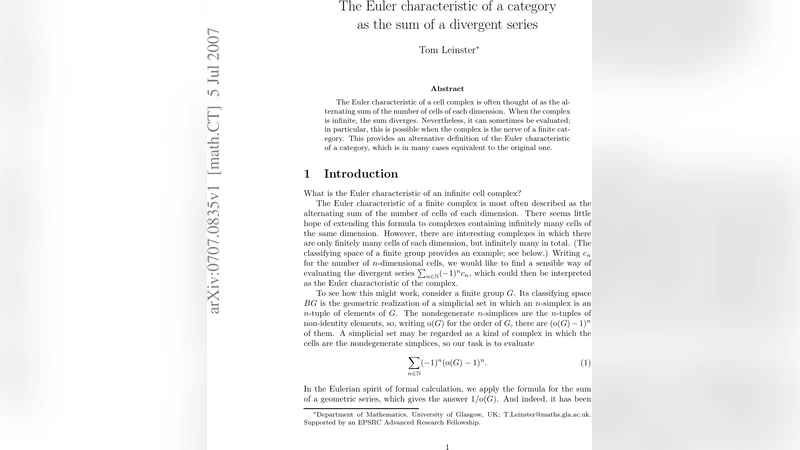
The Euler characteristic of a cell complex is often thought of as the alternating sum of the number of cells of each dimension. When the complex is infinite, the sum diverges. Nevertheless, it can sometimes be evaluated; in particular, this is possible when the complex is the nerve of a finite category. This provides an alternative definition of the Euler characteristic of a category, which is in many cases equivalent to the original one (math.CT/0610260).
💡 Research Summary
The paper addresses a classical difficulty in topology: the Euler characteristic of a cell complex is traditionally defined as the alternating sum (\chi = \sum_{n\ge0} (-1)^n c_n) of the numbers (c_n) of (n)-dimensional cells. When the complex is infinite this series typically diverges, so the naïve definition fails. The author shows that, for a large class of infinite complexes—namely those that arise as the nerve of a finite category—one can still assign a meaningful Euler characteristic by interpreting the divergent alternating sum as a regularized series.
The exposition begins with a concise review of cell complexes, nerves of categories, and the standard categorical Euler characteristic introduced by Leinster. For a finite category (\mathcal C), the nerve (N(\mathcal C)) is a simplicial set whose (n)-simplices are strings of (n) composable morphisms. Consequently the number of (n)-simplices equals the number of (n)-chains of morphisms, which may be infinite even when (\mathcal C) has only finitely many objects. The naïve alternating sum over these simplices therefore diverges.
To overcome this, the author introduces a weighting function (w\colon \operatorname{Ob}(\mathcal C)\to\mathbb R) satisfying the balance condition \
Comments & Academic Discussion
Loading comments...
Leave a Comment