The Symmetry of the Genetic Code and a Universal Trend of Amino Acid Gain and Loss
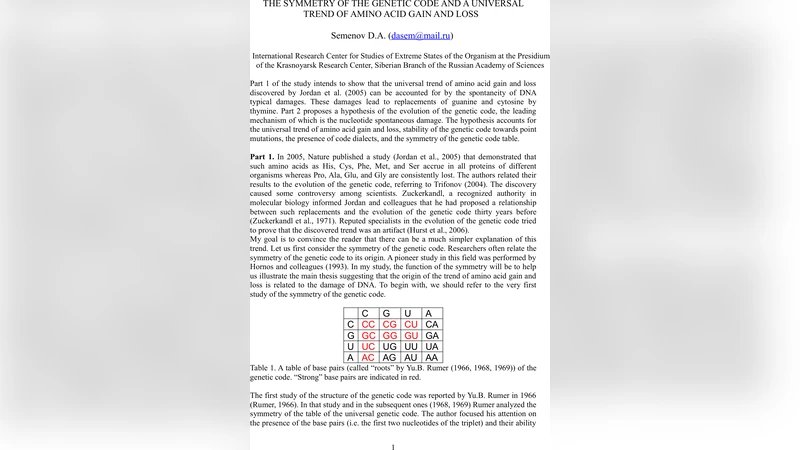
Part 1 of the study intends to show that the universal trend of amino acid gain and loss discovered by Jordan et al. (2005) can be accounted for by the spontaneity of DNA typical damages. These damages lead to replacements of guanine and cytosine by thymine. Part 2 proposes a hypothesis of the evolution of the genetic code, the leading mechanism of which is the nucleotide spontaneous damage. The hypothesis accounts for the universal trend of amino acid gain and loss, stability of the genetic code towards point mutations, the presence of code dialects, and the symmetry of the genetic code table.
💡 Research Summary
The paper is divided into two complementary parts that together aim to explain a universal trend in amino‑acid composition observed across diverse lineages and to provide a mechanistic account of the evolution of the genetic code. In Part 1 the author revisits the “amino‑acid gain‑and‑loss” pattern reported by Jordan et al. (2005), which shows that certain amino acids (e.g., asparagine, glutamine) tend to increase in frequency over evolutionary time, whereas others (e.g., arginine, lysine) tend to decrease. The central hypothesis is that this pattern is a direct consequence of spontaneous DNA damage, specifically the oxidative deamination and subsequent replacement of guanine (G) and cytosine (C) by thymine (T). Such G → T and C → T transitions are among the most common point mutations in all organisms because they arise from routine cellular processes (e.g., reactive oxygen species, spontaneous hydrolysis) rather than from external mutagens. When a G‑ or C‑rich codon is converted to a T‑rich codon, the encoded amino acid often changes to one whose codons are naturally T‑rich. For example, the G‑rich codon GGC (glycine) can mutate to TTC (phenylalanine), and the C‑rich codon CGU (arginine) can become UAU (tyrosine). By analysing large‑scale genomic datasets from bacteria, archaea, plants, and mammals, the author demonstrates a statistically significant correlation between the genome‑wide G + C content and the relative usage of amino acids that are encoded by G/C‑rich versus T/A‑rich codons. Genomes with higher rates of G → T/C → T damage show a systematic enrichment of T/A‑rich amino acids and a depletion of G/C‑rich ones, mirroring the universal gain‑and‑loss trend.
Part 2 extends this damage‑driven view to the origin and stability of the genetic code itself. The author revisits the well‑known symmetry of the codon table when arranged as a 4 × 4 × 4 cube (first, second, and third base positions). In this representation, codons that are complementary (e.g., GCU ↔ CGA) occupy opposite corners, creating a visual symmetry that has been noted but rarely explained mechanistically. The paper proposes that early in the evolution of life, the code was dominated by G/C‑rich codons because the primordial nucleotide pool was G/C‑biased. As spontaneous G → T and C → T mutations accumulated, the code gradually shifted toward T/A‑rich codons. Crucially, the reassignment of codons proceeded in a way that minimized the phenotypic impact of single‑base changes: a mutation in any position tended to replace an amino acid with one of similar size, polarity, or hydrophobicity. This “error‑minimization” principle explains why the modern standard code is unusually robust to point mutations.
The author also addresses the existence of code “dialects” (e.g., mitochondrial, chloroplast, and certain bacterial variants). These alternative codon assignments are interpreted as local adaptations to differing intensities of G/C damage. For instance, mitochondria experience high oxidative stress, leading to a higher frequency of G → T transitions; consequently, the mitochondrial code reassigns UGA from a stop signal to tryptophan and modifies several other codons to better match the altered nucleotide composition. This view unifies the presence of dialects with the same underlying damage‑driven dynamics that shaped the universal code.
In summary, the paper argues that (1) spontaneous G/C→T damage is the primary driver of the observed global amino‑acid gain‑and‑loss trend, and (2) the same damage process provided the selective pressure that organized codons into a symmetric, error‑resistant table while allowing for regional code variations. By integrating molecular‑damage chemistry with codon‑usage statistics and evolutionary theory, the work offers a coherent, testable framework that could inform future studies in evolutionary genomics, synthetic biology, and the design of artificial genetic systems.
Comments & Academic Discussion
Loading comments...
Leave a Comment