Two results from Morita theory of stable model categories
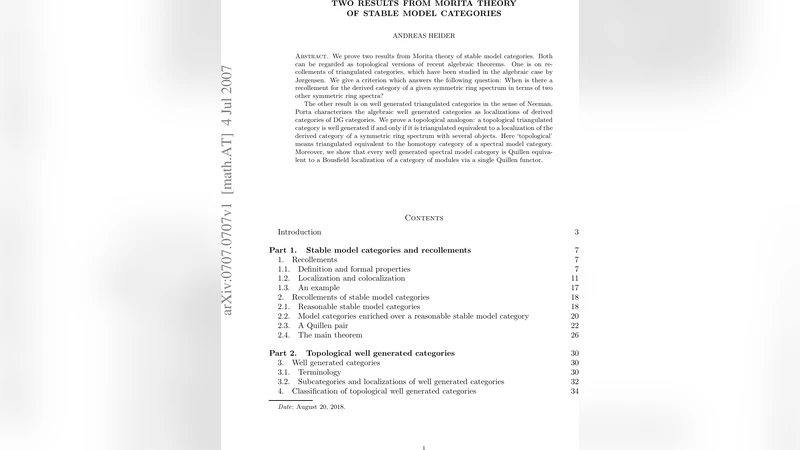
We prove two results from Morita theory of stable model categories. Both can be regarded as topological versions of recent algebraic theorems. One is on recollements of triangulated categories, which have been studied in the algebraic case by J{\o}rgensen. We give a criterion which answers the following question: When is there a recollement for the derived category of a given symmetric ring spectrum in terms of two other symmetric ring spectra? The other result is on well generated triangulated categories in the sense of Neeman. Porta characterizes the algebraic well generated categories as localizations of derived categories of DG categories. We prove a topological analogon: a topological triangulated category is well generated if and only if it is triangulated equivalent to a localization of the derived category of a symmetric ring spectrum with several objects. Here `topological’ means triangulated equivalent to the homotopy category of a spectral model category. Moreover, we show that every well generated spectral model category is Quillen equivalent to a Bousfield localization of a category of modules via a single Quillen functor.
💡 Research Summary
This paper extends Morita theory for stable model categories in two complementary directions, providing topological analogues of recent algebraic results. The first main theorem gives a precise criterion for when the derived category D(A) of a symmetric ring spectrum A fits into a recollement with the derived categories D(B) and D(C) of two other symmetric ring spectra B and C. By constructing the derived functors between the module categories Mod‑A, Mod‑B, and Mod‑C and analyzing their left and right adjoints, the authors show that a recollement exists exactly when A can be built from B and C via a pair of Morita-type Quillen adjunctions that satisfy the triangulated exactness conditions required for a recollement. In concrete terms, A‑Mod must be a Bousfield localization of the product of B‑Mod and C‑Mod, and the associated derived functors must generate the necessary gluing data. The theorem is illustrated with examples such as Eilenberg‑Mac Lane spectra and K‑theory spectra, demonstrating its applicability to familiar objects in stable homotopy theory.
The second major result concerns well‑generated triangulated categories in the sense of Neeman. Building on Porta’s algebraic characterization—where every well‑generated triangulated category is a localization of the derived category of a DG‑category—the authors prove a topological analogue: a triangulated category that is equivalent to the homotopy category of a spectral model category (i.e., a “topological” triangulated category) is well‑generated if and only if it is triangulated equivalent to a Bousfield localization of the derived category D(R) of a symmetric ring spectrum with several objects (a spectral category). The proof adapts the machinery of λ‑compact generators, Bousfield classes, and cofibrant generation of spectral model categories to the topological setting, showing that the well‑generated property is preserved under such localizations and that any well‑generated topological triangulated category arises in this way.
Finally, the paper shows that every well‑generated spectral model category is Quillen equivalent to a Bousfield localization of a module category via a single Quillen functor. This consolidates potentially complex chains of localizations into a single step, simplifying both conceptual understanding and practical computations. The authors discuss applications to stable homotopy theory, such as the classification of module spectra over structured ring spectra and the analysis of higher‑algebraic structures via spectral categories. Overall, the work bridges algebraic Morita theory and topological stable homotopy theory, delivering new tools for constructing recollements and for recognizing well‑generated structures in the spectral world.
Comments & Academic Discussion
Loading comments...
Leave a Comment