Learning from dependent observations
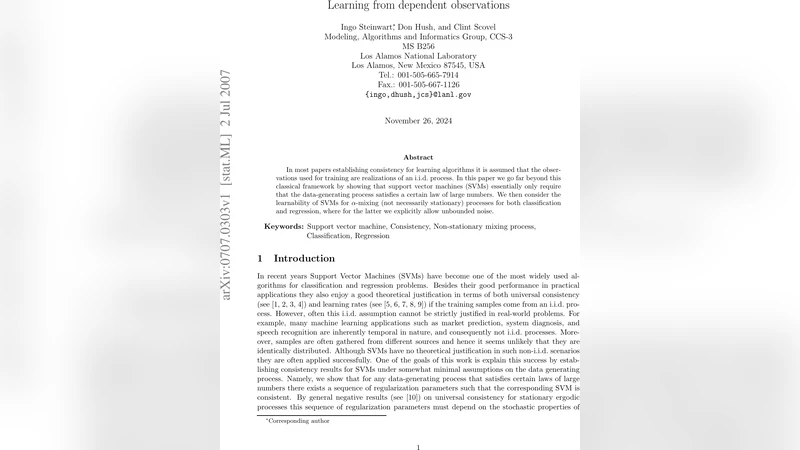
In most papers establishing consistency for learning algorithms it is assumed that the observations used for training are realizations of an i.i.d. process. In this paper we go far beyond this classical framework by showing that support vector machines (SVMs) essentially only require that the data-generating process satisfies a certain law of large numbers. We then consider the learnability of SVMs for $\a$-mixing (not necessarily stationary) processes for both classification and regression, where for the latter we explicitly allow unbounded noise.
💡 Research Summary
The paper “Learning from dependent observations” challenges the conventional assumption that training data for learning algorithms must be independent and identically distributed (i.i.d.). Instead, the authors demonstrate that support vector machines (SVMs) only require a much weaker condition: the data‑generating process must satisfy a law of large numbers (LLN). By building a general convergence framework based on LLN, they show that the regularized empirical risk of an SVM converges to the true risk even when observations are dependent, non‑stationary, or generated by processes with unbounded noise.
The core technical contribution is two‑fold. First, the authors develop a universal LLN‑based argument for reproducing kernel Hilbert spaces (RKHS). They prove that if the sample averages converge to their expectations, then the regularized risk functional—parameterized by a sequence of regularization coefficients λₙ that decay appropriately—remains consistent. This result holds without any independence or stationarity assumptions, provided the kernel is bounded and the RKHS has finite trace.
Second, the paper specializes the general theory to α‑mixing processes, which quantify the decay of dependence between distant observations. The authors assume a summability condition of the form Σₖ α(k)^{δ/(2+δ)} < ∞ for some δ > 0, a condition that is considerably milder than the strong mixing assumptions used in earlier work. Under this α‑mixing regime, they establish that the difference between empirical and true risk shrinks at the usual Oₚ(n^{-1/2}) rate, despite the presence of dependence.
Both classification and regression are treated. For classification, a convex Lipschitz loss such as the hinge loss is employed, and the analysis shows that the SVM classifier remains universally consistent under the α‑mixing condition. For regression, the authors allow the noise variable to have infinite variance; they only require a finite (2+δ)‑th moment, which permits heavy‑tailed disturbances. By using loss functions that are Lipschitz continuous (e.g., ε‑insensitive loss), they prove that the regularized SVM regressor still converges to the optimal predictor.
Practical aspects are also discussed. The paper outlines methods for estimating α‑mixing coefficients (e.g., block bootstrap, autocorrelation‑based estimators) and suggests data‑dependent strategies for choosing the regularization sequence λₙ, such as cross‑validation adjusted for dependence or theoretically motivated decay rates. Moreover, the authors hint at adaptive algorithms that detect non‑stationarity and modify λₙ on the fly.
In conclusion, the study extends the theoretical foundation of SVMs from the restrictive i.i.d. world to a far broader setting that includes dependent, possibly non‑stationary observations and heavy‑tailed noise. This opens the door for reliable application of kernel‑based learning methods to time‑series, spatial data, network traffic, and any domain where observations naturally exhibit temporal or spatial dependence. Future work is proposed to empirically validate the theory on real‑world datasets, to explore other mixing concepts (β‑mixing, φ‑mixing), and to develop concrete algorithms that automatically tune regularization in the presence of dependence.
Comments & Academic Discussion
Loading comments...
Leave a Comment