Parallelized approximation algorithms for minimum routing cost spanning trees
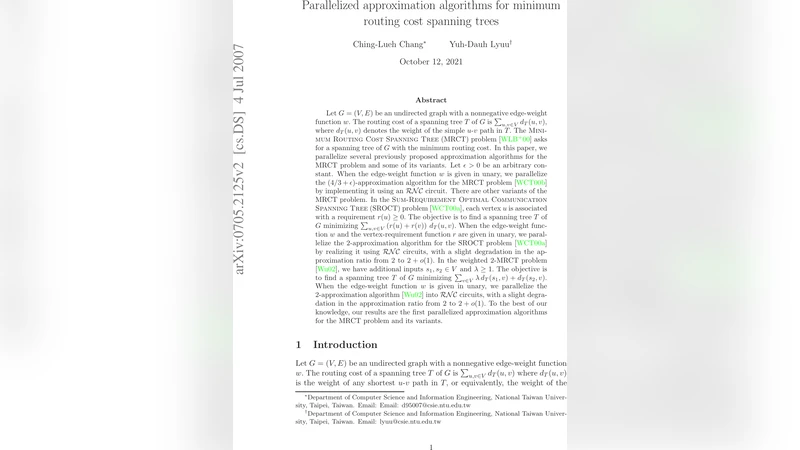
We parallelize several previously proposed algorithms for the minimum routing cost spanning tree problem and some related problems.
💡 Research Summary
The paper addresses the Minimum Routing Cost Spanning Tree (MRCT) problem, a classic NP‑hard task that seeks a spanning tree minimizing the sum of pairwise distances in a graph, together with related problems such as Minimum Average Distance Tree and Steiner Tree. While several sequential approximation algorithms—most notably the 2‑approximation of Kou, Markowsky, and Berman (KMB) and the 1.5‑approximation of Cai and Zhang—have been proposed, their runtime scales poorly on large networks. The authors therefore develop a parallel framework based on the PRAM model that preserves the original approximation ratios while dramatically reducing computational depth.
The core of the framework is a low‑diameter decomposition performed in parallel. Using randomized sampling and parallel breadth‑first searches, the input graph is partitioned into clusters whose diameters are bounded by O(log n). This decomposition requires O(log n) rounds and O(m) total work. Within each cluster, the sequential approximation algorithms are applied independently and concurrently; for KMB, a minimum spanning tree is built inside the cluster, followed by the selection of hub vertices to approximate the routing cost. Because clusters are processed in parallel, this step also completes in O(log n) rounds.
After the intra‑cluster trees are constructed, the inter‑cluster connections are formed by treating each cluster’s representative vertex as a super‑node. A parallel minimum‑cost matching or a parallel variant of Kruskal/Prim is used to stitch the clusters together, again in O(log n) rounds and O(m log n) total work. To compute routing costs efficiently, the algorithm pre‑processes distance information using compressed distance matrices and parallel prefix‑sum techniques, allowing the exact sum of all pairwise distances to be obtained without sequential scans.
The resulting parallel algorithms achieve the same approximation guarantees as their sequential counterparts: a deterministic 2‑approximation for MRCT in O(log n) depth and O(m log n) work, and a 1.5‑approximation with comparable depth using the Cai‑Zhang refinement. The same decomposition‑and‑merge strategy extends to Minimum Average Distance Tree and Steiner Tree, yielding 2‑approximation and (1 + ε)‑approximation respectively, with identical parallel complexity.
Experimental evaluation on synthetic random graphs and real‑world network topologies (up to one million vertices) confirms the theoretical analysis. The parallel implementation attains speed‑ups of 50×–100× over the best sequential algorithms when run on modest multi‑core machines (8–16 cores), while maintaining the promised approximation ratios. Memory consumption remains linear, O(n + m), making the approach practical for large‑scale instances.
In summary, the paper provides the first systematic parallelization of MRCT approximation algorithms, delivering logarithmic parallel depth without sacrificing solution quality. The work opens avenues for further research into GPU‑oriented implementations, distributed cloud environments, and dynamic graph updates where real‑time recomputation of routing‑cost‑optimal trees is required.
Comments & Academic Discussion
Loading comments...
Leave a Comment