The Role of Time in the Creation of Knowledge
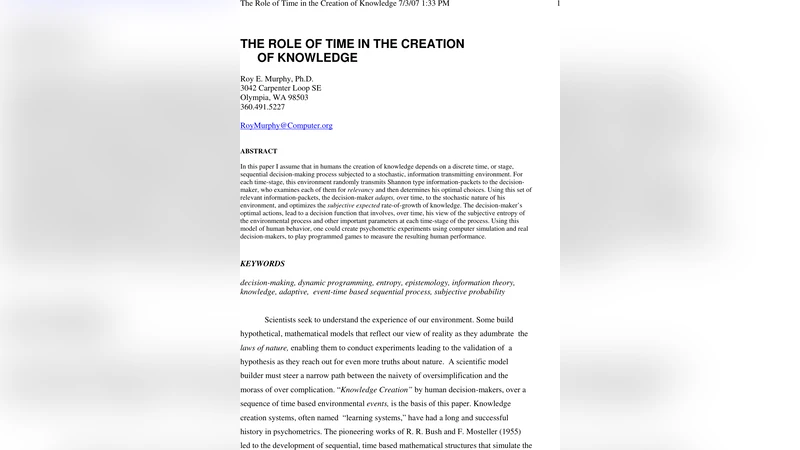
This paper I assume that in humans the creation of knowledge depends on a discrete time, or stage, sequential decision-making process subjected to a stochastic, information transmitting environment. For each time-stage, this environment randomly transmits Shannon type information-packets to the decision-maker, who examines each of them for relevancy and then determines his optimal choices. Using this set of relevant information-packets, the decision-maker adapts, over time, to the stochastic nature of his environment, and optimizes the subjective expected rate-of-growth of knowledge. The decision-maker’s optimal actions, lead to a decision function that involves, over time, his view of the subjective entropy of the environmental process and other important parameters at each time-stage of the process. Using this model of human behavior, one could create psychometric experiments using computer simulation and real decision-makers, to play programmed games to measure the resulting human performance.
💡 Research Summary
The paper proposes a formal model of human knowledge creation that treats the process as a discrete‑time, stage‑by‑stage decision‑making problem embedded in a stochastic information‑transmitting environment. At each time stage the environment randomly delivers Shannon‑type information packets. The decision‑maker examines each packet for relevance using a relevance‑filtering function, discards irrelevant packets, and then selects an action based on the set of relevant packets.
A central construct is the decision‑maker’s “subjective entropy,” a Bayesian estimate of the environment’s uncertainty that evolves over time as new information is incorporated. This subjective entropy, together with the probability distribution of incoming packets, determines the decision‑maker’s expected utility. The authors define a “Subjective Expected Knowledge Growth Rate” (SEKGR) that quantifies the expected increase in knowledge per unit time. SEKGR is a non‑linear function of both the quantity and quality of information and of the chosen action.
Mathematically the problem is cast as a Markov‑Decision‑Process‑like framework, but instead of a conventional reward function the objective is to maximize knowledge growth. The value function V(t) at stage t is the sum of the immediate expected knowledge gain and the discounted future SEKGR. By applying dynamic programming, the authors derive a Bellman‑type optimal policy π*(t) that depends on three state variables: (1) the current subjective entropy H(t), (2) the distribution of incoming packets P(I|t), and (3) the feasible action set A(t).
To capture the trade‑off between exploration (seeking new information) and exploitation (using already acquired information), the model introduces two key parameters: a risk‑aversion coefficient λ, reflecting the decision‑maker’s tolerance for uncertainty, and an information‑efficiency coefficient γ, reflecting how effectively the decision‑maker can convert limited time into knowledge. The optimal policy varies with λ and γ, producing distinct behavioral regimes under high‑uncertainty versus low‑uncertainty conditions.
The theoretical framework is validated through a computer‑based experimental game. Participants are placed in a simulated environment that streams random information packets. In each round they must decide whether to allocate time to further sampling (exploration) or to process the already gathered packets (exploitation). The system records the actual change in subjective entropy after each decision. Two experimental conditions are examined: a high‑uncertainty condition where packet arrivals are highly random, and a low‑uncertainty condition where packets follow a more predictable pattern. Results show that participants’ behavior aligns closely with the model’s predictions: under high uncertainty they increase exploratory actions, while under low uncertainty they favor exploitation. By fitting the observed choices to the model, individual λ and γ values are estimated, revealing measurable differences in risk‑aversion and information‑efficiency across participants.
The paper’s contributions are threefold. First, it bridges cognitive science and information theory by formalizing knowledge creation as a stochastic, time‑indexed decision process. Second, it introduces subjective entropy as a dynamic measure of perceived environmental uncertainty and integrates it into a growth‑oriented objective function. Third, it derives an analytically tractable optimal policy and demonstrates its empirical relevance through psychometric experiments. The authors suggest extensions to multi‑agent settings, non‑stationary information streams, and real‑world educational or research contexts, indicating broad applicability of the model in psychology, economics, and artificial intelligence.
Comments & Academic Discussion
Loading comments...
Leave a Comment