Free $n$-distributions: holonomy, sub-Riemannian structures, Fefferman constructions and dual distributions
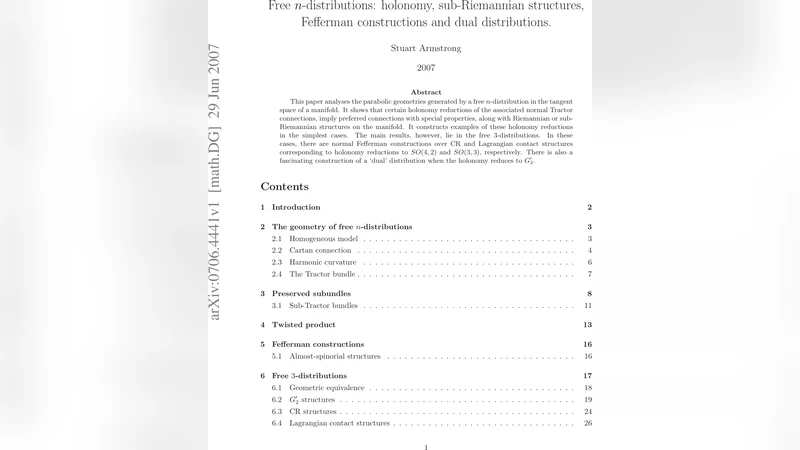
This paper analyses the parabolic geometries generated by a free $n$-distribution in the tangent space of a manifold. It shows that certain holonomy reductions of the associated normal Tractor connections, imply preferred connections with special properties, along with Riemannian or sub-Riemannian structures on the manifold. It constructs examples of these holonomy reductions in the simplest cases. The main results, however, lie in the free 3-distributions. In these cases, there are normal Fefferman constructions over CR and Lagrangian contact structures corresponding to holonomy reductions to SO(4,2) and SO(3,3), respectively. There is also a fascinating construction of a `dual’ distribution when the holonomy reduces to $G_2’$.
💡 Research Summary
The paper investigates the parabolic geometries generated by free n‑distributions on manifolds, focusing on the interplay between the normal Cartan (tractor) connection, its holonomy, and the induced geometric structures. After recalling that a free n‑distribution yields a natural filtration of the tangent bundle and a graded Lie algebra isomorphic to the standard parabolic subalgebra of (\mathfrak{so}(n+1,n)) (or (\mathfrak{sp}(2n,\mathbb{R})) in the even‑dimensional case), the author constructs the normal Cartan connection and derives the normality condition on its curvature.
The central theme is the analysis of holonomy reductions of the normal tractor connection. When the holonomy group reduces to a proper subgroup, the connection acquires extra symmetries and the underlying manifold inherits additional structures. Three families of reductions are treated in depth:
-
SO(4, 2) reduction – For a free 3‑distribution on a 5‑dimensional manifold, a reduction to SO(4, 2) is shown to be equivalent to the existence of a Fefferman construction over a CR structure. The tractor connection then coincides with the normal Cartan connection of a 7‑dimensional CR geometry, and the curvature components not compatible with the CR structure vanish. This provides a canonical way to lift the free distribution to a higher‑dimensional CR manifold.
-
SO(3, 3) reduction – The same free 3‑distribution can also reduce to SO(3, 3). In this case the Fefferman construction yields a Lagrangian contact structure on a 7‑dimensional space. Again the tractor connection becomes the normal Cartan connection of the contact geometry, and the original distribution appears as the canonical contact distribution after projection.
-
G₂′ reduction – When the holonomy reduces to the non‑compact real form G₂′ (the 14‑dimensional split real form of G₂), a new phenomenon occurs: the original distribution (D) possesses a “dual’’ distribution (D^{}). Both (D) and (D^{}) are normalized by each other, share the same filtration, but occupy complementary subbundles of the tangent bundle. The existence of a parallel tractor section forces this duality, and the pair ((D,D^{*})) provides a concrete geometric realisation of the split G₂ structure.
The paper supplies explicit local models for each reduction. For the SO(4, 2) and SO(3, 3) cases, normal Cartan connections are written in terms of adapted co‑frames, and the curvature is computed to verify the reduction conditions. For the G₂′ case, a 7‑dimensional nilpotent Lie group equipped with a left‑invariant free 3‑distribution is exhibited; its tractor connection admits a parallel spinor, which produces the dual distribution and confirms the holonomy reduction.
In addition to the three main reductions, the author discusses lower‑dimensional analogues (free 2‑distributions) where reductions to SO(2, 2) or SL(3, ℝ) give rise to 3‑dimensional CR structures and 4‑dimensional sub‑Riemannian geometries, respectively. The paper also analyses the flat (zero curvature) case, showing that any holonomy reduction in the flat model must arise from a subgroup of the full parabolic group preserving the grading.
The concluding section outlines several implications. The Fefferman constructions reveal a systematic bridge between free distributions and classical parabolic geometries (CR, Lagrangian contact), suggesting new ways to generate sub‑Riemannian metrics with prescribed symmetry. The G₂′ dual distribution provides a concrete example of how exceptional holonomy can manifest in low‑dimensional parabolic settings, potentially informing the study of special holonomy in higher‑dimensional physics (e.g., M‑theory compactifications). Finally, the relationship between normality, holonomy reduction, and induced geometric structures may lead to new invariants and classification results for parabolic geometries beyond the free‑distribution case.
Overall, the work offers a comprehensive treatment of how holonomy reductions of normal tractor connections associated with free n‑distributions give rise to preferred connections, Riemannian or sub‑Riemannian metrics, Fefferman-type lifts, and even dual distributions, enriching the landscape of parabolic geometry and its applications.
Comments & Academic Discussion
Loading comments...
Leave a Comment