Some Quantitative Aspects of Fractional Computability
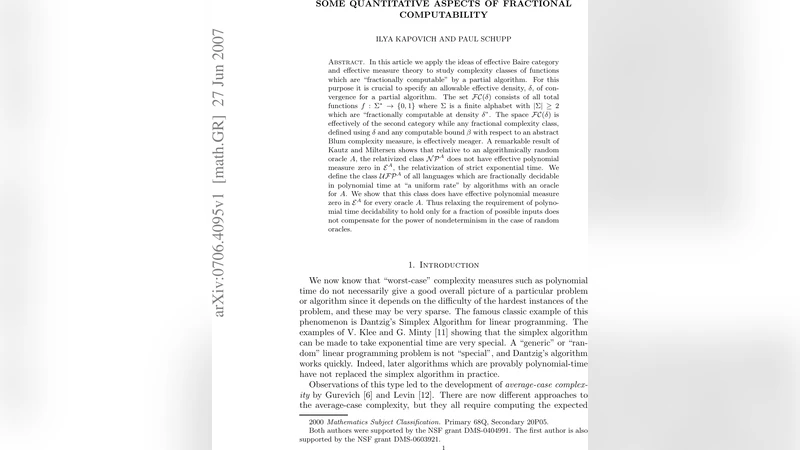
Motivated by results on generic-case complexity in group theory, we apply the ideas of effective Baire category and effective measure theory to study complexity classes of functions which are “fractionally computable” by a partial algorithm. For this purpose it is crucial to specify an allowable effective density, $\delta$, of convergence for a partial algorithm. The set $\mathcal{FC}(\delta)$ consists of all total functions $ f: \Sigma^\ast \to {0,1 }$ where $\Sigma$ is a finite alphabet with $|\Sigma| \ge 2$ which are “fractionally computable at density $\delta$”. The space $\mathcal{FC}(\delta) $ is effectively of the second category while any fractional complexity class, defined using $\delta$ and any computable bound $\beta$ with respect to an abstract Blum complexity measure, is effectively meager. A remarkable result of Kautz and Miltersen shows that relative to an algorithmically random oracle $A$, the relativized class $\mathcal{NP}^A$ does not have effective polynomial measure zero in $\mathcal{E}^A$, the relativization of strict exponential time. We define the class $\mathcal{UFP}^A$ of all languages which are fractionally decidable in polynomial time at ``a uniform rate’’ by algorithms with an oracle for $A$. We show that this class does have effective polynomial measure zero in $\mathcal{E}^A$ for every oracle $A$. Thus relaxing the requirement of polynomial time decidability to hold only for a fraction of possible inputs does not compensate for the power of nondeterminism in the case of random oracles.
💡 Research Summary
The paper introduces and systematically studies the notion of fractional computability, a relaxation of classical total‑function computability in which a partial algorithm is required to give correct answers only on a prescribed fraction of inputs. The authors formalize this by fixing an effective density function δ : ℕ →
Comments & Academic Discussion
Loading comments...
Leave a Comment