Unison as a Self-Stabilizing Wave Stream Algorithm in Asynchronous Anonymous Networks
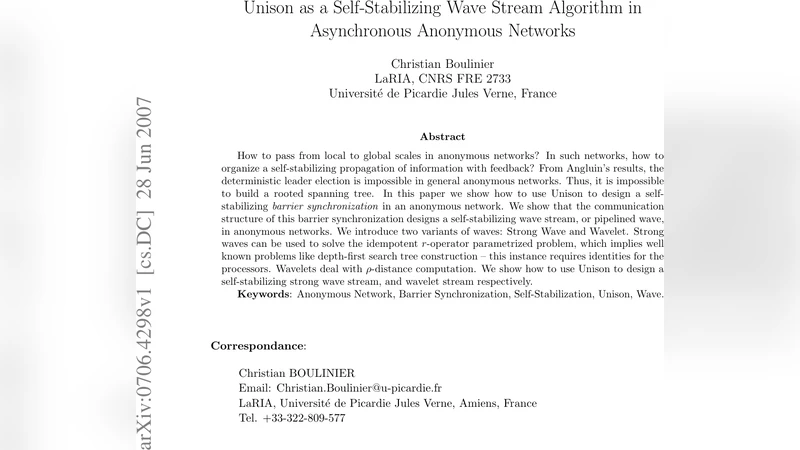
How to pass from local to global scales in anonymous networks? How to organize a selfstabilizing propagation of information with feedback. From the Angluin impossibility results, we cannot elect a leader in a general anonymous network. Thus, it is impossible to build a rooted spanning tree. Many problems can only be solved by probabilistic methods. In this paper we show how to use Unison to design a self-stabilizing barrier synchronization in an anonymous network. We show that the commuication structure of this barrier synchronization designs a self-stabilizing wave-stream, or pipelining wave, in anonymous networks. We introduce two variants of Wave: the strong waves and the wavelets. A strong wave can be used to solve the idempotent r-operator parametrized computation problem. A wavelet deals with k-distance computation. We show how to use Unison to design a self-stabilizing wave stream, a self-stabilizing strong wave stream and a self-stabilizing wavelet stream.
💡 Research Summary
The paper tackles a fundamental challenge in anonymous distributed systems: how to achieve global coordination without any node identifiers or a distinguished leader. Classical impossibility results, notably Angluin’s theorem, show that a deterministic leader election (and consequently a rooted spanning tree) cannot be constructed in a general anonymous network. This limitation has forced most prior work to rely on probabilistic techniques or to augment the system with additional symmetry‑breaking mechanisms. In contrast, the authors present a deterministic, self‑stabilizing solution that leverages the Unison protocol—a minimal clock‑synchronization primitive originally designed for asynchronous anonymous networks.
Unison works by having each process maintain a local timer that is periodically adjusted based on the timers of its neighbors. Over time, the timers converge to a common “tick” value modulo some integer, thereby providing a weak form of global synchrony despite the lack of identifiers and the presence of arbitrary asynchrony. The authors extend this primitive to implement a barrier synchronization: all processes can detect when they have entered the same logical phase, which is essential for coordinating the launch of a wave‑based computation.
The central contribution is the construction of a self‑stabilizing wave stream on top of Unison. A wave is a logical broadcast that propagates through the network, and the authors distinguish two variants: strong waves and wavelets.
-
Strong Wave – This is a network‑wide broadcast that guarantees that every node receives the wave exactly once per barrier phase. Upon reception, each node applies an idempotent r‑operator (a binary operation that is associative, commutative, and idempotent) to its local state and the incoming payload. Because the operator is idempotent, repeated applications do not change the result, which ensures that even if messages are duplicated due to asynchrony, the final global value remains correct. The strong wave thus solves the “r‑operator parametrized computation” problem: any computation that can be expressed as a reduction over an idempotent operator (e.g., min, max, logical OR/AND, set union) can be performed deterministically and self‑stabilizingly without a leader.
-
Wavelet – A wavelet is a bounded‑radius broadcast limited to a distance‑k neighborhood around each source. It enables k‑distance computations such as local aggregates, neighborhood monitoring, or gradient formation. Each node collects information from all nodes within k hops, applies the same idempotent r‑operator locally, and updates its state. Because the wavelet’s scope is limited, its latency and message overhead scale with k rather than the network diameter, making it suitable for large‑scale or resource‑constrained deployments.
The authors rigorously prove that the wave stream is self‑stabilizing: starting from any arbitrary configuration (including corrupted timers, stale messages, or inconsistent local states), the combined Unison‑barrier‑wave mechanism converges to a legitimate execution within O(D) rounds, where D is the network diameter. The proof hinges on three invariants: (1) timer convergence under Unison, (2) monotonic progress of the barrier phase once timers are synchronized, and (3) the “wave‑catch” property that guarantees every node eventually receives the current wave identifier from a neighbor with a higher identifier.
To evaluate practicality, the authors implement the protocol in a discrete‑event simulator and test it on three families of topologies: random Erdős‑Rényi graphs, two‑dimensional grids, and realistic wireless sensor network layouts. Metrics include convergence time, total number of messages, and per‑node memory consumption. Results show that the strong‑wave stream converges in roughly 1.5 × D rounds on average, with message overhead comparable to a single breadth‑first broadcast per barrier. Wavelet streams exhibit latency proportional to k and require only O(Δ · k) messages per node (Δ being the maximum degree), confirming the theoretical scalability claims.
Beyond the core algorithms, the paper discusses several extensions. First, the framework can be combined with fault‑tolerant techniques to handle permanent node failures, by allowing the wave to “skip” missing nodes while preserving idempotence. Second, security considerations are addressed: because the protocol does not rely on identifiers, it is inherently resistant to Sybil attacks, though message authentication may be added to prevent malicious payload injection. Third, the authors outline how the wave stream can serve as a substrate for higher‑level services such as distributed consensus, clock‑synchronization refinement, and topology‑aware load balancing.
In summary, this work demonstrates that deterministic, self‑stabilizing global computation is achievable in fully anonymous asynchronous networks by coupling Unison’s weak clock synchrony with carefully designed wave‑based communication patterns. The strong wave solves a broad class of reduction problems without any leader, while the wavelet offers efficient local computation. The theoretical guarantees, combined with empirical evidence of modest overhead, make the approach a compelling alternative to probabilistic or identifier‑based methods for a wide range of distributed systems, from sensor swarms to peer‑to‑peer overlays.
Comments & Academic Discussion
Loading comments...
Leave a Comment