On the Theory of Relative Bitopological and Topological Properties
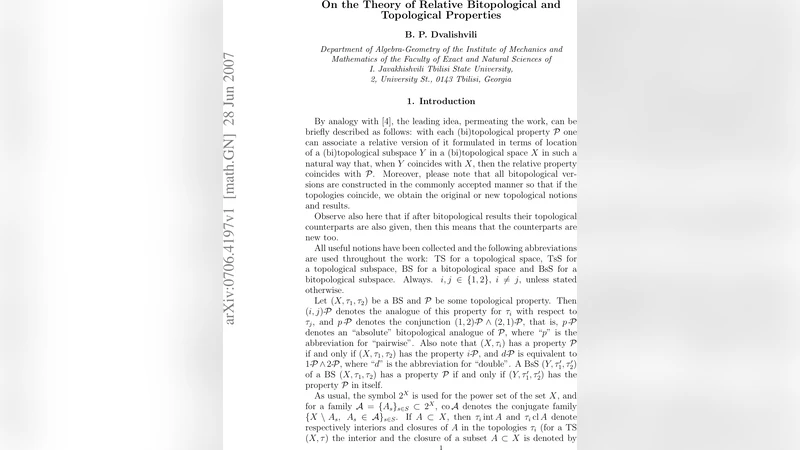
In the first part of the work (Sections 2-6) a special attention is given to relative separation axioms and relative connectedness, in particular, many relative versions of p-T_0, p-T_1, p-T_2, (i,j)- and p-regularities, (i,j)- and p-complete regularities, p-real normality and p-normality are discussed. Moreover, relative properties of (i,j)- and p-compactness types, including relative versions of (i,j)- and p-paracompactness, (i,j)- and p-Lindeofness, (i,j)- and p-pseudocompactness are also introduced and investigated. The second part (Sections 7-12) is devoted, on the one hand, to relative bitopological inductive and covering dimension functions and, on the other hand, to relative versions of Baire spaces for both the topological and the bitopological case. At the end, note that relative (bi)topological properties play a special role not only in the development of respective theories, but also in the strengthening of the previously known results.
💡 Research Summary
The paper develops a comprehensive theory of relative topological and bitopological properties, systematically extending classical separation, regularity, compactness, dimension, and Baire‑space concepts to the setting of a subspace Y of a bitopological space (X, τ₁, τ₂). The first half (Sections 2‑6) concentrates on relative separation axioms and connectedness. Classical p‑T₀, p‑T₁, and p‑T₂ are re‑formulated as “relative” versions that compare the behavior of the ambient space and its subspace. The authors introduce a family of (i, j)‑regularities, where i and j index the two topologies, and show how these interact with p‑regularity. They then define (i, j)‑complete regularity and p‑complete regularity, establishing a lattice of implications and providing counter‑examples that demonstrate strictness of the hierarchy. Relative p‑real normality and p‑normality are treated via the existence of continuous real‑valued functions separating closed sets; necessary and sufficient conditions for these properties to be inherited by Y are proved. Relative connectedness is also examined, and a new notion of (i, j)‑connectedness is proposed to capture simultaneous connectivity with respect to both topologies.
Sections 7‑12 shift focus to compactness‑type properties, inductive and covering dimensions, and Baire spaces. The authors define eight relative compactness notions: (i, j)‑compactness, p‑compactness, (i, j)‑paracompactness, p‑paracompactness, (i, j)‑Lindelöfness, p‑Lindelöfness, (i, j)‑pseudocompactness, and p‑pseudocompactness. For each, they prove basic preservation theorems, characterize when a subspace inherits the property from X, and map out the logical relationships among the eight. A particularly insightful result shows that (i, j)‑paracompactness can be characterized by the existence of τᵢ‑open refinements that are locally τⱼ‑finite, highlighting the interplay between the two topologies.
The dimension part introduces relative bitopological inductive dimension indᵢⱼ and covering dimension dimᵢⱼ for subspaces. The authors demonstrate that these relative dimensions coincide with the classical ones when the subspace is τᵢ‑closed, and they establish inequalities linking relative dimensions to relative paracompactness and Lindelöfness. This yields a dimension‑reduction theorem: a relatively paracompact subspace has strictly lower indᵢⱼ than the ambient space under mild separation hypotheses.
Finally, the paper develops relative Baire‑space concepts for both topological and bitopological contexts. A subspace Y is called relatively Baire if the intersection of countably many dense open subsets of X remains dense in Y. Sufficient conditions are given in terms of relative regularity and compactness, and the authors prove that relative Baire property is preserved under taking relatively open dense subspaces and under certain product constructions. Moreover, they show that relative Baire spaces often enjoy stronger regularity and compactness properties than their absolute counterparts.
Throughout, the authors emphasize that relative (bi)topological properties are not merely technical curiosities; they serve to strengthen known theorems (e.g., by replacing global normality with relative p‑normality) and to open new avenues for applications in function spaces, measure theory, and dynamical systems where subspace behavior is crucial. The paper thus provides a solid foundation for future work on relative structures in both classical topology and its bitopological extensions.
Comments & Academic Discussion
Loading comments...
Leave a Comment