Zero-Bidimension and Various Classes of Bitopological Spaces
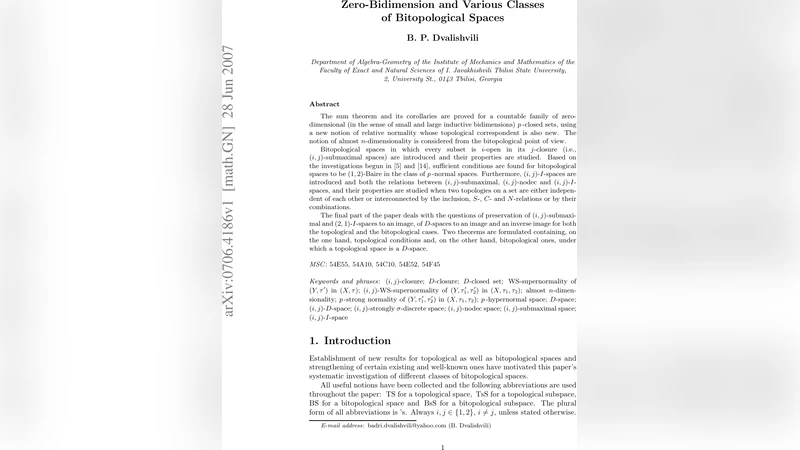
The sum theorem and its corollaries are proved for a countable family of zero-dimensional (in the sense of small and large inductive bidimensions) p-closed sets, using a new notion of relative normality whose topological correspondent is also new. The notion of almost $n$-dimensionality is considered from the bitopological point of view. Bitopological spaces in which every subset is i-open in its $j$-closure (i.e.,(i,j)-submaximal spaces) are introduced and their properties are studied. Based on the investigations begun in [5] and [14], sufficient conditions are found for bitopological spaces to be(1,2)-Baire in the class of p-normal spaces. Furthermore, (i,j)-I-spaces are introduced and both the relations between(i,j)-submaximal, (i,j)-nodec and (i,j)-I-spaces, and their properties are studied when two topologies on a set are either independent of each other or interconnected by the inclusion, S-, C- and N-relations or by their combinations. The final part of the paper deals with the questions of preservation of $(i,j)$-submaximal and $(2,1)\dd I$-spaces to an image, of $D$-spaces to an image and an inverse image for both the topological and the bitopological cases. Two theorems are formulated containing, on the one hand, topological conditions and, on the other hand, bitopological ones, under which a topological space is a $D$-space.
💡 Research Summary
The paper develops a comprehensive theory of zero‑dimensionality and related classes in the setting of bitopological spaces, i.e., a set equipped with two distinct topologies (\tau_{1}) and (\tau_{2}). The authors begin by extending the classical notion of zero‑dimensionality (small and large inductive dimensions both equal to 0) to bitopology. They introduce “p‑closed” sets, which are simultaneously closed in both topologies, and show that such sets have both small and large inductive bidimensions equal to zero.
A central innovation is the definition of a new form of separation called relative normality. Relative normality is a condition that, for a chosen ordered pair ((i,j)) with (i\neq j), any (\tau_{i})-open set can be separated from any (\tau_{j})-closed set by disjoint (\tau_{i})-open neighborhoods. This concept generalizes ordinary normality (which is defined with respect to a single topology) and becomes the key hypothesis in the main “sum theorem”. The sum theorem states that a countable union of zero‑dimensional p‑closed sets remains zero‑dimensional, provided the underlying bitopological space satisfies relative normality. The proof constructs a sequence of separating neighborhoods using the ((i,j))-closure and ((i,j))-interior operators and demonstrates that the union inherits the required inductive bidimension properties. Several corollaries follow, including a bitopological version of the classical result that the union of countably many nowhere‑dense sets is meagre.
The authors then introduce (i,j)-submaximal spaces, defined by the property that every subset which is (\tau_{i})-open and lies inside its (\tau_{j})-closure is already (\tau_{i})-open. This extends the notion of submaximality from single‑topology spaces to the interaction between two topologies. Alongside (i,j)-submaximality they define (i,j)-nodec spaces (every (\tau_{i})-open set is (\tau_{j})-closed) and (i,j)-I‑spaces (every (\tau_{i})-open set coincides with the interior of its (\tau_{j})-closure). The paper studies the lattice of implications among these classes, using three relational schemes:
- S‑relation (one topology is contained in the other),
- C‑relation (one topology’s closed sets are contained in the other’s), and
- N‑relation (one topology’s open sets are contained in the other’s).
By combining these relations the authors obtain a detailed hierarchy that clarifies when, for example, an (i,j)-submaximal space is automatically (i,j)-nodec or an (i,j)-I‑space.
A further contribution is the treatment of almost (n)-dimensionality in the bitopological context. A space is almost (n)-dimensional if every non‑empty subset has ((i,j))-closure of inductive bidimension at most (n-1). Using this notion together with (i,j)-submaximality, the authors give sufficient conditions for a bitopological space to be ((1,2))-Baire within the class of p‑normal spaces. In particular, they prove that if a p‑normal space is (1,2)-submaximal and almost zero‑dimensional, then it is a ((1,2))-Baire space.
The final section deals with preservation under mappings. The paper establishes two families of theorems: one concerning direct images and the other concerning inverse images. For (i,j)-submaximal and ((2,1))-I‑spaces, the authors identify conditions on a continuous map (e.g., openness with respect to one topology, closedness with respect to the other) that guarantee the image retains the same class. They also study (D)-spaces, which are spaces where every open cover admits a closed discrete kernel. Two characterizations are given: a purely topological one—“every closed set is a countable union of discrete sets”—and a bitopological one—“the space is ((i,j))-normal and ((i,j))-submaximal”. Both characterizations are shown to be preserved under appropriate continuous maps and their inverses.
Overall, the paper enriches the theory of bitopological spaces by (1) extending zero‑dimensionality via p‑closed sets, (2) introducing relative normality as a new separation axiom, (3) defining and interrelating several new classes ((i,j)-submaximal, (i,j)-nodec, (i,j)-I‑spaces), (4) providing Baire‑type results for almost (n)-dimensional spaces, and (5) delivering robust preservation theorems for these classes and for (D)-spaces. These contributions open new avenues for research in areas where two interacting topologies naturally arise, such as functional analysis, theoretical computer science, and the study of convergence structures.
Comments & Academic Discussion
Loading comments...
Leave a Comment