The Implicit Function Theorem for continuous functions
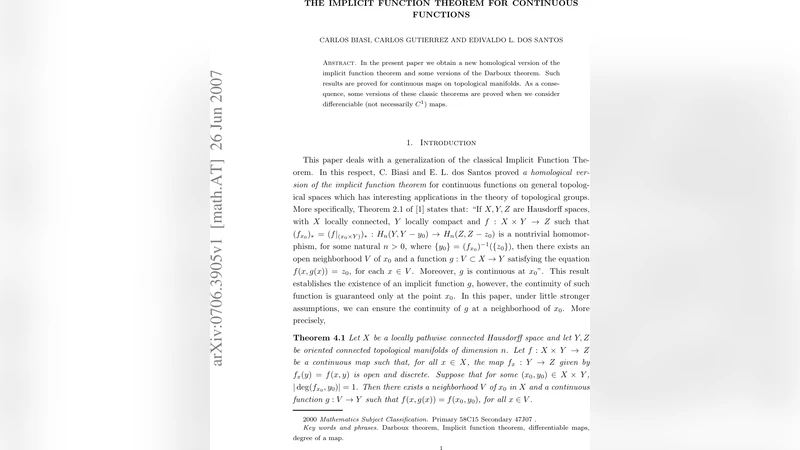
In the present paper we obtain a new homological version of the implicit function theorem and some versions of the Darboux theorem. Such results are proved for continuous maps on topological manifolds. As a consequence, some versions of these classic theorems are proved when we consider differenciable (not necessarily C^1) maps.
💡 Research Summary
The paper presents a homological reformulation of two classical results—the Implicit Function Theorem (IFT) and the Darboux (Intermediate Value) Theorem—under the sole hypothesis of continuity. By moving away from the usual differentiability or C¹‑smoothness requirements, the authors develop a topological framework that works on arbitrary topological manifolds and then specialize it to the case of merely differentiable (but not necessarily C¹) maps.
The work is organized into four main parts. The introductory section reviews the classical statements: the standard IFT assumes a C¹ map f : ℝⁿ × ℝᵐ → ℝᵐ with a Jacobian matrix of full rank at a point (x₀,y₀), guaranteeing a locally unique continuous function g such that f(x,g(x)) = y₀. The Darboux theorem asserts that any real‑valued continuous function on a connected interval attains every intermediate value. Both results rely on differentiability or, at least, on the existence of a derivative that behaves nicely.
The second section introduces the homological machinery needed for the new proofs. The authors work with relative homology groups H_*(X,A) and exploit excision, Mayer–Vietoris sequences, and the invariance of domain for manifolds. They define a homological local bijectivity condition for a continuous map f : U⊂M×N → N at a point (x₀,y₀): for every sufficiently small neighbourhood V of y₀, the preimage f⁻¹(V) has the same homology as V. In other words, f behaves like a homology equivalence locally, even though it may be far from a diffeomorphism. This condition replaces the Jacobian‑full‑rank hypothesis.
The third section contains the two central theorems.
-
Homological Implicit Function Theorem.
Let M and N be topological manifolds, U⊂M×N an open neighbourhood of (x₀,y₀), and f : U→N a continuous map that is homologically locally bijective at (x₀,y₀). Then there exist neighbourhoods U₀⊂M of x₀ and V₀⊂N of y₀ and a continuous function g : U₀→V₀ such that f(x,g(x)) = y₀ for all x∈U₀. The proof constructs a section of the projection π₁ : U→M by using the exactness of the Mayer–Vietoris sequence for the decomposition of U into two overlapping sets that are homologically equivalent to their images under f. The homological bijectivity guarantees that the obstruction to lifting the identity map on U₀ vanishes, yielding the desired continuous selector g. -
Homological Darboux Theorem.
Let M be a connected topological manifold and h : M→ℝ a continuous function. If a<b are values taken by h, then every c∈(a,b) is also attained. The argument proceeds by considering the sublevel sets A = h⁻¹((−∞,c]) and B = h⁻¹(
Comments & Academic Discussion
Loading comments...
Leave a Comment