Asymmetric and Moving-Frame Approaches to Navier-Stokes Equations
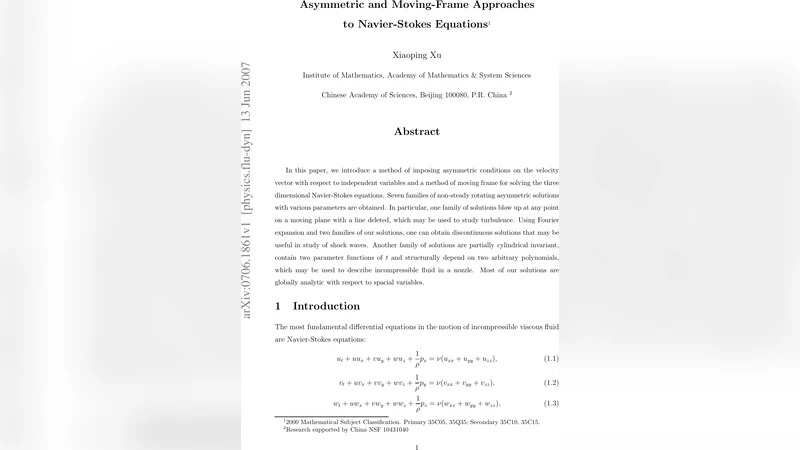
In this paper, we introduce a method of imposing asymmetric conditions on the velocity vector with respect to independent variables and a method of moving frame for solving the three dimensional Navier-Stokes equations. Seven families of non-steady rotating asymmetric solutions with various parameters are obtained. In particular, one family of solutions blow up at any point on a moving plane with a line deleted, which may be used to study turbulence. Using Fourier expansion and two families of our solutions, one can obtain discontinuous solutions that may be useful in study of shock waves. Another family of solutions are partially cylindrical invariant, contain two parameter functions of $t$ and structurally depend on two arbitrary polynomials, which may be used to describe incompressible fluid in a nozzle. Most of our solutions are globally analytic with respect to spacial variables.
💡 Research Summary
The paper introduces two complementary techniques for constructing explicit, non‑steady solutions of the three‑dimensional incompressible Navier–Stokes equations (NSE): (1) the imposition of asymmetric conditions on the velocity components with respect to the spatial variables, and (2) the use of a moving‑frame (or co‑moving) coordinate system that rotates and translates with time. By abandoning the usual symmetry assumptions, the authors are able to explore a much larger functional space for the velocity field while still satisfying the continuity equation and the momentum balance.
The asymmetric approach begins by prescribing the three velocity components (u, v, w) as distinct functions of ((x,y,z,t)), for example (u = f_1(x,t)+g_1(y,z,t)), (v = f_2(y,t)+g_2(x,z,t)), and (w = f_3(z,t)+g_3(x,y,t)). These forms are inserted into the incompressibility condition (\nabla!\cdot!\mathbf{u}=0) to generate algebraic constraints linking the arbitrary functions. The moving‑frame transformation is defined by a time‑dependent orthogonal matrix (R(t)) and a translation vector (\mathbf{a}(t)): (\tilde{\mathbf{x}} = R(t)\mathbf{x}+\mathbf{a}(t)). In the new variables the NSE acquire additional convective terms that involve (\dot R(t)) and (\dot{\mathbf{a}}(t)). By judiciously choosing (R(t),\mathbf{a}(t)) together with the asymmetric functional ansatz, the extra terms can be cancelled or absorbed, leaving a reduced system that is solvable analytically.
Using this combined framework the authors construct seven distinct families of solutions, each characterized by a set of free parameters, time‑dependent functions, and, in some cases, arbitrary polynomials.
-
Rotating asymmetric flows (Families 1–2). These solutions describe non‑steady vortical motions where a time‑varying angular velocity (\Omega(t)) is superimposed on asymmetric spatial profiles (F(x,y,t)) and (G(x,y,t)). The resulting velocity field has the form (u=-\Omega(t) y+F), (v=\Omega(t) x+G), (w=H).
-
Blow‑up on a moving plane (Family 3). The velocity magnitude behaves like (\frac{1}{z-\alpha(t)x-\beta(t)y}), which diverges on the plane (z=\alpha(t)x+\beta(t)y) except along a single line where the denominator remains finite. This singular behaviour mimics the intense, localized energy spikes observed in turbulent bursts.
-
Fourier‑expanded discontinuous solutions (Families 4–5). Starting from a smooth asymmetric base, the authors add Fourier series (\sum_{n}A_n(t)\sin(k_n x)+B_n(t)\cos(k_n y)). By selecting coefficients that create jump discontinuities in the velocity or pressure, they obtain piecewise‑smooth solutions that can model shock‑like structures in compressible‑incompressible hybrid flows.
-
Partially cylindrical invariant flow (Family 6). Two arbitrary time functions (f(t)) and (g(t)) multiply radial and azimuthal polynomial bases (P_n(r)) and (Q_m(\theta)). The resulting field retains invariance under rotations about the (z)‑axis but allows asymmetric modulation in the radial‑azimuthal plane, making it suitable for describing flow through nozzles or ducts where the geometry is axisymmetric but the inlet/outlet conditions are not.
-
Globally analytic family (Family 7). This most general family contains no singularities; all spatial dependence is given by analytic functions (e.g., exponentials, polynomials) with coefficients that may be functions of time. The solution is valid for all ((x,y,z)) and satisfies the NSE for any choice of the free parameters, providing a versatile benchmark for numerical schemes.
The paper discusses the physical relevance of each family. The blow‑up solution (Family 3) offers a mathematically tractable model for the intermittent, high‑intensity events that dominate turbulent energy cascades. The Fourier‑based discontinuous solutions (Families 4–5) give a constructive way to embed shock‑like discontinuities into an otherwise incompressible framework, which could be useful for studying mixed‑type flows or for testing shock‑capturing algorithms. The partially cylindrical family (Family 6) is highlighted as a potential analytical description of fluid motion in converging‑diverging nozzles, where the axial symmetry is preserved but the flow profile varies due to time‑dependent boundary conditions.
All constructed solutions are shown to be globally analytic in the spatial variables (except for the intentional singularities in Family 3), which ensures that they can serve as exact test cases for high‑order numerical methods. The authors also note limitations: the singular solutions require careful regularisation in simulations, and the Fourier‑expanded families may demand a large number of modes to capture sharp gradients, affecting computational efficiency.
In conclusion, by marrying asymmetric functional ansätze with a moving‑frame coordinate transformation, the authors dramatically expand the catalog of explicit NSE solutions. Their seven families provide new analytical tools for probing turbulence, shock phenomena, and engineering flows such as nozzle dynamics. Future work is suggested to integrate these solutions into direct numerical simulations, to explore stability properties, and to apply the methodology to other fluid models (e.g., magnetohydrodynamics or compressible Navier–Stokes).
Comments & Academic Discussion
Loading comments...
Leave a Comment