Gorenstein cohomology in abelian categories
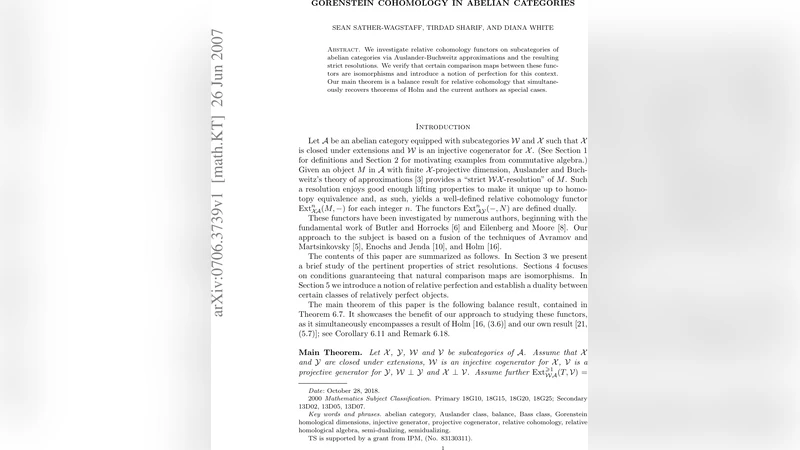
We investigate relative cohomology functors on subcategories of abelian categories via Auslander-Buchweitz approximations and the resulting strict resolutions. We verify that certain comparison maps between these functors are isomorphisms and introduce a notion of perfection for this context. Our main theorem is a balance result for relative cohomology that simultaneously recovers theorems of Holm and the current authors as special cases.
💡 Research Summary
The paper develops a comprehensive framework for relative cohomology in arbitrary abelian categories by exploiting Auslander‑Buchweitz approximation theory and the notion of strict resolutions. Starting with two subcategories 𝒜 and of an abelian category 𝒞, the authors introduce the concepts of 𝒜‑proper (or 𝒜‑precise) and ‑proper resolutions. These are built from objects of 𝒜 and respectively, and each differential is required to be a morphism that is “precise’’ with respect to the chosen subcategory. Using such resolutions they define two families of relative Ext functors, Extⁿ_𝒜(–,–) and Extⁿ_(–,–), which generalize the classical projective and injective Ext when 𝒜 (resp. ) consists of projectives (resp. injectives).
A central technical achievement is the construction of “strict’’ resolutions: by imposing an additional compatibility condition on the chain maps, the authors obtain resolutions that are simultaneously 𝒜‑proper and ‑proper. This allows them to produce natural comparison morphisms
φⁿ : Extⁿ_𝒜(X,Y) → Extⁿ_(X,Y)
for every pair of objects X,Y and every integer n≥0. The main theorem of the first part shows that, under the hypothesis that every object admits both an 𝒜‑proper and a ‑proper resolution, each φⁿ is an isomorphism. The proof proceeds by constructing explicit chain homotopy equivalences between the two strict resolutions, thereby demonstrating that the two derived functors compute the same cohomology groups.
To capture the objects for which the two relative theories behave best, the authors introduce a new notion of perfection. An object is called (𝒜,)-perfect if it admits a resolution that is both 𝒜‑proper and ‑proper and remains exact under the functors Hom_𝒞(–, –) with arguments in either subcategory. The class of perfect objects forms a thick subcategory of 𝒞, and the relative Ext functors restrict to long exact sequences on this subcategory, mirroring the familiar properties of Gorenstein projective and injective modules.
The balance theorem—the paper’s main result—states that if 𝒜 and are sufficiently rich (i.e., they provide enough proper resolutions for all objects) and every object is (𝒜,)-perfect, then for all X,Y∈𝒞 and all n≥0 we have a natural isomorphism
Extⁿ_𝒜(X,Y) ≅ Extⁿ_(X,Y).
This theorem simultaneously recovers two previously known balance results: Holm’s balance theorem for Gorenstein projective versus Gorenstein injective cohomology, and the authors’ earlier balance theorem for relative cohomology in module categories. Consequently, the new framework unifies these disparate results under a single, category‑theoretic umbrella.
The authors illustrate the theory with several concrete examples. In the classical module category Mod‑R, taking 𝒜 to be the subcategory of Gorenstein projective modules and to be the subcategory of Gorenstein injective modules reproduces Holm’s theorem verbatim. In the category of chain complexes, choosing 𝒜 as the DG‑projective complexes and as the DG‑injective complexes shows that the balance theorem also holds in derived‑category contexts, providing a tool for computing derived functors via either projective‑type or injective‑type models.
Finally, the paper outlines future directions. The authors suggest extending the relative cohomology theory to triangulated and ∞‑categorical settings, investigating whether the perfection condition can be relaxed or replaced by homotopical analogues, and exploring connections with model‑category structures to obtain new homotopy‑theoretic invariants. In summary, the work offers a robust, unified approach to relative cohomology in abelian categories, introduces a novel perfection concept, and delivers a powerful balance theorem that subsumes earlier Gorenstein‑cohomology results, thereby opening avenues for further research in homological algebra and its applications.
Comments & Academic Discussion
Loading comments...
Leave a Comment