NP by means of lifts and shadows
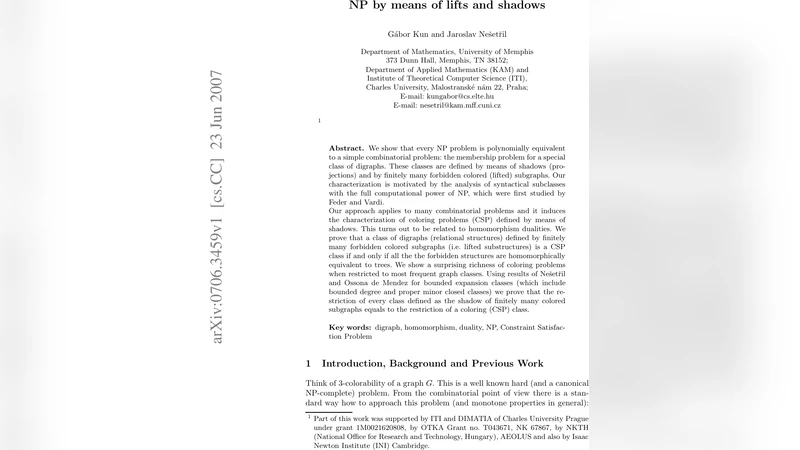
We show that every NP problem is polynomially equivalent to a simple combinatorial problem: the membership problem for a special class of digraphs. These classes are defined by means of shadows (projections) and by finitely many forbidden colored (lifted) subgraphs. Our characterization is motivated by the analysis of syntactical subclasses with the full computational power of NP, which were first studied by Feder and Vardi. Our approach applies to many combinatorial problems and it induces the characterization of coloring problems (CSP) defined by means of shadows. This turns out to be related to homomorphism dualities. We prove that a class of digraphs (relational structures) defined by finitely many forbidden colored subgraphs (i.e. lifted substructures) is a CSP class if and only if all the the forbidden structures are homomorphically equivalent to trees. We show a surprising richness of coloring problems when restricted to most frequent graph classes. Using results of Ne\v{s}et\v{r}il and Ossona de Mendez for bounded expansion classes (which include bounded degree and proper minor closed classes) we prove that the restriction of every class defined as the shadow of finitely many colored subgraphs equals to the restriction of a coloring (CSP) class.
💡 Research Summary
The paper introduces two operations on relational structures—lifts and shadows—and shows that they provide a universal combinatorial framework for the whole class NP. A lift enriches a plain digraph with a finite set of vertex or edge colours (labels), thereby defining a class ( \operatorname{Forb}(\mathcal{F}) ) of coloured digraphs that avoid a finite family ( \mathcal{F} ) of forbidden coloured substructures. A shadow strips away the colour information, mapping a coloured structure ( \mathbf{A} ) to its underlying uncoloured digraph ( \operatorname{sh}(\mathbf{A}) ).
The central theorem states that for every decision problem in NP there exists a finite family ( \mathcal{F} ) such that the problem is polynomial‑time equivalent to the membership test for the shadow class ( \operatorname{sh}(\operatorname{Forb}(\mathcal{F})) ). In other words, any NP problem can be encoded as “does a given digraph belong to the shadow of a class defined by finitely many forbidden coloured subgraphs?” This establishes a tight, polynomial‑time equivalence between the entire NP hierarchy and a very simple combinatorial problem.
A second major result characterises when such a shadow class is actually a Constraint Satisfaction Problem (CSP) class. The authors prove that ( \operatorname{sh}(\operatorname{Forb}(\mathcal{F})) ) is a CSP class if and only if every forbidden coloured structure in ( \mathcal{F} ) is homomorphically equivalent to a tree. This condition aligns precisely with the well‑studied notion of homomorphism dualities: tree‑like forbidden patterns guarantee the existence of a dual CSP template, while non‑tree patterns lead to strictly harder NP‑complete problems that are not captured by any CSP.
The paper further leverages the theory of bounded expansion (due to Nešetřil and Ossona de Mendez). For graph classes of bounded expansion—including bounded‑degree graphs and all proper minor‑closed families—the authors show that the restriction of any shadow class coincides with the restriction of some CSP class. Consequently, on most “natural’’ sparse graph families, every problem definable by a finite set of coloured forbidden subgraphs can be reformulated as a CSP, preserving computational complexity.
Finally, the authors connect their framework to the syntactic subclasses of NP originally investigated by Feder and Vardi. By demonstrating that lifts and shadows can simulate any NP problem, they provide a new proof that these syntactic subclasses are in fact as powerful as full NP. The work therefore bridges complexity theory, graph homomorphisms, and combinatorial optimisation, offering a unified language for describing and analysing NP‑complete problems through the lens of coloured subgraph avoidance and its uncoloured shadows.
Comments & Academic Discussion
Loading comments...
Leave a Comment