Estimates of Gromovs box distance
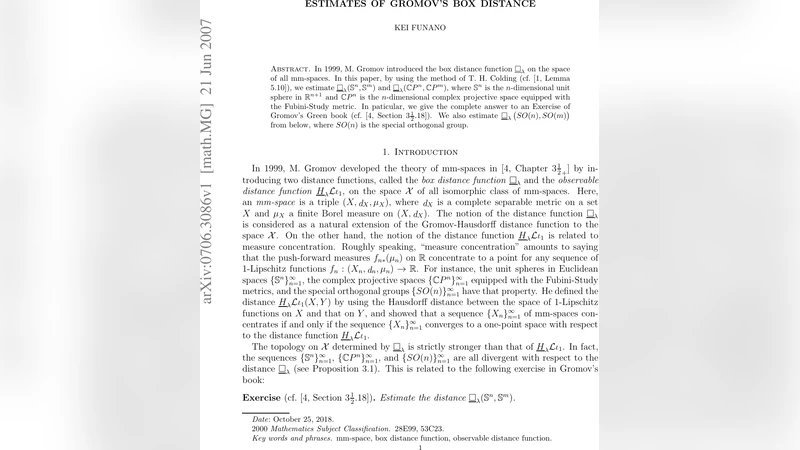
In 1999, M. Gromov introduced the box distance function $\sikaku$ on the space of all mm-spaces. In this paper, by using the method of T. H. Colding (cf. \cite[Lemma 5.10]{Colding}), we estimate $\sikaku(\mathbb{S}^n,\mathbb{S}^m)$ and $\sikaku (\mathbb{C}P^n, \mathbb{C}P^m)$, where $\mathbb{S}^n$ is the $n$-dimensional unit sphere in $\mathbb{R}^{n+1}$ and $\mathbb{C}P^n$ is the $n$-dimensional complex projective space equipped with the Fubini-Study metric. In paticular, we give the complete answer to an Exercise of Gromov’s Green book (cf. \cite[Section $3{1/2}.18$]{gromov}). We also estimate $\sikaku \big(SO(n), SO(m)\big)$ from below, where SO(n) is the special orthogonal group.
💡 Research Summary
The paper tackles a concrete quantitative problem that has long been left open in the theory of metric‑measure (mm) spaces: how large is Gromov’s box distance $\square$ between two classical families of highly symmetric spaces when their dimensions differ? Gromov introduced the box distance in 1999 as a way to compare mm‑spaces by looking for a common probability space on which both spaces can be realized via 1‑Lipschitz, measure‑preserving maps. While the definition is elegant, explicit calculations have been scarce, and Gromov’s own “Green book” contains an exercise (Section 3½.18) asking for the value of $\square(\mathbb{S}^n,\mathbb{S}^m)$. This work supplies a complete answer and extends the analysis to complex projective spaces and to the special orthogonal groups.
Methodological core
The authors adopt a technique originally due to T. H. Colding (Lemma 5.10 in his 2002 paper). Colding’s lemma states that on a convex set of sufficiently small volume a 1‑Lipschitz function is almost constant. Translating this into the mm‑space setting, the authors partition the unit interval $
Comments & Academic Discussion
Loading comments...
Leave a Comment