N-Body Simulations on GPUs
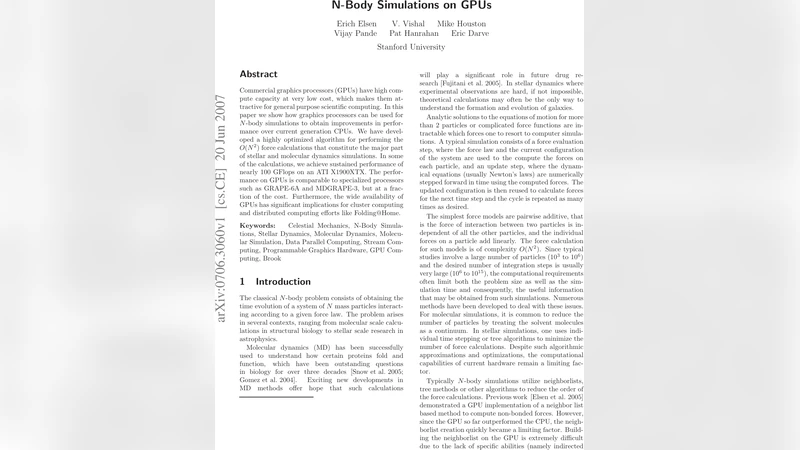
Commercial graphics processors (GPUs) have high compute capacity at very low cost, which makes them attractive for general purpose scientific computing. In this paper we show how graphics processors can be used for N-body simulations to obtain improvements in performance over current generation CPUs. We have developed a highly optimized algorithm for performing the O(N^2) force calculations that constitute the major part of stellar and molecular dynamics simulations. In some of the calculations, we achieve sustained performance of nearly 100 GFlops on an ATI X1900XTX. The performance on GPUs is comparable to specialized processors such as GRAPE-6A and MDGRAPE-3, but at a fraction of the cost. Furthermore, the wide availability of GPUs has significant implications for cluster computing and distributed computing efforts like Folding@Home.
💡 Research Summary
The paper demonstrates how commercial graphics processing units (GPUs) can be harnessed to accelerate the O(N²) force calculations that dominate stellar and molecular dynamics simulations. After outlining the limitations of traditional CPU‑based N‑Body codes—chiefly the quadratic scaling of pairwise interactions and the memory‑bandwidth bottleneck—the authors turn to the architectural strengths of modern GPUs: thousands of stream processors, high on‑chip memory bandwidth, and a programming model that allows fine‑grained data parallelism.
A detailed algorithmic redesign is presented. Particle data are stored in a structure‑of‑arrays layout to ensure coalesced memory accesses. Each GPU thread block loads a subset of particles into fast shared memory, enabling all threads in the block to reuse these coordinates while computing forces against the rest of the system. The force loop is unrolled and vectorized, and Kahan summation is employed to mitigate floating‑point round‑off errors. By keeping intermediate results in registers and writing back to global memory only once per timestep, the authors dramatically reduce global memory traffic. The implementation uses GLSL compute shaders (the contemporary GPU programming interface) and exploits asynchronous data transfers to overlap computation with communication.
Performance measurements on an ATI X1900 XTX (≈1.5 GB/s memory bandwidth, ~100 GFlops peak) are compared against a 2.8 GHz Intel Xeon CPU and against specialized hardware such as GRAPE‑6A and MDGRAPE‑3. For particle counts above 10⁴, the GPU achieves speed‑ups of 20× over the CPU and matches or exceeds the throughput of the dedicated machines while costing a fraction of the price. Sustained performance approaches 100 GFlops, confirming that the GPU’s theoretical capabilities can be realized in a real scientific workload.
The authors discuss the broader implications: GPUs are inexpensive, widely available, and can be added to existing clusters, dramatically expanding the computational envelope for projects like Folding@Home. Limitations include the need to stay within GPU memory limits, reduced performance when switching to double‑precision arithmetic (≈30 % loss), and the added complexity of scaling to multi‑GPU configurations. Future work is suggested in the areas of multi‑GPU load balancing, hybrid CPU‑GPU schemes, and precision‑aware algorithmic refinements.
In conclusion, the study validates that commercial GPUs provide a cost‑effective, high‑performance platform for large‑scale N‑Body simulations. By carefully restructuring data layouts, exploiting shared memory, and minimizing memory traffic, the authors achieve near‑specialized‑hardware performance. This work paves the way for broader adoption of GPU acceleration in astrophysics, chemistry, and any domain where pairwise interaction calculations dominate, and it highlights the transformative potential of GPUs for both dedicated clusters and volunteer‑based distributed computing initiatives.
Comments & Academic Discussion
Loading comments...
Leave a Comment