Rational formality of function spaces
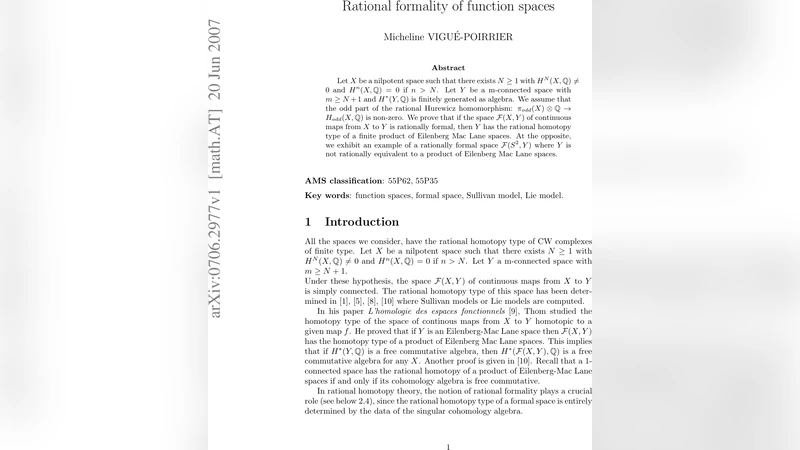
Let $X$ be a nilpotent space such that there exists $N\geq 1$ with $H^N(X,\mathbb Q) \ne 0$ and $H^n(X,\mathbb Q)=0$ if $n>N$. Let $Y$ be a m-connected space with $m\geq N+1$ and $H^*(Y,\mathbb Q)$ is finitely generated as algebra. We assume that the odd part of the rational Hurewicz homomorphism: $\pi_{odd}(X)\otimes \mathbb Q\to H_{odd}(X,\mathbb Q)$ is non-zero. We prove that if the space $\mathcal F(X,Y)$ of continuous maps from $X$ to $Y$ is rationally formal, then $Y$ has the rational homotopy type of a finite product of Eilenberg Mac Lane spaces. At the opposite, we exhibit an example of a rationally formal space $\mathcal F(S^2,Y)$ where $Y$ is not rationally equivalent to a product of Eilenberg Mac Lane spaces.
💡 Research Summary
The paper investigates the relationship between the rational formality of a mapping space 𝔽(X,Y) and the rational homotopy type of the target space Y. The authors work under the following hypotheses: X is a nilpotent space whose rational cohomology is non‑trivial only up to a finite degree N (i.e. Hⁿ(X,ℚ)≠0 and Hᵏ(X,ℚ)=0 for k>N); Y is an m‑connected space with m≥N+1 and its rational cohomology algebra H⁎(Y,ℚ) is finitely generated; and the odd‑degree part of the rational Hurewicz homomorphism π₍odd₎(X)⊗ℚ→H₍odd₎(X,ℚ) is non‑zero. Under these conditions the authors prove a striking rigidity result: if the mapping space 𝔽(X,Y) is rationally formal, then Y must have the rational homotopy type of a finite product of Eilenberg–Mac Lane spaces K(ℚ,n).
The proof proceeds by using the Haefliger–Brown–Szczarba model for mapping spaces. One writes minimal Sullivan models (ΛV,d) for X and (ΛW,d) for Y. The model for 𝔽(X,Y) is then (ΛHom(V,W),D), where D encodes both the differentials of V and W and the action of the evaluation map. Formality of 𝔽(X,Y) means that this differential D can be killed by a quasi‑isomorphism to a free commutative differential graded algebra with zero differential. The non‑vanishing odd Hurewicz map forces V₍odd₎ to inject non‑trivially into H₍odd₎(X,ℚ), which in turn forces any non‑trivial differential in Hom(V,W) to survive unless the differential on W itself is zero. Consequently W must be a free graded vector space with trivial differential, i.e. the minimal model of a product of K(ℚ,n)’s. Hence Y is rationally equivalent to such a product.
To show that the converse does not hold in general, the authors construct an explicit counterexample. Take X=S² and let Y be a space whose minimal model is (Λ(x,y),d) with |x|=3, |y|=4 and d(y)=x². This Y is not a product of Eilenberg–Mac Lane spaces because of the non‑trivial quadratic differential. Nevertheless a direct computation of the Haefliger model for 𝔽(S²,Y) shows that the resulting differential can be eliminated, so 𝔽(S²,Y) is formal. This demonstrates that the condition “𝔽(X,Y) formal ⇒ Y a product of K(ℚ,n)’s” is not reversible without the extra hypotheses on X and Y.
The paper situates these results within the broader literature on rational homotopy theory, noting that previous work (e.g., Félix–Halperin–Thomas, Tanré) has identified various sufficient conditions for mapping spaces to be formal, but the present work provides a new set of necessary conditions linking the formality of the mapping space to the algebraic simplicity of the target. The authors also discuss possible extensions, such as relaxing the connectivity gap m≥N+1, investigating the role of the Hurewicz map in more general settings, and classifying all pairs (X,Y) for which 𝔽(X,Y) is formal while Y is not a product of Eilenberg–Mac Lane spaces. Open questions are posed concerning additional algebraic structures (Koszulness, Gorenstein properties) that might enforce similar rigidity.
In summary, the article establishes that under natural finiteness and connectivity assumptions, the rational formality of a function space forces the target to be rationally a finite product of Eilenberg–Mac Lane spaces, and it provides a concrete counterexample showing that the converse fails without these hypotheses. This contributes a nuanced understanding of how the algebraic properties of mapping spaces reflect the underlying homotopy types of the spaces involved.
Comments & Academic Discussion
Loading comments...
Leave a Comment