Mackey functors on compact closed categories
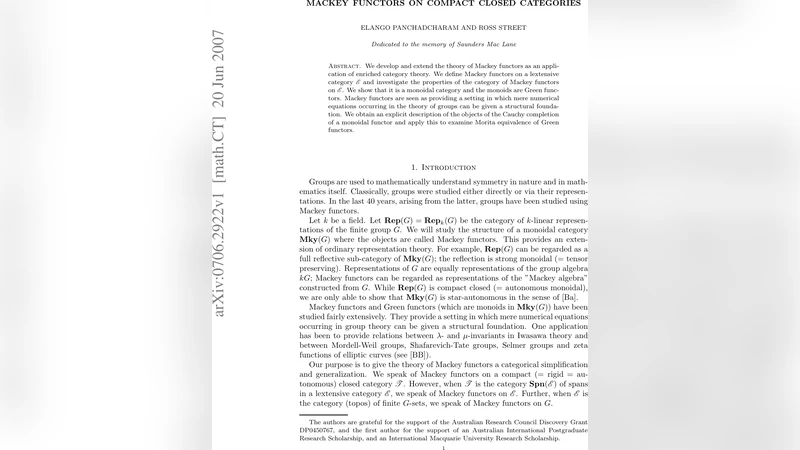
We develop and extend the theory of Mackey functors as an application of enriched category theory. We define Mackey functors on a lextensive category $\E$ and investigate the properties of the category of Mackey functors on $\E$. We show that it is a monoidal category and the monoids are Green functors. Mackey functors are seen as providing a setting in which mere numerical equations occurring in the theory of groups can be given a structural foundation. We obtain an explicit description of the objects of the Cauchy completion of a monoidal functor and apply this to examine Morita equivalence of Green functors.
💡 Research Summary
The paper develops a categorical framework for Mackey functors by placing them on a lextensive category 𝔈 and then exploiting enriched category theory to study their structural properties. The authors begin by recalling that a lextensive category possesses finite coproducts and finite limits that distribute over each other, which makes it an ideal setting for defining spans. A span X ← S → Y in 𝔈 is the basic morphism used to encode induction, restriction, and conjugation operations familiar from classical Mackey theory. By constructing the span bicategory Sp(𝔈) and showing that composition via pull‑backs and push‑outs satisfies the required associativity and unit laws, the authors obtain a robust 2‑categorical environment in which functors can be defined.
A Mackey functor is then defined as a strong functor from Sp(𝔈) to the category of abelian groups (or more generally to any additive monoidal category). This definition automatically yields the familiar Mackey double‑coset formula because the functor respects both the additive and multiplicative structure of spans. The collection of all such functors forms a category Mack(𝔈). The authors prove that Mack(𝔈) is complete, cocomplete, and carries a natural monoidal product ⊗ induced by the external product of spans. Crucially, they show that monoids in Mack(𝔈) are precisely Green functors—Mackey functors equipped with a compatible bilinear multiplication. This identification allows one to treat Green functors as algebra objects in a well‑behaved monoidal category, opening the door to a module theory analogous to classical representation theory.
The second major contribution concerns the Cauchy completion of a monoidal functor F : 𝔈 → 𝔙, where 𝔙 is a closed monoidal category. By analysing idempotent splittings and dualizable objects in the image of F, the authors give an explicit description of the objects of the Cauchy completion of F. They demonstrate that every dualizable object in the completion can be expressed as a retract of a tensor product of representables, and that the completion is itself a closed monoidal category. This technical result is then applied to the study of Morita equivalence for Green functors.
Two Green functors A and B are declared Morita equivalent when their categories of modules, A‑Mod and B‑Mod, are monoidally equivalent. Using the explicit description of the Cauchy completion, the authors construct a monoidal equivalence between these module categories precisely when there exists a bimodule that is a progenerator on both sides. The conditions are expressed in terms of spans: a bimodule corresponds to a span equipped with compatible left and right actions, and the progenerator condition translates into the existence of certain split idempotents in Sp(𝔈). This categorical reformulation of Morita theory generalises the classical result for rings to the setting of Green functors, and it shows how the abstract machinery of enriched categories provides concrete criteria for equivalence.
Overall, the paper achieves three intertwined goals: (1) it embeds Mackey functor theory into the language of enriched category theory, (2) it identifies Green functors as monoid objects in a natural monoidal category of Mackey functors, and (3) it leverages the Cauchy completion of monoidal functors to give a clean, categorical characterization of Morita equivalence for Green functors. The work not only clarifies the algebraic underpinnings of numerical equations that appear in group theory but also suggests new applications in areas such as equivariant stable homotopy theory, higher representation theory, and categorical algebra.
Comments & Academic Discussion
Loading comments...
Leave a Comment