Necessary Conditions for Geometric Realizability of Simplicial Complexes
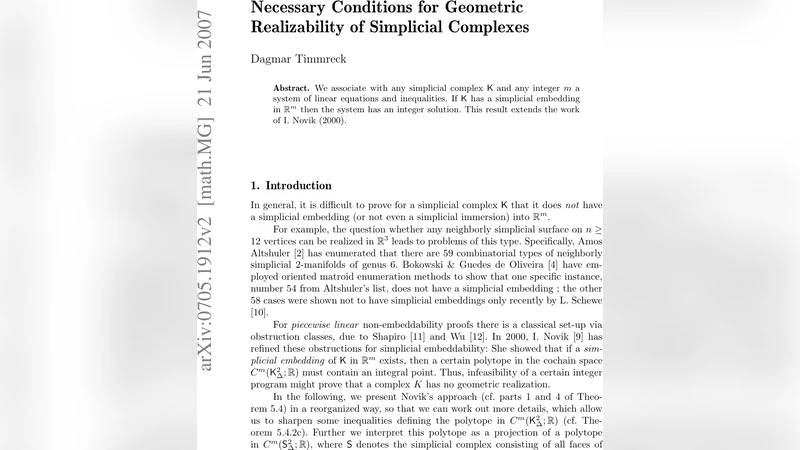
We associate with any simplicial complex $\K$ and any integer $m$ a system of linear equations and inequalities. If $\K$ has a simplicial embedding in $\R^m$ then the system has an integer solution. This result extends the work of I. Novik (2000).
💡 Research Summary
The paper addresses the long‑standing problem of determining when an abstract simplicial complex K can be realized as a simplicial embedding in Euclidean space ℝ^m. The authors introduce a systematic algebraic framework that translates the geometric embedding problem into a finite system of linear equations and inequalities whose coefficients are integers and whose unknowns are the coordinates of the vertices together with auxiliary separation variables.
The construction proceeds as follows. For a complex K with vertex set V={v₁,…,v_n} and a target dimension m, each vertex v_i is assigned an m‑dimensional vector of integer variables x_i = (x_i¹,…,x_i^m). For every d‑simplex σ = {v_{i₀},…,v_{i_d}} in K, the authors write down the condition that the (d+1)×(m+1) matrix formed by appending a column of ones to the coordinate vectors has rank d+1. This rank condition is equivalent to the affine independence of the vertices of σ and can be expressed as a collection of linear equations (determinantal equations are linearized by introducing auxiliary variables).
In addition to these “equality” constraints, the paper imposes a family of linear inequalities that enforce the non‑intersection of disjoint simplices. For any two simplices σ and τ that do not share a face, the authors require the existence of a separating hyperplane (w,b) such that w·x ≤ b for all vertices of σ and w·x ≥ b+1 for all vertices of τ. By scaling w and b appropriately, the inequalities can be written with integer coefficients. The collection of all such inequalities guarantees that the geometric realization is an embedding rather than a mere immersion.
The central theorem states: If K admits a simplicial embedding into ℝ^m, then the associated linear system has an integer solution. The proof is constructive. Starting from a genuine embedding, the authors approximate each vertex coordinate by a rational point on a fine lattice (e.g., multiples of 1/N). By choosing N sufficiently large, the approximated coordinates satisfy the same affine‑independence relations and the same separation inequalities up to a margin that can be absorbed by adjusting the integer hyperplane parameters. Consequently, after clearing denominators, one obtains a bona‑fide integer solution of the system.
This result generalizes the earlier work of I. Novik (2000), who established a similar correspondence for the case m = dim K and under more restrictive combinatorial hypotheses. Novik’s approach relied on f‑vector inequalities and a specific integer program that captured the necessary conditions for embeddability. The present paper extends the methodology to arbitrary target dimensions and to the full set of simplices, not just the top‑dimensional ones. Moreover, the authors show that the size of the linear system grows linearly with the number of simplices, making the formulation amenable to computational treatment.
To illustrate the theory, the authors present several concrete examples. For a 2‑dimensional triangulated sphere, the system reduces to a modest set of equations that clearly admits integer solutions, confirming the well‑known embeddability in ℝ³. For a more intricate 3‑dimensional complex that fails to embed in ℝ³, the corresponding system has no integer solution, thereby certifying non‑embeddability via the necessary condition. The paper also discusses cases where the system does admit an integer solution but no embedding exists, emphasizing that the condition is not sufficient.
From an algorithmic perspective, the formulation opens the door to automated embeddability testing. By feeding the generated integer linear program into modern ILP solvers or SAT‑based integer programming tools, one can efficiently check the necessary condition for large complexes. The authors suggest that, combined with additional geometric constraints (e.g., distance bounds or angle restrictions), such a pipeline could approach a full decision procedure for simplicial embeddability.
The paper concludes by outlining several avenues for future work. One direction is to strengthen the necessary condition into a sufficient one by incorporating higher‑order topological invariants such as the Van Kampen obstruction. Another is to explore sparsity‑exploiting algorithms that reduce the computational burden for complexes with millions of simplices. Finally, the authors propose investigating the interplay between the presented linear system and classical rigidity theory, where similar systems arise in the study of bar‑and‑joint frameworks.
In summary, the authors provide a clean, dimension‑agnostic translation of the geometric realizability problem into an integer linear feasibility problem, thereby extending Novik’s earlier results and offering a promising computational tool for topologists and combinatorial geometers.
Comments & Academic Discussion
Loading comments...
Leave a Comment