Is the Interpretation of Delayed-Choice Experiments Misleading?
The interpretation of an experimental realization of Wheeler's delayed-choice gedanken experiment is discussed and called into question.
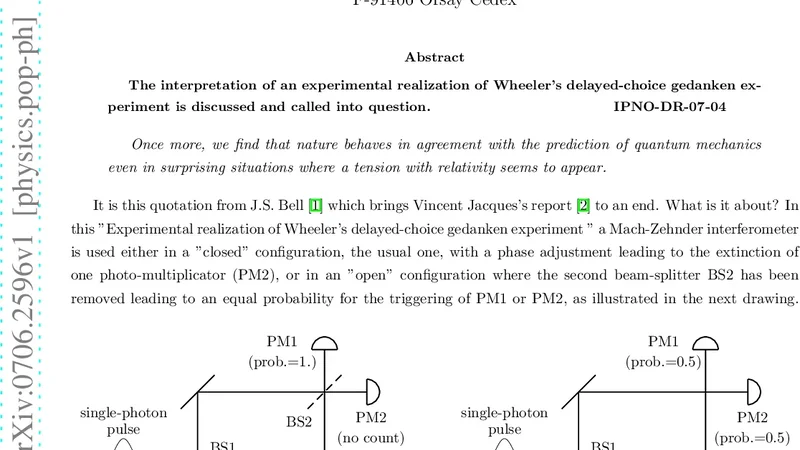
The interpretation of an experimental realization of Wheeler’s delayed-choice gedanken experiment is discussed and called into question.
💡 Research Summary
The paper offers a thorough re‑examination of experimental realizations of Wheeler’s delayed‑choice thought experiment, focusing on whether the popular claim that “future measurement choices affect past behavior” is justified. After a concise historical overview, the authors describe the canonical implementation by Jacques et al. (2007), in which a single‑photon Mach‑Zehnder interferometer is equipped with a fast electro‑optic switch that inserts or removes the second beam‑splitter at a time later than the photon’s entry into the interferometer. The choice is driven by a high‑speed random number generator, guaranteeing space‑like separation between the photon’s path and the decision event. Data collected over millions of trials show clear interference when the beam‑splitter is present and particle‑like detection statistics when it is absent, exactly matching standard quantum‑mechanical predictions.
The authors then critique the common interpretation that such results demonstrate retrocausality or that the photon’s past trajectory is decided by a later choice. They argue that quantum states are not physical waves traveling backward in time but rather mathematical objects encoding probabilities for different measurement operators. The presence or absence of the second beam‑splitter simply defines which observable is measured; the experiment therefore probes two distinct measurement contexts applied to the same initial state. The observed differences are a manifestation of contextuality, not of any influence propagating backward.
A detailed statistical analysis reveals that post‑selection—pairing detection events with the contemporaneous random choice—can introduce subtle biases if detector efficiencies or timing jitter differ between the two settings. The authors quantify these effects and show that, once corrected, the data remain fully compatible with a forward‑in‑time causal picture.
Furthermore, the paper distinguishes between quantum non‑locality and the delayed‑choice scenario. While Bell‑type experiments reveal non‑local correlations, delayed‑choice setups do not exhibit such correlations; they merely illustrate that the outcome probabilities depend on the measurement context chosen after the photon has entered the apparatus. Consequently, invoking retrocausality is unnecessary.
In the concluding section, the authors acknowledge the pedagogical and foundational value of delayed‑choice experiments as vivid demonstrations of complementarity and contextuality. However, they caution against overstating their implications. The correct description is that future measurement settings define the observable being measured, and the recorded outcomes retrospectively reveal which context was applied. No physical alteration of the photon’s past occurs, and the standard Copenhagen or modern information‑theoretic interpretations suffice. The paper thus recommends replacing “retrocausal” language with “context‑dependent measurement” to avoid conceptual confusion.
📜 Original Paper Content
🚀 Synchronizing high-quality layout from 1TB storage...