The Intrinsic Fundamental Group of a Linear Category
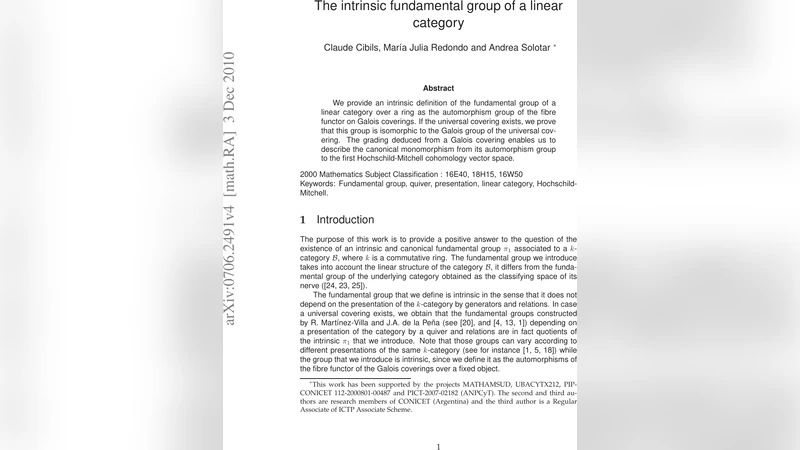
We provide an intrinsic definition of the fundamental group of a linear category over a ring as the automorphism group of the fibre functor on Galois coverings. If the universal covering exists, we prove that this group is isomorphic to the Galois group of the universal covering. The grading deduced from a Galois covering enables us to describe the canonical monomorphism from its automorphism group to the first Hochschild-Mitchell cohomology vector space.
💡 Research Summary
The paper introduces an intrinsic, category‑theoretic definition of the fundamental group for a linear category C over a ring R. Rather than relying on external choices such as base objects or paths, the authors use the notion of a Galois covering p : E → C, where E is a linear category equipped with a free action of a group G and p is a surjective functor preserving the linear structure. For any such covering they consider the fibre functor F_p : E → Mod‑R that sends each object of E to the corresponding R‑module determined by p. The group of natural automorphisms Aut(F_p) – i.e., families of R‑module automorphisms η_e compatible with p – is taken as the fundamental group π₁(C).
The authors first establish basic properties of Galois coverings: normality, faithfulness, and fullness guarantee that F_p is both full and faithful, making Aut(F_p) a well‑behaved group. They then prove a central theorem: if a universal covering E_univ → C exists, then Aut(F_univ) is canonically isomorphic to the Galois group Gal(E_univ/C). This mirrors the classical topological result that the fundamental group of a space is the group of deck transformations of its universal covering. The proof relies on the universal property of the universal covering and on the fact that any other Galois covering factors uniquely through it.
A further major contribution is the connection between the fundamental group and the first Hochschild‑Mitchell cohomology HH¹(C). Every Galois covering induces a G‑grading on C, where each morphism is decomposed according to the element of G that lifts it. Using this grading, the authors construct, for each η ∈ Aut(F_p), a 1‑cocycle δ_η in the Hochschild‑Mitchell complex. They verify that δ_η is a cocycle and that the assignment η ↦
Comments & Academic Discussion
Loading comments...
Leave a Comment