We study relatively minimal subgroups in topological groups. We find, in particular, some natural relatively minimal subgroups in unipotent groups which are defined over "good" rings. By "good" rings we mean archimedean absolute valued (not necessarily associative) division rings. Some of the classical rings which we consider besides the field of reals are the ring of quaternions and the ring of octonions. This way we generalize in part a previous result which was obtained by Dikranjan and Megrelishvili and involved the Heisenberg group.
Deep Dive into Minimality in topological groups and Heisenberg type groups.
We study relatively minimal subgroups in topological groups. We find, in particular, some natural relatively minimal subgroups in unipotent groups which are defined over “good” rings. By “good” rings we mean archimedean absolute valued (not necessarily associative) division rings. Some of the classical rings which we consider besides the field of reals are the ring of quaternions and the ring of octonions. This way we generalize in part a previous result which was obtained by Dikranjan and Megrelishvili and involved the Heisenberg group.
A Hausdorff topological group G is minimal if G does not admit a strictly coarser Hausdorff group topology or equivalently if every injective continuous group homomorphism G → P into a Hausdorff topological group is a topological embedding. The concept of minimal topological groups was introduced by Stephenson [9] and Doïchinov [2] in 1971 as a natural generalization of compact groups.
Heisenberg group and more precisely its generalization, which we present in section 2 (see also [4,7]), provides many examples of minimal groups.
Recently Dikranjan and Megrelishvili [1] introduced the concept of co-minimality (see Definition 2.5) of subgroups in topological groups after the latter author had introduced the concept of relative minimality (see Definition 2.3 and also [3]) of subgroups in topological groups and found such subgroups in a generalized Heisenberg group (see [4,7]).
In [1,Proposition 2.4.2] Megrelishvili and Dikranjan proved that the canonical bilinear mapping V × V * → R, < v, f >= f (v) is strongly minimal (see Definition 2.7) for all normed spaces V.
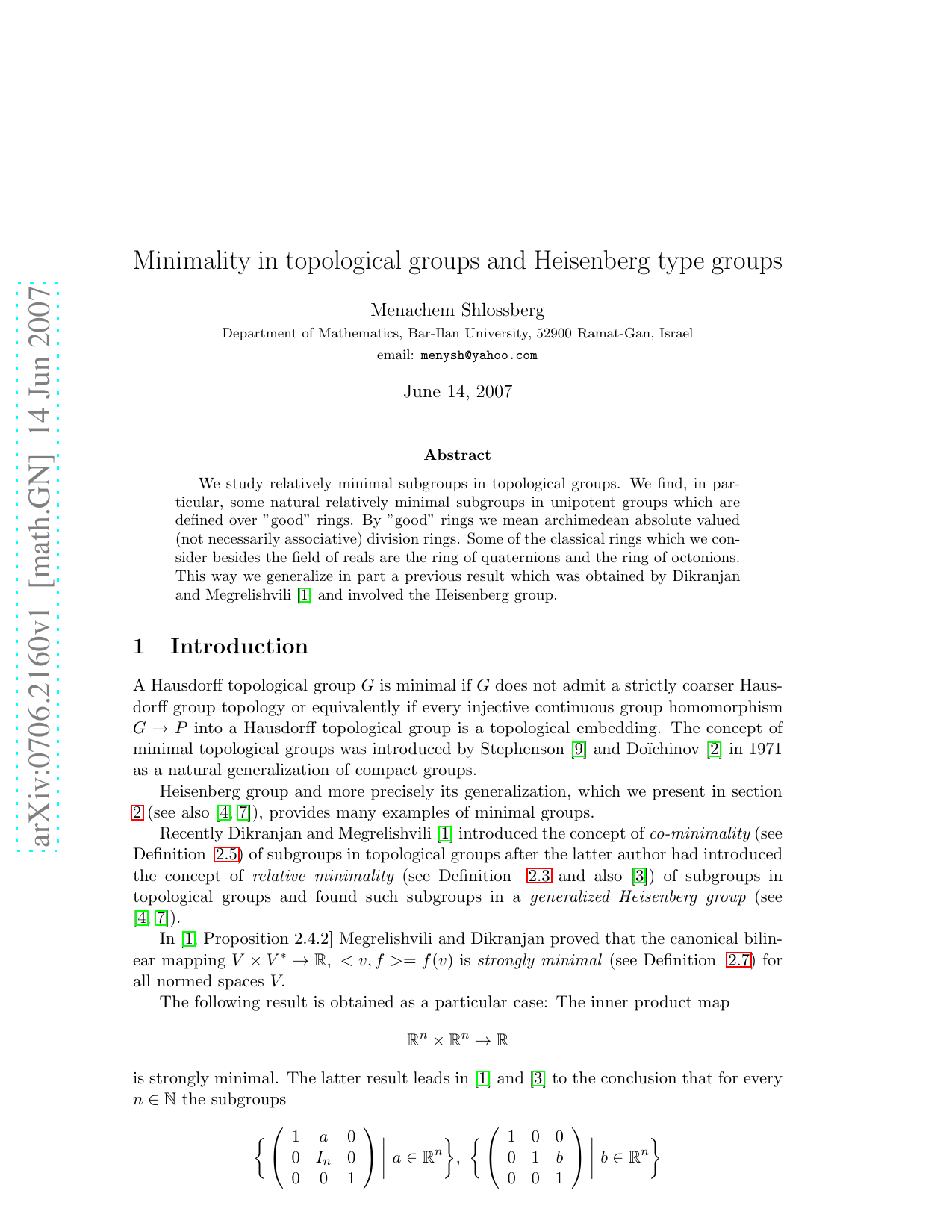
The following result is obtained as a particular case: The inner product map
is strongly minimal. The latter result leads in [1] and [3] to the conclusion that for every n ∈ N the subgroups
are relatively minimal in the group
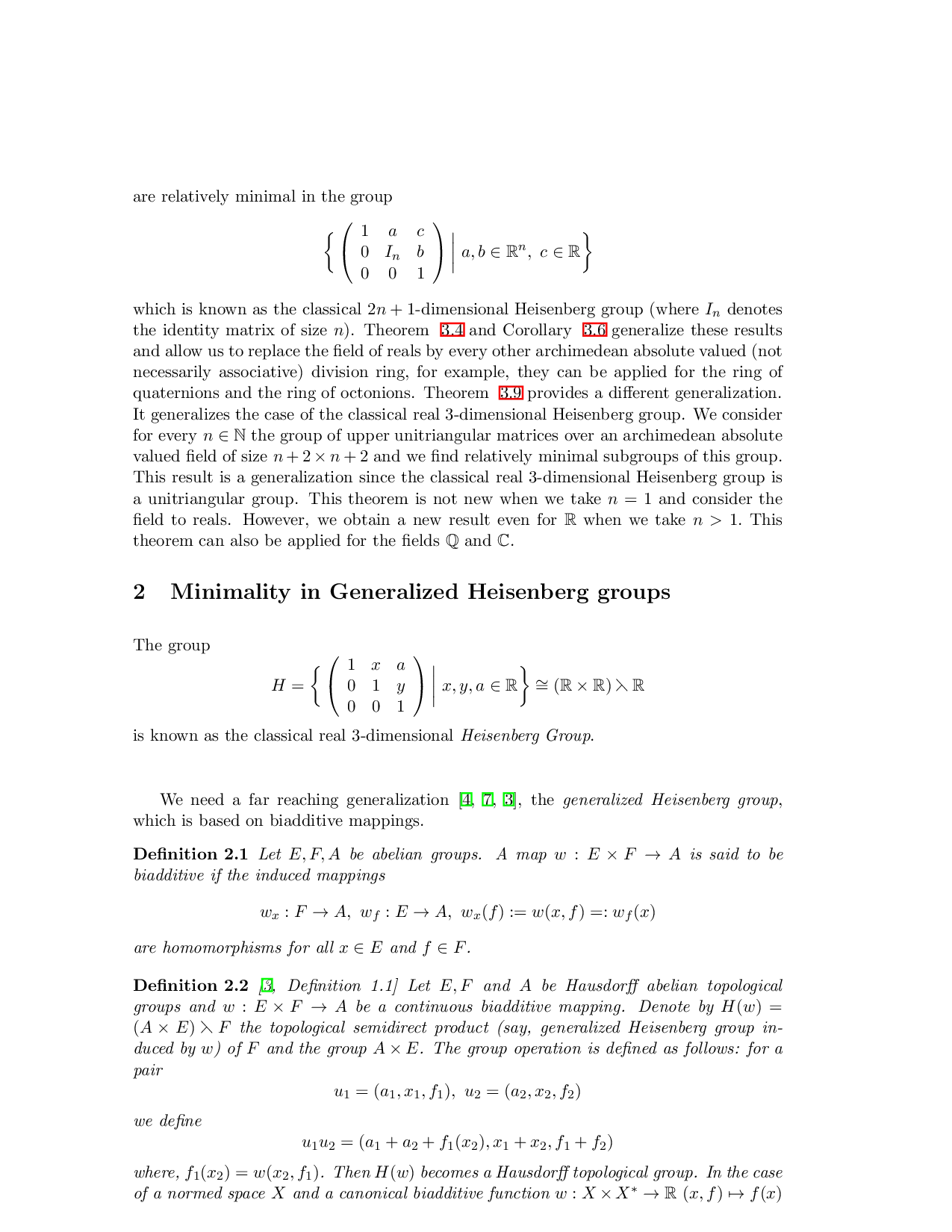
which is known as the classical 2n + 1-dimensional Heisenberg group (where I n denotes the identity matrix of size n). Theorem 3.4 and Corollary 3.6 generalize these results and allow us to replace the field of reals by every other archimedean absolute valued (not necessarily associative) division ring, for example, they can be applied for the ring of quaternions and the ring of octonions. Theorem 3.9 provides a different generalization.
It generalizes the case of the classical real 3-dimensional Heisenberg group. We consider for every n ∈ N the group of upper unitriangular matrices over an archimedean absolute valued field of size n + 2 × n + 2 and we find relatively minimal subgroups of this group. This result is a generalization since the classical real 3-dimensional Heisenberg group is a unitriangular group. This theorem is not new when we take n = 1 and consider the field to reals. However, we obtain a new result even for R when we take n > 1. This theorem can also be applied for the fields Q and C.
The group
is known as the classical real 3-dimensional Heisenberg Group.
We need a far reaching generalization [4,7,3], the generalized Heisenberg group, which is based on biadditive mappings. Definition 2.1 Let E, F, A be abelian groups. A map w : E × F → A is said to be biadditive if the induced mappings
are homomorphisms for all x ∈ E and f ∈ F . Definition 2.2 [3, Definition 1.1] Let E, F and A be Hausdorff abelian topological groups and w : E × F → A be a continuous biadditive mapping. Denote by H(w) = (A × E) ⋋ F the topological semidirect product (say, generalized Heisenberg group induced by w) of F and the group A × E. The group operation is defined as follows: for a pair
we define
where, f 1 (x 2 ) = w(x 2 , f 1 ). Then H(w) becomes a Hausdorff topological group. In the case of a normed space X and a canonical biadditive function w :
(where X * is the Banach space of all continuous functionals from X to R, known as the dual space of X) we write H(X) instead of H(w).
Definition 2.3 [1, Definition 1.1.1] Let X be a subset of a Hausdorff topological group (G, τ ). We say that X is relatively minimal in G if every coarser Hausdorff group topology σ ⊂ τ of G induces on X the original topology. That is, σ| X = τ | X .
Theorem 2.4 [3, Theorem 2.2] The subgroups X and X * are relatively minimal in the generalized Heisenberg group H(X) = (R × X) ⋋ X * for every normed space X.
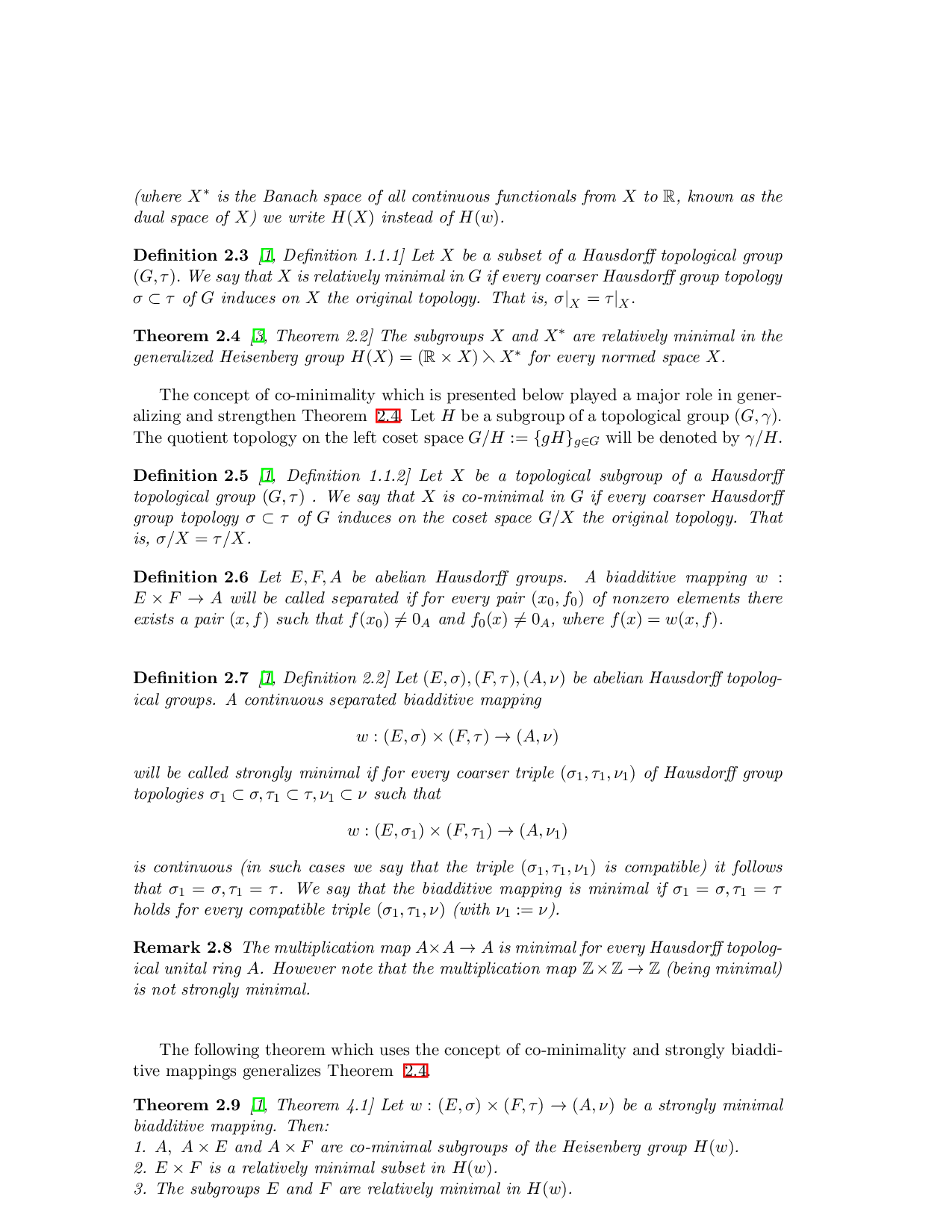
The concept of co-minimality which is presented below played a major role in generalizing and strengthen Theorem 2.4. Let H be a subgroup of a topological group (G, γ). The quotient topology on the left coset space G/H := {gH} g∈G will be denoted by γ/H. Definition 2.5 [1, Definition 1.1.2] Let X be a topological subgroup of a Hausdorff topological group (G, τ ) . We say that X is co-minimal in G if every coarser Hausdorff group topology σ ⊂ τ of G induces on the coset space G/X the original topology. That is, σ/X = τ /X. Definition 2.6 Let E, F, A be abelian Hausdorff groups. A biadditive mapping w : E × F → A will be called separated if for every pair (x 0 , f 0 ) of nonzero elements there exists a pair (x, f ) such that f (x 0 ) = 0 A and f 0 (x) = 0 A , where f (x) = w(x, f ). Definition 2.7 [1, Definition 2.2] Let (E, σ), (F, τ ), (A, ν) be abelian Hausdorff topological groups. A continuous separated biadditive mapping
will be called strongly minimal if for every coarser triple
is continuous (in such cases we say that the triple
Remark 2.8 The multiplication map A×A → A is minimal for every Hausdorff topological unital ring A. However note that the multiplication map Z × Z → Z (being minimal) is not strongly minimal.
The followin
…(Full text truncated)…
This content is AI-processed based on ArXiv data.