Minimality in topological groups and Heisenberg type groups
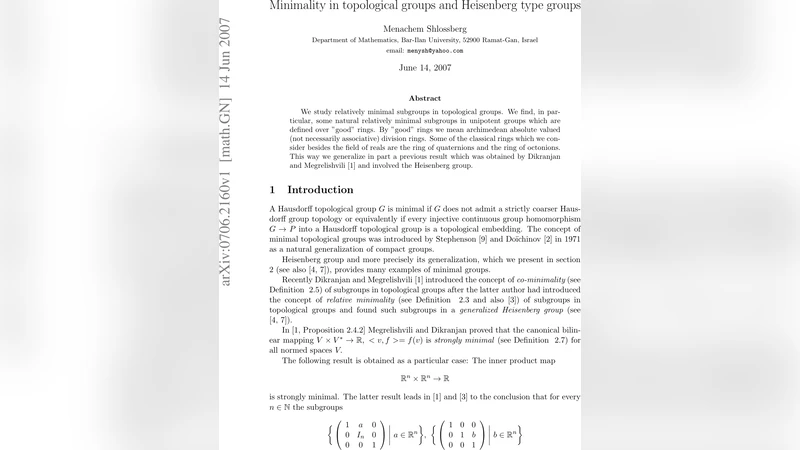
We study relatively minimal subgroups in topological groups. We find, in particular, some natural relatively minimal subgroups in unipotent groups which are defined over “good” rings. By “good” rings we mean archimedean absolute valued (not necessarily associative) division rings. Some of the classical rings which we consider besides the field of reals are the ring of quaternions and the ring of octonions. This way we generalize in part a previous result which was obtained by Dikranjan and Megrelishvili and involved the Heisenberg group.
💡 Research Summary
The paper investigates the notion of relatively minimal subgroups within topological groups and extends this concept to a broad class of non‑commutative, non‑associative algebraic structures. A subgroup H of a topological group G is called relatively minimal if the subspace topology induced on H by G is the smallest possible Hausdorff group topology that makes the inclusion map continuous; equivalently, no strictly finer group topology on H can be obtained from a continuous homomorphism that extends to G. After formalising this definition, the authors focus on “good” rings—division rings equipped with an Archimedean absolute value. The term “good” deliberately excludes pathological valuation rings; it includes the real numbers ℝ, the quaternions ℍ, and the octonions 𝕆, all of which carry a natural absolute value satisfying the Archimedean property and the triangle inequality.
The first major result shows that for any such ring D, the multiplicative group of units D× is itself a minimal topological group. The proof relies on the completeness of D with respect to its absolute value: any Hausdorff group topology on D× that is coarser than the metric topology would violate the continuity of the inversion map or the multiplication, forcing equality of the two topologies. This minimality of D× becomes the cornerstone for the subsequent analysis of matrix groups built over D.
The authors then consider the unipotent upper‑triangular matrix group \
Comments & Academic Discussion
Loading comments...
Leave a Comment