General concepts of graphs
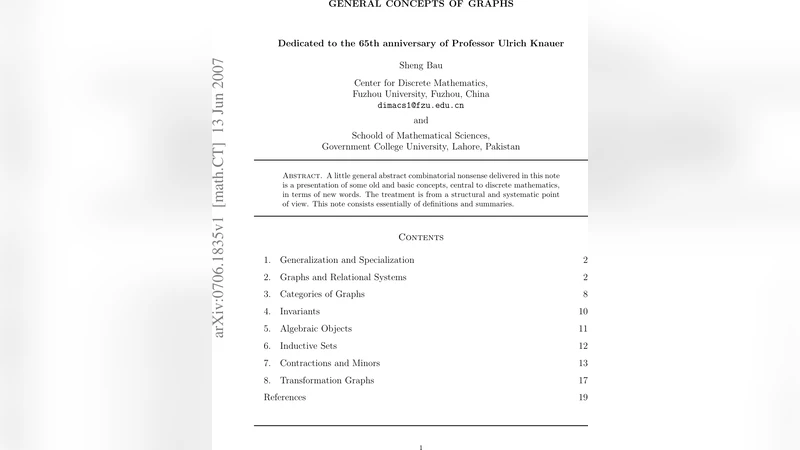
A little general abstract combinatorial nonsense delivered in this note is a presentation of some old and basic concepts, central to discrete mathematics, in terms of new words. The treatment is from a structural and systematic point of view. This note consists essentially of definitions and summaries.
💡 Research Summary
The paper presents a systematic re‑phrasing of the foundational concepts of graph theory using a fresh vocabulary that aligns more closely with contemporary computer‑science terminology. It begins by redefining a graph as a collection of “nodes” (vertices) and “connections” (edges), distinguishing between “unidirectional connections” and “bidirectional connections” to cover directed and undirected graphs within a single framework. The notion of adjacency is expanded into “proximity”: directly linked nodes are “directly proximal,” while nodes linked through a single intermediate node are “indirectly proximal.” This terminology clarifies immediate versus mediated relationships, which is useful in network flow and routing contexts.
Degree is renamed “connection count,” with directed graphs further split into “in‑connection count” and “out‑connection count,” providing an intuitive way to discuss inbound and outbound traffic in communication networks or circuit designs. Paths and cycles become “continuous connection sequences” and “closed connection sequences,” respectively. The paper explicitly introduces “simple continuous connection sequences” (no repeated vertices) and “simple closed connection sequences” to emphasize the non‑repetition condition that underlies many classic results. The concept of a “shortest continuous connection sequence” replaces the traditional “shortest path,” allowing the same algorithmic problems to be expressed in the new lexicon.
Connectivity is categorized as “global proximity” (the whole graph forms a single “proximity cluster”) or “partial proximity” (the graph consists of multiple disjoint clusters). Each cluster maintains internal proximity while possibly lacking connections to other clusters, mirroring community structures in social‑network analysis.
Trees are defined as “non‑closed continuous connection structures,” i.e., acyclic connected graphs. A rooted tree is a “continuous connection structure with a designated start point,” making the distinction between root and leaves explicit. The paper restates classic tree properties as formal statements such as “every non‑closed continuous connection structure possesses at least one start point.”
Bipartite graphs are described as “proximity clusters that can be partitioned into two sets with only cross‑set connections,” termed “cross‑proximity.” This reframing unifies the 2‑colorability theorem and matching theory under a single terminology. The author provides a concise theorem: “A graph that can be partitioned into two sets satisfying cross‑proximity is bipartite and therefore 2‑colorable.”
The bulk of the article consists of a series of definitions followed by succinct theorems that restate well‑known results in the new language. By doing so, the paper aims to reduce terminological friction for students and practitioners, offering a coherent, structure‑oriented perspective that can be directly applied in teaching, algorithm design, and interdisciplinary research. In essence, the work is a lexicon‑driven re‑engineering of graph theory’s core ideas, preserving mathematical rigor while enhancing conceptual clarity for modern applications.
Comments & Academic Discussion
Loading comments...
Leave a Comment