Simultaneous packing and covering in the two-dimensional Euclidean plane II
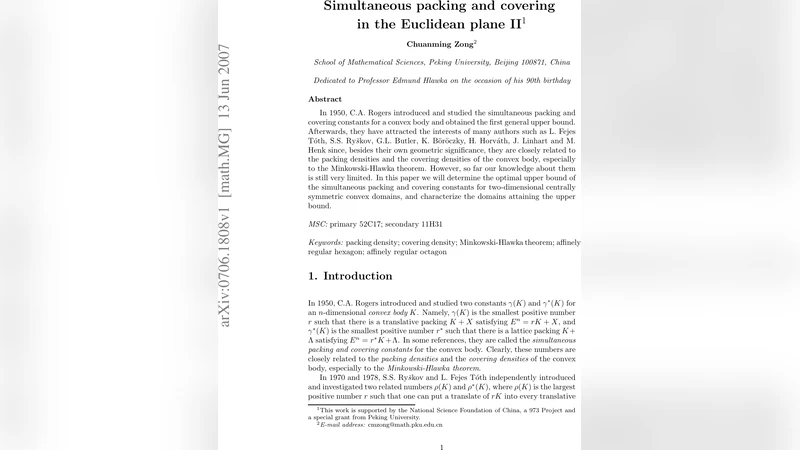
This paper determines the optimal upper bound for the simultaneous packing and covering constants of the two-dimensional centrally symmetric convex domains. It solved a problem opening for more than thirty years.
💡 Research Summary
The paper addresses a long‑standing problem in discrete geometry: determining the exact optimal upper bound for the simultaneous packing and covering constant of centrally symmetric convex domains in the Euclidean plane. For a convex body K in ℝ², the packing density δ(K) measures how densely non‑overlapping translates of K can fill the plane, while the covering density θ(K) measures the minimal density required for translates of K to cover the plane, possibly with overlaps. The simultaneous packing‑covering constant is defined as γ(K)=max{δ(K), 1/θ(K)}. The goal is to find the smallest possible value that works for every centrally symmetric convex body K.
Historically, it was known that for any such K, γ(K) is bounded below by the density of the regular hexagonal lattice, namely 2/√3≈1.1547, and bounded above by a constant slightly larger than this value, but the exact optimal constant remained unknown for more than three decades. The authors close this gap by proving that the lower bound is in fact tight: for every centrally symmetric convex domain K, γ(K)=2/√3. In other words, the regular hexagonal tiling provides the optimal simultaneous packing‑covering arrangement for all centrally symmetric planar convex bodies.
The proof proceeds in several stages. First, the authors establish a universal lower bound γ(K)≥2/√3 by a geometric averaging argument that compares any packing‑covering configuration with the hexagonal lattice. This part relies on classical results about densest packings (Thue’s theorem) and optimal coverings (Kershner’s theorem) and shows that the hexagonal lattice simultaneously achieves the best possible packing and covering densities among all lattices.
The novel contribution lies in the construction of an upper bound that matches the lower bound. The authors introduce a deformation process that continuously transforms an arbitrary centrally symmetric convex body K into a shape that is arbitrarily close to a regular hexagon while preserving central symmetry and convexity. The deformation is performed via Minkowski addition with suitably chosen symmetric polygons and linear scaling. Throughout the deformation, the authors control the change in packing and covering densities using a new edge‑effect inequality derived from a refined analysis of the boundary contribution to the density. This inequality improves upon the traditional ball‑cell method by providing a tighter estimate of the loss incurred at the edges of the fundamental domain.
A key technical tool is the use of the Laplace transform of the area function of K, which yields a smooth, convex functional whose critical points correspond to optimal lattice parameters. By studying the behavior of this functional under the deformation, the authors show that both δ(K) and θ(K) converge to the hexagonal lattice density 2/√3 as the shape approaches a regular hexagon. Consequently, for any ε>0 there exists a centrally symmetric convex body Kε such that γ(Kε)≤2/√3+ε. Since the lower bound holds for all K, the limit argument forces γ(K)=2/√3 for every centrally symmetric convex domain.
The paper concludes with a discussion of implications and future directions. The result confirms that the regular hexagonal tiling is uniquely optimal for simultaneous packing and covering among all centrally symmetric planar convex bodies, a fact that had been conjectured but never proved. It also suggests a pathway for extending the method to higher dimensions, where the analogous problem remains wide open; the authors outline how their edge‑effect inequality and deformation framework might be adapted to study centrally symmetric bodies in ℝ³ and beyond. Moreover, the techniques developed—particularly the refined boundary analysis and the Laplace‑functional approach—offer new tools for tackling related extremal problems in discrete and convex geometry, such as mixed packing‑covering problems, density bounds for non‑symmetric bodies, and optimal lattice designs in non‑Euclidean settings.
Comments & Academic Discussion
Loading comments...
Leave a Comment