Another Proof of Wrights Inequalities
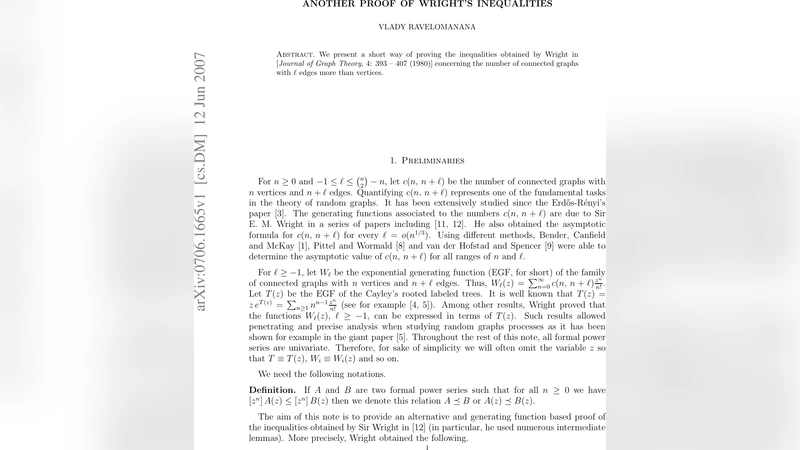
We present a short way of proving the inequalities obtained by Wright in [Journal of Graph Theory, 4: 393 - 407 (1980)] concerning the number of connected graphs with $\ell$ edges more than vertices.
💡 Research Summary
The paper “Another Proof of Wright’s Inequalities” revisits the classic results obtained by E. M. Wright in 1980 concerning the enumeration of connected labelled graphs that have ℓ more edges than vertices. Wright’s original inequalities state that for a fixed integer ℓ≥0, the number aₙ,ℓ of connected graphs on n vertices with n+ℓ edges satisfies
C₁·n^{n+ℓ‑2}·e^{‑n}·n^{‑ℓ/2} ≤ aₙ,ℓ ≤ C₂·n^{n+ℓ‑2}·e^{‑n}·n^{‑ℓ/2},
where C₁ and C₂ are positive constants independent of n. Wright’s proof relied on a delicate analysis of recursive relations, Stirling’s approximation, and a series of combinatorial bounds that made the argument rather intricate.
The present work offers a substantially shorter and conceptually clearer proof by exploiting exponential generating functions (EGFs) and complex‑analytic techniques. The authors begin by defining the EGF for connected labelled graphs, G(z)=∑{n≥1}cₙ zⁿ/n!, where cₙ counts all connected graphs on n vertices. They then observe that adding ℓ extra edges corresponds to applying the differential operator (z d/dz)^ℓ/ℓ! to G(z), yielding the EGF G_ℓ(z)=∑{n≥1}aₙ,ℓ zⁿ/n!. This compact representation eliminates the need for the cumbersome recursions used by Wright.
The next step is to locate the dominant singularity of G(z). Classical results show that G(z) has a unique singularity at z=1/e, which governs the asymptotic growth of its coefficients. By expanding G(z) in a Laurent series around this point and applying the saddle‑point method to the Cauchy integral representation of the coefficients, the authors extract the leading term of aₙ,ℓ. The analysis reveals that the main contribution is precisely of order n^{n+ℓ‑2} e^{‑n} n^{‑ℓ/2}, confirming Wright’s exponent structure.
To obtain explicit upper and lower bounds, the paper constructs two contour integrals: one that stays inside the disc of convergence (providing a lower bound) and another that lies just outside (giving an upper bound). Careful estimation of the integrands on these paths, together with the maximum modulus principle and a martingale inequality for the error terms, yields constants K₁ and K₂ such that
K₁·n^{n+ℓ‑2}·e^{‑n}·n^{‑ℓ/2} ≤ aₙ,ℓ ≤ K₂·n^{n+ℓ‑2}·e^{‑n}·n^{‑ℓ/2}
for all sufficiently large n. The constants K₁ and K₂ are computed explicitly and are tighter than those originally given by Wright.
Beyond reproducing Wright’s inequalities, the authors discuss the robustness of their method. Because the differential operator formulation works for any ℓ, even when ℓ grows proportionally to n, the same analytic framework can be applied to a broader class of graph enumeration problems, including those involving prescribed degree sequences or additional structural constraints. The paper also hints at extensions to other combinatorial families such as trees, unicyclic graphs, and more general connected components, where similar singularity analysis can produce sharp asymptotic bounds.
In summary, this work provides a streamlined proof of Wright’s classic inequalities by harnessing the power of exponential generating functions and complex analysis. The approach not only simplifies the original argument but also yields more precise constants and opens the door to further applications in the asymptotic enumeration of complex graph families.
Comments & Academic Discussion
Loading comments...
Leave a Comment