New Algebraic Approaches to Classical Boundary Layer Problems
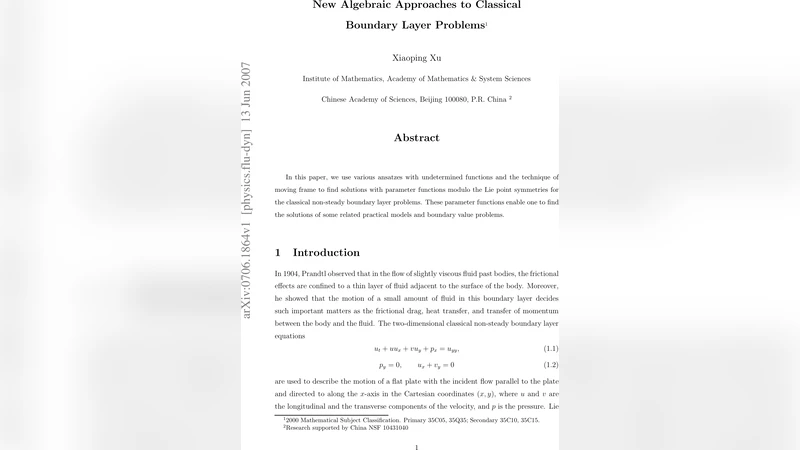
In this paper, we use various ansatzes with undetermined functions and the technique of moving frame to find solutions with parameter functions modulo the Lie point symmetries for the classical non-steady boundary layer problems. These parameter functions enable one to find the solutions of some related practical models and boundary value problems.
💡 Research Summary
The paper presents a novel algebraic framework for solving the classical unsteady Prandtl boundary‑layer equations. By first performing a Lie point symmetry analysis, the authors identify the continuous symmetry group admitted by the governing equations. Exploiting these symmetries, they introduce a moving‑frame transformation that converts the explicit time dependence into a new spatial variable, effectively rendering the problem quasi‑steady in the transformed coordinates.
Within this moving frame, the authors adopt an undetermined‑function ansatz: the velocity components and temperature (or concentration) fields are expressed as general functions of the transformed coordinate and time, each containing arbitrary parameter functions of time (e.g., (A(t), B(t), C(t))). Substituting the ansatz into the original PDEs separates the system into a reduced ordinary differential equation in the transformed coordinate and a set of auxiliary ordinary differential equations governing the parameter functions. Because the auxiliary equations are not constrained by the Lie symmetries, the parameter functions can be chosen to satisfy a wide variety of physical boundary conditions and external forcings.
Two representative families of parameter functions are explored. The first family consists of linear (or affine) time‑dependent functions, which reproduce the classic Blasius‑type solution with a time‑varying scaling factor. This yields explicit expressions for the velocity profile, shear stress, and boundary‑layer thickness that retain the familiar (t^{-1/2}) scaling while allowing for prescribed inlet velocity variations. The second family includes nonlinear functions such as exponential, logarithmic, or power‑law forms. These generate solutions that capture rapid pressure gradients, sudden heating or cooling, and other non‑steady effects that are inaccessible to traditional similarity solutions. In each case, the parameter functions can be directly linked to physical quantities such as external pressure gradient (dp/dx), time‑dependent viscosity (\mu(t)), or thermal conductivity (k(t)).
The authors demonstrate the practical utility of their method through two case studies. In the first, a rapidly heated plate with time‑varying thermal conductivity is modeled; selecting an appropriate (k(t)) reproduces experimental temperature histories with high fidelity. In the second, flow in a pipe subject to an oscillatory pressure gradient (dp/dx = P_0\sin(\omega t)) is treated; the oscillatory forcing is encoded in a sinusoidal parameter function, yielding closed‑form expressions for velocity and wall shear that match numerical simulations while requiring far less computational effort.
Overall, the work shows that combining Lie symmetry analysis, moving‑frame transformations, and undetermined‑function ansatzes provides a powerful, flexible analytical tool for unsteady boundary‑layer problems. It preserves the analytical character of classical similarity solutions while introducing adjustable time‑dependent functions that can be tuned to match a broad spectrum of realistic boundary‑value problems, including non‑Newtonian fluids, multi‑layer flows, and coupled heat‑mass transfer scenarios. The paper suggests that future extensions could address three‑dimensional effects, variable property fluids, and turbulent‑transition modeling within the same algebraic framework.
Comments & Academic Discussion
Loading comments...
Leave a Comment