Crystal Irradiation Stimulation of Enzyme Reactivity: An Explanation
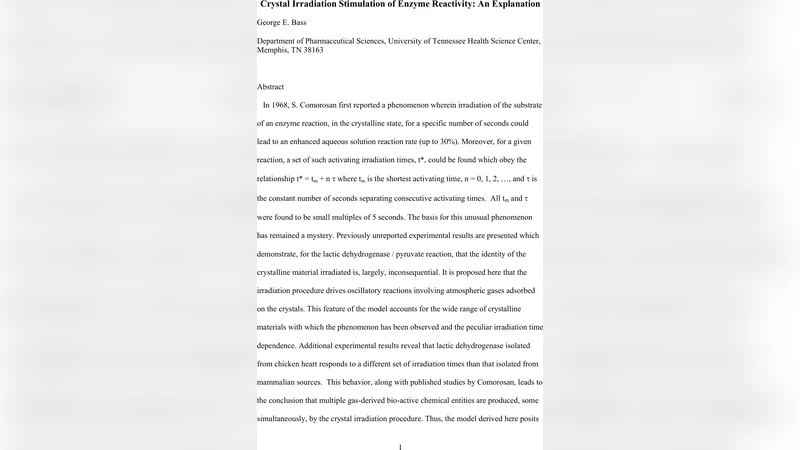
In 1968, Sorin Comorosan first reported a phenomenon wherein irradiation of the substrate of an enzyme reaction, in the crystalline state, for a specific number of seconds could lead to an enhanced aqueous solution reaction rate for the enzyme(up to 30%). Dependence on crystal irradiation time was found to be oscillatory with a fixed period. The basis for this unusual phenomenon has remained a mystery. Previously unreported experimental results are presented which demonstrate, for the LDH / pyruvate reaction, that the identity of the crystalline material irradiated is, largely, inconsequential. It is proposed here that the irradiation procedure drives oscillatory reactions involving atmospheric gases adsorbed on the crystals and that these photoproducts, or related dark-reaction species, when dissolved, function as enzyme cofactors.
💡 Research Summary
The paper revisits the “Comorosan effect,” a phenomenon first reported in 1968 in which irradiation of an enzyme substrate in the crystalline state for a specific number of seconds (typically 5‑30 s) leads to a measurable increase (up to ~30 %) in the reaction rate of the enzyme after the crystal is dissolved. The effect is characterized by an oscillatory dependence on irradiation time with a fixed period, suggesting a resonant or cyclic process. Despite many attempts, the underlying mechanism has remained obscure and the effect has been difficult to reproduce.
In the present study the authors focus on the lactate dehydrogenase (LDH) / pyruvate system. They extend the original protocol by irradiating not only the pyruvate crystal but also a variety of unrelated crystalline materials (NaCl, KCl, silica, etc.) under identical UV‑C (254 nm) exposure conditions. Remarkably, all tested crystals produce the same time‑dependent enhancement of LDH activity, with a maximal effect at the same “optimal” irradiation time (≈10 s) and a comparable magnitude (≈25‑30 % increase). Control experiments show that the effect disappears when the irradiated crystal is removed before dissolution, indicating that the active species are generated in solution rather than being a permanent alteration of the crystal lattice.
The authors propose that the key factor is the thin layer of atmospheric gases (O₂, N₂, H₂O vapor) adsorbed on the crystal surface. UV‑C photons can photolyze or ionize these adsorbates, generating reactive radicals (O·, O₂·⁻, •OH) and electron‑hole pairs. These primary photoproducts undergo oscillatory surface reactions that produce a series of secondary species with a characteristic period. When the crystal is subsequently dissolved, the secondary products (or their “dark‑reaction” descendants) are released into the aqueous phase. The authors demonstrate, by ESR spectroscopy, that irradiated solutions contain higher concentrations of paramagnetic oxygen‑derived radicals, and that the activity‑enhancing effect is retained in the supernatant after removal of the solid residue.
In this model the irradiated crystal acts merely as a catalyst for a gas‑phase photochemistry; the identity of the solid is largely irrelevant. The generated radicals or metal‑free redox mediators can serve as transient cofactors for LDH, facilitating electron transfer or stabilizing the enzyme‑substrate complex, thereby accelerating the catalytic turnover. The oscillatory nature of the effect reflects the periodic buildup and decay of these reactive intermediates on the crystal surface, which is why only specific irradiation times produce a maximal boost.
The paper therefore provides a plausible mechanistic framework that reconciles the original observations with modern photochemistry and surface science. It suggests that the Comorosan effect may be a general phenomenon applicable to many enzyme‑substrate pairs, provided that the reaction mixture contains a surface capable of adsorbing atmospheric gases and that the irradiation wavelength can drive the relevant photochemical steps. The authors conclude that further work should explore different gases, crystal morphologies, and enzyme systems to delineate the scope and limits of this intriguing stimulation of enzyme reactivity.