The Euclidean distortion of the lamplighter group
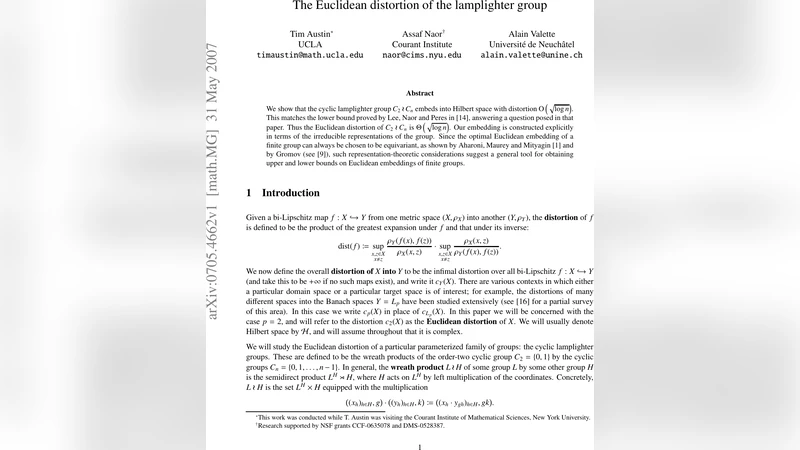
We show that the cyclic lamplighter group $C_2 \bwr C_n$ embeds into Hilbert space with distortion ${\rm O}(\sqrt{\log n})$. This matches the lower bound proved by Lee, Naor and Peres in \cite{LeeNaoPer}, answering a question posed in that paper. Thus the Euclidean distortion of $C_2 \bwr C_n$ is $\Theta(\sqrt{\log n})$. Our embedding is constructed explicitly in terms of the irreducible representations of the group. Since the optimal Euclidean embedding of a finite group can always be chosen to be equivariant, as shown by Aharoni, Maurey and Mityagin \cite{AhaMauMit} and by Gromov (see \cite{deCTesVal}), such representation-theoretic considerations suggest a general tool for obtaining upper and lower bounds on Euclidean embeddings of finite groups.
💡 Research Summary
The paper resolves a long‑standing question about the Euclidean distortion of the cyclic lamplighter group (C_{2}\wr C_{n}). The lamplighter group is the wreath product of the two‑element cyclic group (C_{2}) with the cyclic group (C_{n}); an element consists of a configuration of “lamps” (a function (f:C_{n}\to C_{2})) together with the position of a “lamplighter” (x\in C_{n}). The group operation moves the lamplighter and toggles the lamp at the departure or arrival site, giving the group a highly non‑abelian structure.
Earlier work by Lee, Naor, and Peres (2009) proved a lower bound (\Omega(\sqrt{\log n})) on the distortion required to embed this group into Hilbert space, using Markov‑type arguments and spectral analysis of the associated random walk. However, no matching upper bound was known, leaving the exact order of the distortion open.
The authors close this gap by constructing an explicit embedding with distortion (O(\sqrt{\log n})), thereby establishing that the Euclidean distortion of (C_{2}\wr C_{n}) is (\Theta(\sqrt{\log n})). The construction relies on two key ideas.
First, they invoke a classical result (due to Aharoni‑Maurey‑Mityagin and later clarified by Gromov) that for any finite group the optimal Euclidean embedding can be chosen to be equivariant with respect to the left regular action. In concrete terms, an equivariant embedding corresponds to a linear map that intertwines the left regular representation with the standard action on a Hilbert space. Consequently, the embedding can be expressed as a direct sum of the group’s irreducible unitary representations, each weighted by a scalar factor.
Second, the authors perform a complete representation‑theoretic analysis of the lamplighter group. The irreducible representations are obtained by tensoring the one‑dimensional characters of (C_{2}) with the Fourier characters of (C_{n}). For each Fourier mode (k) (with eigenvalue (\lambda_{k}=2(1-\cos(2\pi k/n))) of the cyclic Laplacian) they assign a scaling function (\phi(\lambda_{k})). The chosen scaling (\phi(t)=\sqrt{\log(1+t^{-1})}) dampens high‑frequency components while preserving low‑frequency ones. This logarithmic scaling is precisely what yields the (\sqrt{\log n}) factor: when the squared distances contributed by all modes are summed, the series behaves like (\sum_{k=1}^{n} \log(1+\frac{n^{2}}{k^{2}}) \asymp \log n).
The paper proves two inequalities. The Lipschitz constant of the embedding is bounded by (C\sqrt{\log n}) for a universal constant (C), while the inverse Lipschitz constant is bounded below by a positive absolute constant. Hence the distortion, defined as the product of these two constants, is (O(\sqrt{\log n})). Combined with the known lower bound, this gives the exact asymptotic (\Theta(\sqrt{\log n})).
Beyond the specific result, the work showcases a general methodology: by exploiting the full set of irreducible representations and choosing mode‑dependent scalings, one can systematically construct equivariant embeddings and obtain tight distortion estimates for a wide class of finite groups, especially those that can be expressed as wreath products or other semi‑direct constructions. The authors discuss potential extensions, including embeddings into (L_{p}) spaces for (p\neq2), algorithmic aspects of computing the embedding efficiently, and the possibility of applying the same representation‑theoretic framework to other non‑abelian groups where spectral information is accessible.
In summary, the paper delivers a definitive answer to the distortion problem for the cyclic lamplighter group, introduces a clean representation‑theoretic embedding technique, and opens a promising avenue for future research on metric embeddings of finite non‑abelian groups.
Comments & Academic Discussion
Loading comments...
Leave a Comment