Mass in the Hyperbolic Plane
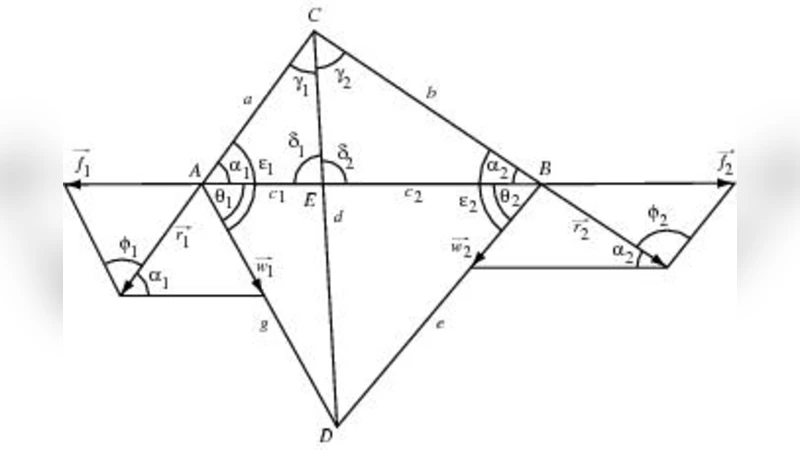
The notions of mass and center of mass are extended to laminae of the hyperbolic plane. The resulting formulae contain many surprises.
💡 Research Summary
The paper “Mass in the Hyperbolic Plane” develops a rigorous framework for defining mass and the center of mass of two‑dimensional laminae embedded in a hyperbolic (constant‑negative‑curvature) geometry. The authors begin by recalling the standard metric of the hyperbolic plane in polar coordinates, (ds^{2}=dr^{2}+\sinh^{2}r,d\theta^{2}), from which the area element follows as (dA=\sinh r,dr,d\theta). This elementary factor, (\sinh r), grows exponentially with the radial coordinate, and therefore any mass density (\rho(r,\theta)) multiplied by this area element yields a mass element (dm=\rho,\sinh r,dr,d\theta) that is dramatically larger at greater distances from the origin than in Euclidean space.
Using this element, the total mass of an arbitrary lamina (\Omega) is defined by the integral \
Comments & Academic Discussion
Loading comments...
Leave a Comment