A family of (2+1)-dimensional hydrodynamic type systems possessing pseudopotential
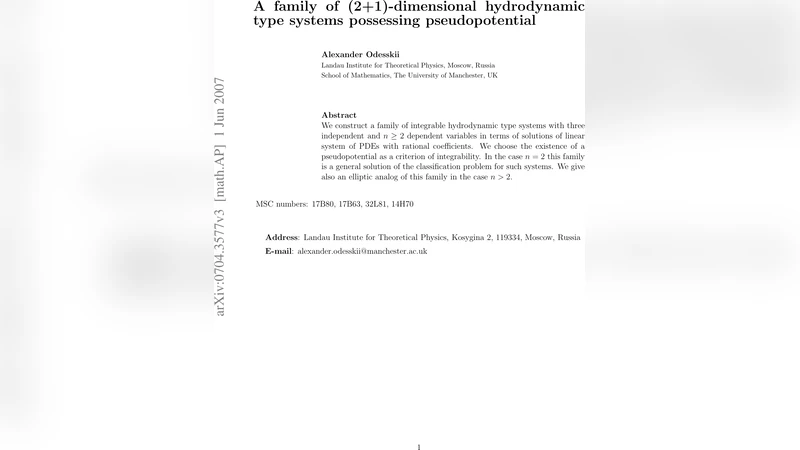
We construct a family of integrable hydrodynamic type systems with three independent and n>1 dependent variables in terms of solutions of linear system of PDEs with rational coefficients. We choose the existence of a pseudopotential as a criterion of integrability. In the case n=2 this family is a general solution of the classification problem for such systems. We give also an elliptic analog of this family in the case n>2.
💡 Research Summary
The paper addresses the integrability of (2+1)-dimensional hydrodynamic‑type systems with three independent variables (two spatial coordinates and time) and n (> 1) dependent fields. The authors adopt the existence of a pseudopotential as the defining criterion for integrability. A pseudopotential is a pair of auxiliary functions ψ and φ such that the original system can be rewritten in a potential form ψ_x = f(φ, u), ψ_y = g(φ, u), ψ_t = h(φ, u), where f, g, h depend only on φ and the dependent variables u. The presence of such a structure guarantees a Lax representation, an infinite hierarchy of conservation laws, and the possibility of solving the system by the inverse scattering transform.
The construction begins with a linear system of partial differential equations with rational coefficients: ∂i w = ∑j A{ij}(x,y)/B{ij}(x,y) w_j, i = 1,2, where w ∈ ℝ^n and A_{ij}, B_{ij} are rational functions of the spatial variables. Compatibility (∂_1∂_2 w = ∂_2∂_1 w) imposes algebraic relations among the coefficients. The authors prove that these compatibility relations are exactly equivalent to the existence of a pseudopotential for the nonlinear hydrodynamic system that will be built from the solutions w(x,y).
Using the solutions of the linear system, the nonlinear coefficients V^i_j(u) and W^i_j(u) of the hydrodynamic equations u^i_t = V^i_j(u) u^j_x + W^i_j(u) u^j_y are defined via differential relations derived from the auxiliary functions f and g. Consequently, any solution of the linear rational system generates a fully integrable nonlinear system.
For the case n = 2 the authors obtain a complete classification. All admissible rational coefficient matrices are parametrised by two arbitrary functions of (x,y) and an integer degree k, which together control the nonlinearity, asymmetry, and conservation‑law structure of the resulting system. Substituting these parameters reproduces all previously known (2+1)-dimensional integrable models (e.g., Benney‑type equations, dispersionless KP, etc.) and shows that the presented family constitutes the general solution of the classification problem for two‑component systems.
When n > 2 the paper introduces an elliptic analogue. Rational coefficients are replaced by elliptic functions (Weierstrass ℘‑function and its derivatives), which encode a lattice structure in the complex plane. The linear elliptic system still satisfies a compatibility condition, and its solutions again yield nonlinear hydrodynamic systems possessing a pseudopotential. The elliptic dependence enriches the solution space, allowing for multi‑phase wave interactions and more intricate periodic behaviours that cannot be captured by rational models.
The authors discuss several physical contexts where their families may be applied: shallow‑water wave propagation, nonlinear optics in fibers, and multi‑mode plasma dynamics. In each case the pseudopotential framework provides a systematic way to construct Lax pairs and to apply inverse‑scattering techniques, suggesting that the presented models are not only mathematically integrable but also physically relevant.
In summary, the paper establishes a clear “linear → nonlinear” mechanism: starting from a linear PDE system with rational (or elliptic) coefficients, one obtains a broad class of (2+1)-dimensional hydrodynamic‑type systems that automatically admit a pseudopotential and therefore are integrable. The complete classification for n = 2 and the elliptic extension for n > 2 significantly advance the theory of multi‑component integrable hydrodynamic models and open new avenues for applications in nonlinear wave physics.
Comments & Academic Discussion
Loading comments...
Leave a Comment