A universal property of the monoidal 2-category of cospans of finite linear orders and surjections
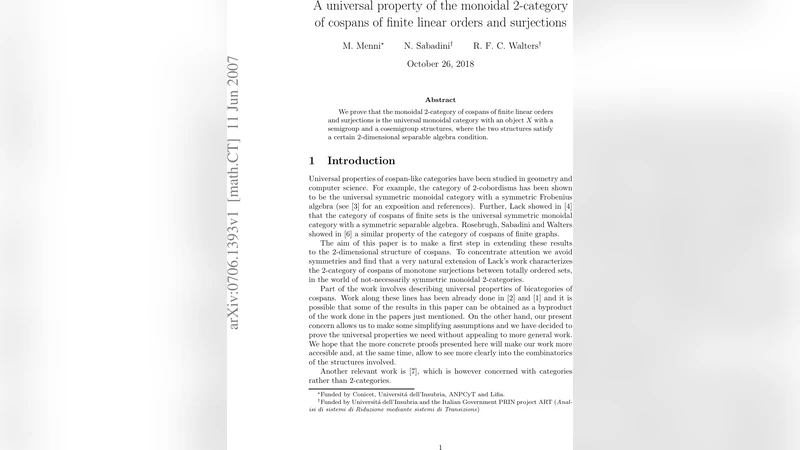
We prove that the monoidal 2-category of cospans of finite linear orders and surjections is the universal monoidal category with an object X with a semigroup and a cosemigroup structures, where the two structures satisfy a certain 2-dimensional separable algebra condition.
💡 Research Summary
The paper establishes a precise universal property for the monoidal 2‑category built from cospans of finite linear orders with surjective maps, denoted Cospan(FinOrd_surj). The objects of this 2‑category are finite totally ordered sets (often identified with the ordinal numbers n = {0<1<…<n‑1}), and a 1‑cell from n to m is a cospan n ← k → m where the legs are surjections. 2‑cells are morphisms of cospans, i.e. surjective maps h : k → k′ making the obvious triangles commute. Composition of 1‑cells is performed by taking pushouts in FinOrd_surj, which always exist because surjections are stable under pullback and pushout in this setting.
The monoidal structure is given by ordinal sum ⊕: for two linear orders n and m, n⊕m is the order obtained by placing the elements of n before those of m. This operation is strictly associative, with the empty order ∅ as the unit, and it lifts to a monoidal product on cospans by acting component‑wise on the legs of the cospan.
The central theorem states that Cospan(FinOrd_surj) is the initial monoidal 2‑category equipped with an object X that carries both a semigroup (multiplication μ : X⊗X → X) and a cosemigroup (comultiplication δ : X → X⊗X) structure satisfying a 2‑dimensional separable algebra condition. The condition consists of three parts:
- Separability: μ∘δ = id_X (the multiplication is a retraction of the comultiplication).
- Associativity up to a 2‑cell: the usual associativity diagram for μ commutes only up to a specified invertible 2‑cell, and similarly for coassociativity of δ.
- Compatibility of the 2‑cells: the associativity and coassociativity 2‑cells interact with the separability 2‑cell in a coherent way that mirrors the usual Frobenius equations but in a strictly 2‑categorical setting.
To prove the universal property, the authors construct, for any monoidal 2‑category 𝒟 with such an object X, a monoidal 2‑functor
F : Cospan(FinOrd_surj) → 𝒟
as follows. On objects, F sends the ordinal n to the n‑fold tensor power X^{⊗ n}. A surjection f : k → n is interpreted as a “copy‑and‑merge” operation: first duplicate X^{⊗ k} into X^{⊗ n} using δ repeatedly, then merge the copies using μ according to the fibers of f. This yields a 1‑cell in 𝒟 that precisely corresponds to the cospan leg. For a full cospan n ← k → m, the image is obtained by composing the images of the two legs, and the pushout composition in Cospan(FinOrd_surj) is reflected by the coherence 2‑cells supplied by the separable algebra structure.
The authors verify that F strictly preserves the monoidal product (thanks to the canonical identification X^{⊗ n}⊗X^{⊗ m} ≅ X^{⊗ (n+m)}) and that it respects 2‑cells because any map of cospans is forced to be a composite of the basic 2‑cells coming from the associativity, coassociativity, and separability data. Uniqueness is shown by constructing a natural equivalence between any two such functors; the components of this equivalence are forced to be identities on the tensor powers of X, and the coherence conditions follow from the universal property of pushouts together with the separable algebra axioms.
The paper situates this result among known constructions. When one forgets the order and works with cospans of finite sets (allowing all functions), one recovers the well‑studied PROP FinSet, which classifies commutative special Frobenius algebras. By retaining the linear order and restricting to surjections, the authors obtain a finer PROP that distinguishes “sequential” from “parallel” composition, making it suitable for modeling processes where the order of events matters, such as string‑diagrammatic presentations of linear algebraic operations or classical data flow in quantum circuits.
Several examples illustrate the theory. In Vect_k, taking X to be a one‑dimensional vector space, μ and δ can be chosen as the usual multiplication and diagonal map, yielding a monoidal 2‑functor that interprets each cospan as a linear map built from tensor products, copies, and merges. In the category of finite sets with disjoint union, the construction reproduces the classical copying‑deleting operations of a commutative separable algebra.
Finally, the authors discuss future directions: extending the framework to include injections (yielding a dual “co‑separable” structure), enriching over other bases (e.g., topological spaces or chain complexes), and exploring connections with higher‑dimensional algebraic theories such as higher PROPs or operadic categories. The result thus provides a robust categorical foundation for any setting where one needs a freely generated object equipped simultaneously with a multiplication and comultiplication that satisfy separability at the 2‑dimensional level.
Comments & Academic Discussion
Loading comments...
Leave a Comment