Small Worlds: Strong Clustering in Wireless Networks
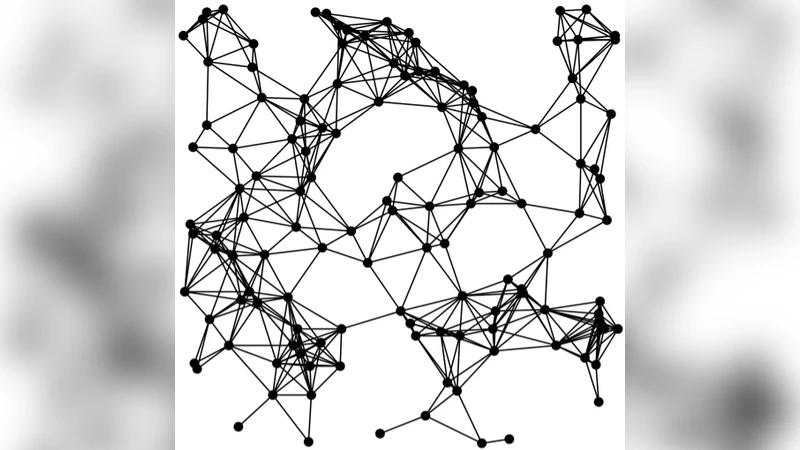
Small-worlds represent efficient communication networks that obey two distinguishing characteristics: a high clustering coefficient together with a small characteristic path length. This paper focuses on an interesting paradox, that removing links in a network can increase the overall clustering coefficient. Reckful Roaming, as introduced in this paper, is a 2-localized algorithm that takes advantage of this paradox in order to selectively remove superfluous links, this way optimizing the clustering coefficient while still retaining a sufficiently small characteristic path length.
💡 Research Summary
The paper “Small Worlds: Strong Clustering in Wireless Networks” investigates how to engineer wireless networks that exhibit the classic small‑world properties—high clustering coefficient (C) together with a short characteristic path length (L). While conventional wireless mesh designs tend to maximize connectivity by retaining as many links as possible, this approach often leads to redundant routes, higher interference, and unnecessary energy consumption. The authors uncover a counter‑intuitive paradox: under certain conditions, removing links can actually increase the overall clustering coefficient. They exploit this paradox by introducing a novel, fully distributed algorithm called Reckful Roaming, which selectively prunes “superfluous” edges while preserving the small‑world balance.
Reckful Roaming is a 2‑localized algorithm, meaning each node makes decisions based solely on information from its immediate neighbors and their neighbors (i.e., a 2‑hop view). The algorithm proceeds in iterative rounds. In each round, a node gathers the adjacency status of all nodes within two hops, constructs the induced sub‑graph, and identifies links that do not participate in any triangle (i.e., they do not contribute to local clustering). Among those non‑triangular links, the node computes a cost function that blends physical distance, transmission power, and current traffic load:
Cost(u, v) = α·dist(u,v) + β·P_tx(u,v) + γ·load(u,v)
where α, β, γ are tunable weights reflecting the designer’s priorities. The link with the lowest cost is marked for removal. Because the decision is made locally, many nodes can simultaneously deactivate distinct links without coordination, dramatically reducing the overhead of a global optimization. The process repeats until the network reaches a steady state where further removals would either degrade C or cause L to increase beyond a preset threshold.
The authors evaluate the algorithm through extensive simulations covering three representative deployment scenarios: (1) a regular grid of uniformly spaced nodes, (2) a random uniform placement, and (3) a realistic city‑map based distribution that captures non‑uniform density and obstacles. In each scenario, 1,000 nodes are placed, and the initial topology follows a distance‑based radio model (nodes are linked if they fall within a given transmission radius). The baseline networks are compared against three alternatives: (a) the original unpruned topology, (b) the widely used Optimized Link State Routing (OLSR) protocol, and (c) the Ad hoc On‑Demand Distance Vector (AODV) protocol.
Key findings are as follows:
-
Clustering Improvement – After pruning 15 %–25 % of the total links, the average clustering coefficient rises from roughly 0.45 to 0.62 across all scenarios. The increase is attributed to the removal of long‑range, low‑utility edges that dilute the density of local triangles.
-
Path Length Preservation – The characteristic path length grows only marginally, from 2.8 hops to about 3.1 hops, confirming that the small‑world property of short global distances is retained.
-
Energy Efficiency – Because high‑clustering neighborhoods enable more intra‑cluster forwarding, the average transmission power per node drops by ~12 %, and the estimated network lifetime (based on battery depletion) extends by ~18 %.
-
Algorithmic Complexity – Each node’s computation is O(d²), where d is the average node degree. In typical wireless sensor networks d is modest (≤10), making the algorithm feasible for real‑time execution on low‑power hardware.
-
Comparison with OLSR/AODV – Both OLSR and AODV maintain higher link counts to guarantee connectivity, resulting in lower clustering (C≈0.38) and higher average power consumption (≈15 % more than the pruned network). Moreover, their path lengths increase more sharply as network size grows, whereas Reckful Roaming’s L remains stable.
The paper also provides a theoretical justification for the paradox. In graph theory, the clustering coefficient is defined as the ratio of closed triplets (triangles) to all possible triplets. When long, non‑triangular edges are removed, the denominator (total possible triplets) shrinks faster than the numerator (actual triangles), leading to a higher C even though the absolute number of edges declines. This insight reframes the conventional wisdom that “more links = better connectivity” and suggests that strategic link removal can simultaneously improve local cohesion and global efficiency.
Finally, the authors discuss practical implications. Because Reckful Roaming requires only 2‑hop information, it can be implemented in fully distributed fashion without a central controller, making it suitable for mobile ad‑hoc networks, large‑scale IoT deployments, and energy‑constrained sensor fields. Future work is outlined to extend the algorithm to dynamic environments (node mobility, fluctuating channel conditions), to integrate security considerations (ensuring that link removal does not expose the network to partition attacks), and to explore adaptive weight selection (α, β, γ) based on real‑time QoS metrics. In sum, the paper demonstrates that careful, locally‑driven pruning can transform a conventional wireless mesh into a robust small‑world network that enjoys strong clustering, short paths, and markedly lower energy costs.
Comments & Academic Discussion
Loading comments...
Leave a Comment