Shelling-type orderings of regular CW-complexes and acyclic matchings of the Salvetti complex
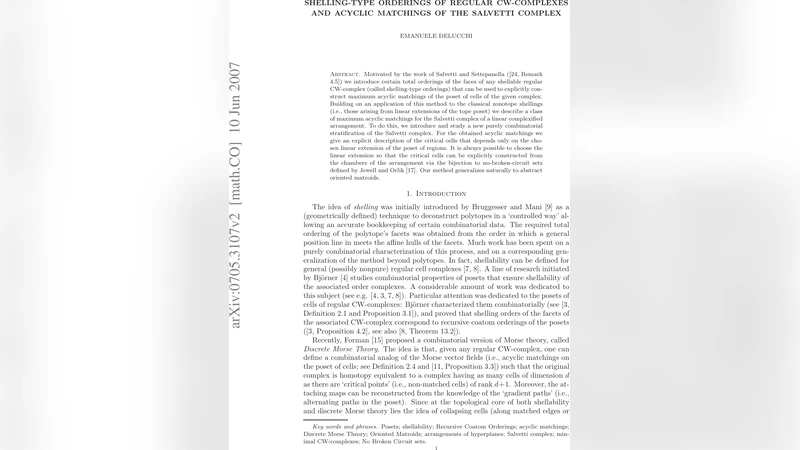
Motivated by the work of Salvetti and Settepanella we introduce certain total orderings of the faces of any shellable regular CW-complex (called `shelling-type orderings’) that can be used to explicitly construct maximum acyclic matchings of the poset of cells of the given complex. Building on an application of this method to the classical zonotope shellings we describe a class of maximum acyclic matchings for the Salvetti complex of a linear complexified arrangement. To do this, we introduce and study a new combinatorial stratification of the Salvetti complex. For the obtained acyclic matchings we give an explicit description of the critical cells that depends only on the chosen linear extension of the poset of regions. It is always possible to choose the linear extension so that the critical cells can be explicitly constructed from the chambers of the arrangement via the bijection to no-broken-circuit sets defined by Jewell and Orlik. Our method can be generalized to arbitraty oriented matroids.
💡 Research Summary
The paper introduces a novel combinatorial framework for constructing maximal acyclic matchings on the face poset of any shellable regular CW‑complex. The authors first define a “shelling‑type ordering,” a total ordering of the cells that extends the classical notion of a shelling. In this ordering each new cell is attached along a subcomplex already covered by earlier cells, guaranteeing that the matching built by pairing each cell with a uniquely determined lower‑dimensional face is acyclic. By proving that this construction yields a matching of maximal size, the authors provide a systematic method for applying Forman’s discrete Morse theory to arbitrary shellable CW‑complexes.
The framework is then applied to the well‑studied case of zonotope shellings. Zonotopes arise as Minkowski sums of line segments determined by a linear hyperplane arrangement, and their canonical shellings are shown to be instances of shelling‑type orderings. Consequently, the face poset of a zonotope admits a canonical maximal acyclic matching obtained directly from the ordering.
The central application concerns the Salvetti complex of a complexified real hyperplane arrangement. The Salvetti complex is a regular CW‑complex whose cells encode the combinatorics of the arrangement’s regions (chambers) together with their intersections. The authors fix a linear extension L of the poset of regions, which imposes a total order on the chambers. Using L they construct a shelling‑type ordering on the Salvetti cells and then apply the general matching procedure. The critical cells of the resulting discrete Morse function are described explicitly: they correspond precisely to the no‑broken‑circuit (NBC) sets associated with the chosen linear extension, via the Jewell‑Orlik bijection between chambers and NBC sets. In other words, each critical cell is uniquely determined by a chamber together with the NBC set that encodes the broken‑circuit structure of the arrangement. By an appropriate choice of L, the set of critical cells can be read off directly from the arrangement’s chambers, providing a transparent combinatorial description.
Beyond arrangements, the authors observe that the same construction works for any oriented matroid. An oriented matroid admits a regular CW‑realization (the Folkman‑Lawrence topological representation) whose face poset is shellable. The shelling‑type ordering can be defined using any linear extension of the covector poset, and the maximal acyclic matching obtained in exactly the same way yields critical cells that correspond to the oriented‑matroid NBC sets. This shows that the method is not limited to realizable arrangements but extends to the full combinatorial class of oriented matroids.
The paper concludes with several explicit examples (e.g., the A₂ and B₃ arrangements) that illustrate the construction, compute the size of the matchings, and verify that the number of critical cells matches the known Betti numbers of the Salvetti complex. These examples demonstrate that the shelling‑type ordering dramatically simplifies the computation of discrete Morse functions compared with previous ad‑hoc algorithms.
Overall, the work provides a unified, combinatorial approach to discrete Morse theory on shellable CW‑complexes, bridges the gap between shellings, zonotope geometry, hyperplane arrangement topology, and oriented‑matroid theory, and offers a practical tool for obtaining optimal acyclic matchings and explicit descriptions of critical cells.
Comments & Academic Discussion
Loading comments...
Leave a Comment