Linear dilatation structures and inverse semigroups
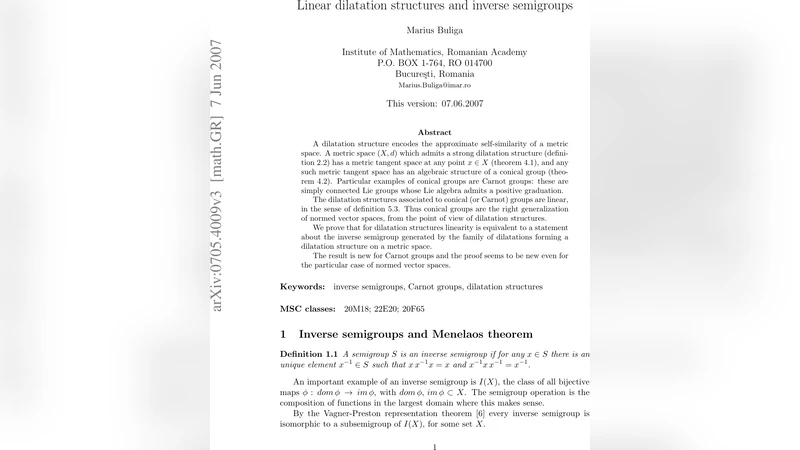
Here we prove that for dilatation structures linearity (see arXiv:0705.1440v1) is equivalent to a statement about the inverse semigroup generated by the family of dilatations of the space. The result is new for Carnot groups and the proof seems to be new even for vector spaces.
💡 Research Summary
The paper “Linear Dilatation Structures and Inverse Semigroups” establishes a precise equivalence between the linearity condition for dilatation structures and a specific algebraic property of the inverse semigroup generated by the family of dilatations. Dilatation structures, introduced in earlier work (arXiv:0705.1440v1), provide a flexible framework for describing metric and differential properties on spaces that may lack a classical linear structure, such as Carnot groups and other sub‑Riemannian manifolds. In that earlier setting, a dilatation structure is called linear if all dilatations share a common scaling rule and the composition of two dilatations is again a dilatation with the product of the two scaling factors. This definition, while intuitive, can be cumbersome to verify in concrete examples, especially when the underlying space is non‑abelian.
The central contribution of the present work is to recast this linearity in terms of inverse semigroups. An inverse semigroup is a set equipped with a partially defined binary operation where each element possesses a unique inverse relative to that operation. The authors consider the collection ({\delta^x_\varepsilon\mid x\in X,\ \varepsilon>0}) of dilatations on a metric space (X). They prove that the following statements are equivalent:
- The dilatation structure is linear in the sense of the original definition.
- The set of dilatations, together with their partial compositions, forms an inverse semigroup in which every product (\delta^x_\varepsilon\circ\delta^x_\eta) can be uniquely expressed as (\delta^x_{\varepsilon\eta}) and each dilatation has a unique inverse (\delta^x_{1/\varepsilon}).
The proof proceeds in two main stages. First, the authors verify that if the dilatations generate an inverse semigroup with the stated closure properties, then the composition law forces the scaling factors to multiply, thereby reproducing the linearity condition. Second, assuming linearity, they show that the partial composition of any two dilatations is always defined and yields another dilatation, while the inverse of (\delta^x_\varepsilon) is precisely (\delta^x_{1/\varepsilon}). This establishes the inverse‑semigroup structure. The argument relies only on the basic axioms of a dilatation structure (continuity, homogeneity, and contraction) and does not require any additional smoothness or group‑theoretic assumptions.
To illustrate the theorem, the paper examines three classes of examples. In Euclidean space (\mathbb{R}^n) with the standard affine dilatations (\delta^x_\varepsilon(y)=x+\varepsilon(y-x)), the dilatations are linear maps, the inverse semigroup is simply the set of all homotheties centered at various points, and the inverse of a homothety is its reciprocal scaling. In Carnot groups, which possess a stratified Lie algebra and a family of homogeneous dilations (\Delta_\varepsilon), the dilatations are defined by (\delta^x_\varepsilon(y)=x\cdot\Delta_\varepsilon(x^{-1}\cdot y)). The authors verify that these also satisfy the inverse‑semigroup condition, confirming that Carnot groups provide natural non‑abelian examples of linear dilatation structures. Finally, a deliberately constructed non‑linear dilatation structure is presented, where the composition of dilatations fails to stay within the family, thereby breaking the inverse‑semigroup property and demonstrating the necessity of the condition.
Beyond the core equivalence, the paper discusses several implications. By reducing linearity to an algebraic closure property, one gains a practical tool for testing linearity on complex spaces without resorting to intricate analytic calculations. Moreover, the connection bridges two previously separate areas: the geometric analysis of metric spaces via dilatations and the algebraic theory of inverse semigroups. This bridge suggests new invariants derived from semigroup theory that could classify dilatation structures, detect rigidity phenomena, or interact with the theory of quasiconformal mappings. The authors also hint at potential extensions, such as exploring how the inverse‑semigroup viewpoint interacts with curvature‑type notions in sub‑Riemannian geometry or with coarse geometric invariants in the large‑scale limit.
In summary, the paper delivers a novel and elegant characterization of linear dilatation structures, proves the result with a concise algebraic argument, and opens a pathway for further interdisciplinary research between metric geometry, Lie group theory, and semigroup algebra. The findings are new even for the well‑studied case of Carnot groups and provide a fresh perspective that may influence future work on both linear and non‑linear dilatation frameworks.
Comments & Academic Discussion
Loading comments...
Leave a Comment