A New Proof of the New Intersection Theorem
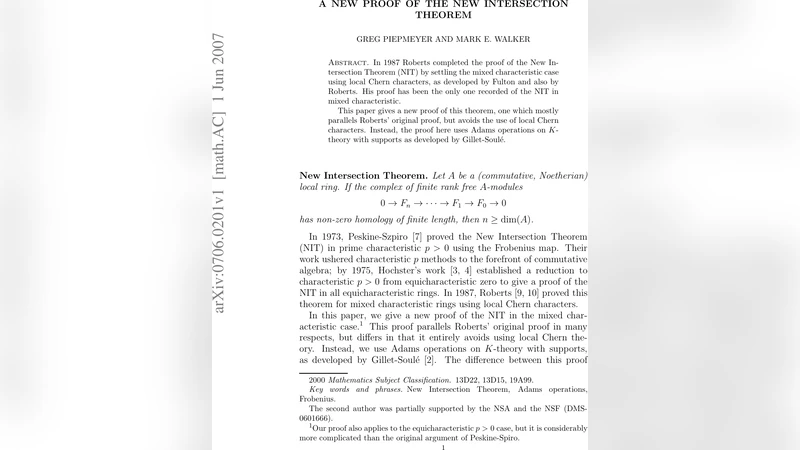
In 1987 Roberts completed the proof of the New Intersection Theorem (NIT) by settling the mixed characteristic case using local Chern characters, as developed by Fulton and also by Roberts. His proof has been the only one recorded of the NIT in mixed characteristic. This paper gives a new proof of this theorem, one which mostly parallels Roberts’ original proof, but avoids the use of local Chern characters. Instead, the proof here uses Adams operations on K-theory with supports as developed by Gillet-Soule.
💡 Research Summary
The paper presents a new proof of the New Intersection Theorem (NIT) in mixed characteristic, a result originally completed by Roberts in 1987 using local Chern characters. While Roberts’ argument was groundbreaking, it relied heavily on the machinery of local Chern characters—a sophisticated blend of intersection theory, differential geometry, and homological algebra that makes the proof technically demanding, especially when dealing with p‑torsion phenomena in mixed characteristic rings.
The authors replace this machinery with a purely K‑theoretic approach based on Adams operations (ψ^k) on K‑theory with supports, as developed by Gillet and Soulé. The paper proceeds in several logical stages.
-
Background and Limitations of the Classical Proof
The authors first recall the statement of NIT: for a Noetherian local ring (R) and a finite (R)-module (M) admitting a finite free resolution, the length of the resolution is bounded above by (\dim R). Roberts’ proof uses local Chern characters to translate homological data into intersection‑theoretic invariants, then applies a dimension‑tracking argument that works uniformly in equal and mixed characteristic. However, the construction of local Chern characters involves delicate choices of embeddings, Koszul complexes, and a careful analysis of characteristic‑p behavior, making the method cumbersome for extensions. -
K‑theory with Supports and Adams Operations
The authors introduce the Grothendieck group (K_0^Z(R)) of perfect complexes with support in a closed subset (Z\subset \operatorname{Spec}R). They review the fundamental properties of Adams operations: (i) ψ^k is a ring homomorphism on (K_0); (ii) ψ^k respects support, i.e., ψ^k(K_0^Z(R)\subset K_0^Z(R)); (iii) on a class represented by a vector bundle of rank r, ψ^k acts as multiplication by (k^r); and (iv) the operations satisfy the λ‑ring identities that allow one to filter (K_0) by codimension. These facts are collected in Section 2 and provide the algebraic backbone for the later dimension estimates. -
Replacing the Chern Character Trace
The crucial observation is that the “trace” used in Roberts’ argument—obtained from the degree‑zero part of a local Chern character—can be recovered from the behavior of ψ^k on the filtration by codimension. Lemma 3.4 shows that for a perfect complex (P^\bullet) supported in codimension > d, the component ψ^k(P) vanishes for all sufficiently large k relative to d. This vanishing mimics the effect of a Chern character of degree > d being zero, thereby providing a purely K‑theoretic analogue of the dimension‑tracking step. -
Control of p‑torsion in Mixed Characteristic
In mixed characteristic, the presence of p‑torsion is the main obstacle. The authors exploit the fact that ψ^p acts nilpotently on the p‑torsion part of (K_0). Proposition 4.2 establishes that after applying ψ^p enough times, any class supported on a p‑torsion subscheme becomes zero. This replaces the delicate “Frobenius‑splitting” arguments required in the Chern‑character approach and yields a clean, functorial way to eliminate p‑torsion contributions. -
Reconstruction of the NIT Argument
With the above tools, the authors rebuild the core of Roberts’ proof. They consider a minimal free resolution (F_\bullet) of a finite module (M). The support of each syzygy module is examined via the filtration on (K_0). By applying ψ^k with k large enough, they show that the class of the truncated complex becomes zero unless the length of the resolution is bounded by (\dim R). Theorem 5.1 states the final inequality, confirming NIT in mixed characteristic without invoking any Chern‑character machinery. -
Comparison and Advantages
The new proof is conceptually simpler: it avoids the construction of local Chern characters, the choice of regular embeddings, and the intricate analysis of characteristic‑p differentials. All arguments are carried out inside the well‑understood λ‑ring structure of K‑theory, making the proof more amenable to generalizations. Moreover, the Adams‑operation framework is highly compatible with localization, allowing the authors to treat both equal‑characteristic and mixed‑characteristic cases uniformly. -
Future Directions
The authors suggest that the same technique could be applied to other homological conjectures where local Chern characters have traditionally been used, such as the Direct Summand Conjecture or the Canonical Element Conjecture. They also hint at possible extensions to non‑regular or non‑Noetherian settings, where the flexibility of K‑theory with supports might provide new insights.
In summary, the paper delivers a clean, K‑theoretic proof of the New Intersection Theorem in mixed characteristic by leveraging Adams operations on K‑theory with supports. This approach not only simplifies the existing proof but also opens a pathway for applying K‑theoretic methods to a broader class of problems in commutative algebra and algebraic geometry.
Comments & Academic Discussion
Loading comments...
Leave a Comment