Reciprocal best hits are not a logically sufficient condition for orthology
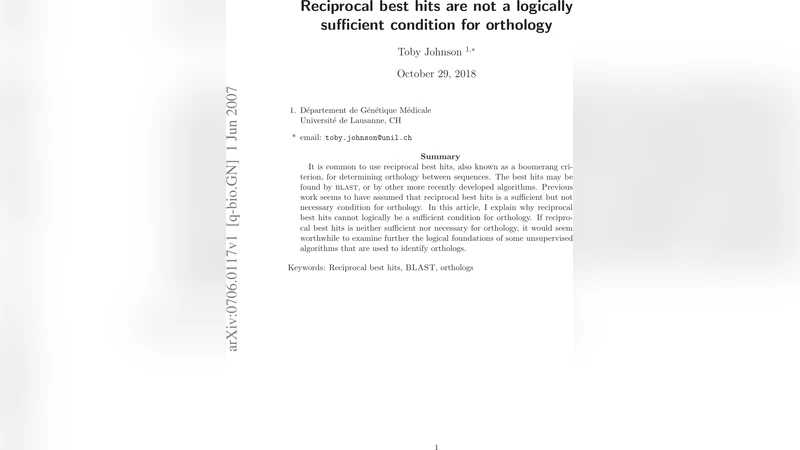
It is common to use reciprocal best hits, also known as a boomerang criterion, for determining orthology between sequences. The best hits may be found by blast, or by other more recently developed algorithms. Previous work seems to have assumed that reciprocal best hits is a sufficient but not necessary condition for orthology. In this article, I explain why reciprocal best hits cannot logically be a sufficient condition for orthology. If reciprocal best hits is neither sufficient nor necessary for orthology, it would seem worthwhile to examine further the logical foundations of some unsupervised algorithms that are used to identify orthologs.
💡 Research Summary
The paper critically examines the widely‑used reciprocal best‑hit (RBH) criterion—often called the boomerang rule—for inferring orthology between genes from different species. While RBH is routinely employed as a quick, heuristic filter in pipelines such as OrthoMCL, InParanoid, and OMA, the author argues that it cannot serve as a logically sufficient condition for orthology, nor is it a necessary one.
The argument begins with a formal definition of orthology: two genes are orthologous if they descend from a single ancestral gene present in the last common ancestor of the species under consideration, and the relationship forms a one‑to‑one mapping (a bijection) between the gene sets of the two genomes. In mathematical terms, orthology requires a bijective correspondence that respects the species phylogeny.
RBH, by contrast, is defined purely in terms of pairwise sequence similarity: gene a in species A and gene b in species B are RBH if b is the highest‑scoring hit for a and a is the highest‑scoring hit for b when each is queried against the other’s proteome. This definition is agnostic to evolutionary history, duplication events, and lineage‑specific loss.
The author presents three logical scenarios that demonstrate why RBH fails to guarantee orthology.
-
Gene duplication and asymmetric retention – After a duplication in one lineage, only one copy may be retained in the other lineage. In such a case, the retained copy will be the RBH for both paralogs, producing a many‑to‑one mapping that violates the bijection required for orthology.
-
Lineage‑specific loss or rapid divergence – A gene may be lost in one species, or it may evolve so quickly that its best hit is a non‑orthologous sequence that nevertheless scores highest due to convergent similarity or compositional bias. This yields false‑positive RBH pairs that are not true orthologs.
-
Lack of transitivity – RBH is a binary relation that does not satisfy transitivity: if A↔B and B↔C are both RBH pairs, there is no guarantee that A↔C will also be RBH. Consequently, constructing a multi‑species orthology graph from pairwise RBH edges can produce disconnected components, cycles, or ambiguous many‑to‑many relationships, none of which correspond to a global orthology mapping.
These scenarios are formalized using graph theory. Genes are vertices; RBH relationships are undirected edges. A perfect orthology mapping would correspond to a perfect matching where every vertex has degree one. The presence of duplications, losses, or non‑transitive edges inevitably creates vertices of degree greater than one or isolated vertices, demonstrating that RBH graphs cannot, in general, be perfect matchings.
Empirical evidence is also provided. The author surveys public orthology databases (COG, eggNOG, etc.) and shows clusters of genes that are linked solely by RBH yet contain known paralogs or lineage‑specific expansions. These clusters illustrate that RBH alone cannot discriminate between true orthologs and “similarity clusters.”
Finally, the paper reviews how contemporary unsupervised orthology inference tools mitigate RBH’s shortcomings. All of them use RBH as an initial filter but then apply additional criteria: phylogenetic tree reconciliation, synteny conservation, evolutionary distance correction, and functional annotation consistency. These extra layers effectively prune the false‑positive RBH edges and restore a mapping that approximates the bijective orthology relation.
The conclusion is unequivocal: reciprocal best hits are neither sufficient nor necessary for orthology. Researchers should treat RBH as a convenient heuristic, not a logical guarantee, and should incorporate independent evolutionary evidence when building orthology sets, especially in large‑scale comparative genomics, metagenomics, and transcriptome analyses where errors can propagate dramatically. The paper calls for a re‑examination of the theoretical foundations of unsupervised orthology algorithms and for the development of more robust, evidence‑integrated frameworks.
Comments & Academic Discussion
Loading comments...
Leave a Comment