Braided Sweedler cohomology
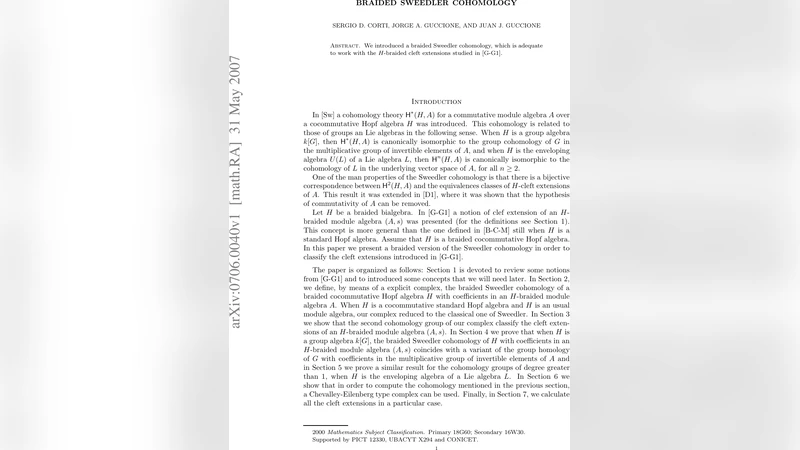
We introduced a braided Sweedler cohomology, which is adequate to work with the H-braided cleft extensions studied in [J. A. Guccione and J. J. Guccione, Theory of braided Hopf crossed products, Journal of Algebra, Vol 261 (2003) 54-101]
💡 Research Summary
The paper introduces a cohomology theory that extends the classical Sweedler cohomology to the setting of braided Hopf algebras, called “braided Sweedler cohomology”. The motivation is that many constructions in the theory of Hopf algebras—particularly H‑braided cleft extensions and braided crossed products—take place in a braided monoidal category where the tensor product is not strictly symmetric. In such a context the usual Sweedler cochain complex, built from Hom‑spaces Hom(H^{⊗n},A) with the standard differential, fails to respect the braiding and therefore does not capture the relevant deformation data.
The authors begin by fixing a braided monoidal category 𝒞 with braiding c_{X,Y}:X⊗Y→Y⊗X. Within 𝒞 they consider a Hopf algebra H and an H‑module algebra A, both equipped with compatible braiding maps so that A becomes an H‑braided module algebra. The central construction is a cochain complex C^{n}_{br}(H,A)=Hom_k(H^{⊗n},A) together with a differential d^{n} that incorporates the braiding at every step. Concretely, the differential is defined by
d^{n}(f)(h_{1},…,h_{n+1}) = h_{1}\cdot f(h_{2},…,h_{n+1})
+ Σ_{i=1}^{n} (-1)^{i} f(h_{1},…,h_{i}h_{i+1},…,h_{n+1})
+ (-1)^{n+1} f(h_{1},…,h_{n})·h_{n+1},
where each multiplication “·” is understood to be pre‑composed with the appropriate braiding maps so that the elements of H and A are interchanged according to c. The authors verify that d^{n+1}∘d^{n}=0, establishing a bona‑fide cochain complex. The resulting cohomology groups H^{n}_{br}(H,A) are called braided Sweedler cohomology groups.
A substantial part of the paper is devoted to interpreting the low‑degree groups. H^{1}{br}(H,A) consists of H‑linear maps f:H→A satisfying a braided derivation condition; these are precisely the 1‑cocycles that classify H‑braided cleft extensions of A by H up to equivalence. H^{2}{br}(H,A) consists of braided 2‑cocycles σ:H⊗H→A. Such a σ can be used to deform the ordinary smash product into a braided crossed product A♯{σ}H, where the multiplication is twisted by σ and the braiding. Two crossed products are equivalent if and only if their defining 2‑cocycles differ by a braided coboundary, so H^{2}{br}(H,A) classifies braided crossed products (or equivalently, H‑braided cleft extensions) up to isomorphism.
The paper shows that when the braiding is the ordinary flip (i.e., the category is symmetric), the braided differential collapses to the classical Sweedler differential, and the groups H^{n}_{br} reduce to the usual Sweedler cohomology groups. Thus the new theory genuinely generalizes the classical one. Conversely, in genuinely braided situations—such as when H is a quantum group equipped with its R‑matrix—the authors exhibit non‑trivial braided 2‑cocycles that have no counterpart in the symmetric theory. This demonstrates that braided Sweedler cohomology captures deformation phenomena invisible to the classical framework.
To illustrate the theory, the authors work out explicit calculations for the quantum enveloping algebra U_q(sl₂) with its standard R‑matrix. Taking A to be the base field k, they compute C^{2}(U_q(sl₂),k) and find a non‑zero σ satisfying the braided cocycle condition. The associated crossed product k♯{σ}U_q(sl₂) is a non‑trivial braided cleft extension, showing that the cohomology class in H^{2}{br} indeed corresponds to a genuine deformation of the smash product. They also treat the case of a group algebra kG with the trivial braiding, recovering the classical group cohomology picture, and compare it with the braided case where a non‑trivial R‑matrix is imposed on G.
In the final section the authors discuss further directions. They point out that higher‑degree groups H^{n}_{br} (n≥3) should control higher extensions and obstruction theory for iterated braided crossed products, much as in the classical case. They suggest investigating connections with braided deformation quantization, with the theory of Hopf‑cocycle twists, and with applications to braided tensor categories arising in low‑dimensional topology and quantum field theory. Moreover, they propose studying spectral sequences relating braided Sweedler cohomology to other cohomology theories (e.g., Hochschild, Hopf‑Galois, or Yetter‑Drinfeld cohomology) to better understand the interplay between algebraic and categorical structures.
Overall, the paper provides a rigorous definition of braided Sweedler cohomology, establishes its basic properties, interprets the first two cohomology groups in terms of braided cleft extensions and crossed products, and demonstrates through concrete quantum‑group examples that the theory yields new, non‑trivial invariants. By extending a classical tool to the braided setting, the work opens a pathway for systematic study of deformations and extensions in braided Hopf algebra theory and its applications.
Comments & Academic Discussion
Loading comments...
Leave a Comment