Modeling Epidemic Spread in Synthetic Populations - Virtual Plagues in Massively Multiplayer Online Games
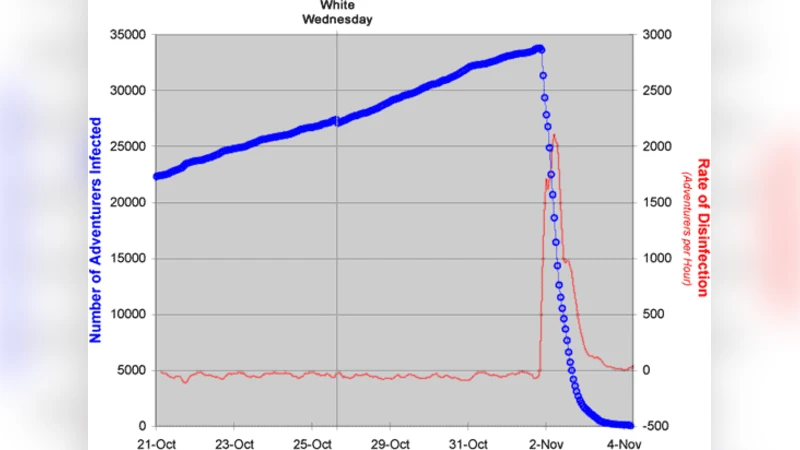
A virtual plague is a process in which a behavior-affecting property spreads among characters in a Massively Multiplayer Online Game (MMOG). The MMOG individuals constitute a synthetic population, and the game can be seen as a form of interactive executable model for studying disease spread, albeit of a very special kind. To a game developer maintaining an MMOG, recognizing, monitoring, and ultimately controlling a virtual plague is important, regardless of how it was initiated. The prospect of using tools, methods and theory from the field of epidemiology to do this seems natural and appealing. We will address the feasibility of such a prospect, first by considering some basic measures used in epidemiology, then by pointing out the differences between real world epidemics and virtual plagues. We also suggest directions for MMOG developer control through epidemiological modeling. Our aim is understanding the properties of virtual plagues, rather than trying to eliminate them or mitigate their effects, as would be in the case of real infectious disease.
💡 Research Summary
The paper investigates “virtual plagues” – phenomena in which a behavior‑affecting property spreads among avatars in a massively multiplayer online game (MMOG). The authors treat the population of game characters as a synthetic, interactive model that can be examined with epidemiological tools, while also recognizing that virtual plagues differ fundamentally from real‑world infectious diseases. The study proceeds in three logical stages: (1) a review of basic epidemiological measures (basic reproduction number R0, infection period, latency, etc.) and their direct applicability to a virtual environment; (2) an analysis of the structural and behavioral differences that separate virtual plagues from biological ones; and (3) a proposal of control strategies for game developers based on adapted epidemiological modeling.
First, the authors note that classic epidemiological metrics can be calculated from game logs, but their interpretation must be adjusted. In a real epidemic, R0 reflects the average number of secondary infections generated by a typical case in a fully susceptible population, assuming passive transmission. In an MMOG, players can actively decide to spread or contain the virtual disease, turning R0 into a variable that depends on player intent, game mechanics, and in‑game incentives. Consequently, the authors introduce an “intent parameter” (θ) ranging from 0 (purely accidental spread) to 1 (deliberate propagation) to capture this dimension.
Second, the paper highlights two major divergences. The transmission network is not limited to physical proximity; it also includes quests, trade of items, party formation, chat channels, and scripted events. These non‑traditional pathways can cause sudden spikes in infection when a high‑traffic event (e.g., a raid boss encounter) occurs. Moreover, the effect of infection is not physiological damage but a modification of gameplay – reduced movement speed, disabled abilities, altered chat permissions, or forced participation in specific quests. These effects are deliberately designed to influence player experience, making the virtual plague a potential game‑design mechanic rather than a purely negative event.
Methodologically, the authors propose a hybrid modeling framework that combines agent‑based simulation (ABS) with system dynamics (SD). ABS models each avatar with a rule set governing movement, interaction, item exchange, and decision‑making about whether to spread the plague. SD captures aggregate variables such as overall infection prevalence, recovery rate, and “mortality” (character deletion or forced logout). The hybrid approach allows the researchers to observe emergent macro‑level patterns while retaining the granularity needed to test policy interventions (e.g., adjusting θ, imposing quarantine zones).
Data collection relies on three sources: (a) server logs that timestamp infection events, source and target of transmission, and recovery; (b) real‑time event tracking that monitors high‑traffic zones and in‑game economies; and (c) post‑event surveys that gauge player perception, intentionality, and behavioral changes. By triangulating these data, the model can incorporate subjective variables that are absent in traditional epidemiology, such as the desire to “play the plague” for prestige or reward.
The experimental section explores three scenarios. In a baseline case with low intent (θ≈0), the virtual plague spreads through random encounters, peaks quickly, and then dies out as susceptible avatars become scarce. In a high‑intent scenario (θ≈0.7), players actively disseminate the plague to achieve in‑game goals, resulting in a sustained outbreak that overloads certain servers and distorts the in‑game economy. Finally, a controlled scenario applies developer‑designed interventions: dynamic reduction of the transmission coefficient β over time, geographic quarantine (limiting infection to specific zones or level ranges), and reward mechanisms for players who aid containment. This controlled approach maintains the plague long enough to create a compelling narrative arc while preventing catastrophic player loss or server instability.
The discussion emphasizes that virtual plagues should be viewed less as bugs to eradicate and more as levers for game design. By treating the plague as a tunable parameter, developers can craft emergent storytelling, introduce temporary challenges, and stimulate player cooperation. The authors recommend concrete control tools: (1) time‑varying β schedules, (2) region‑based infection caps, (3) incentive structures (special items, experience bonuses) for players who help contain or cure the disease, and (4) real‑time dashboards for monitoring infection metrics.
In conclusion, the paper demonstrates that epidemiological theory, when suitably adapted, provides a powerful lens for understanding and managing virtual plagues. MMOGs offer a unique, large‑scale synthetic population that can be observed and manipulated in ways impossible in real‑world settings, opening avenues for both game design innovation and methodological research into complex adaptive systems. Future work is suggested on more sophisticated decision‑making models, simultaneous multi‑plague simulations, and comparative studies that align virtual plague dynamics with real‑world disease control strategies.
Comments & Academic Discussion
Loading comments...
Leave a Comment