A Small Polyhedral Z-Acyclic 2-Complex in R4
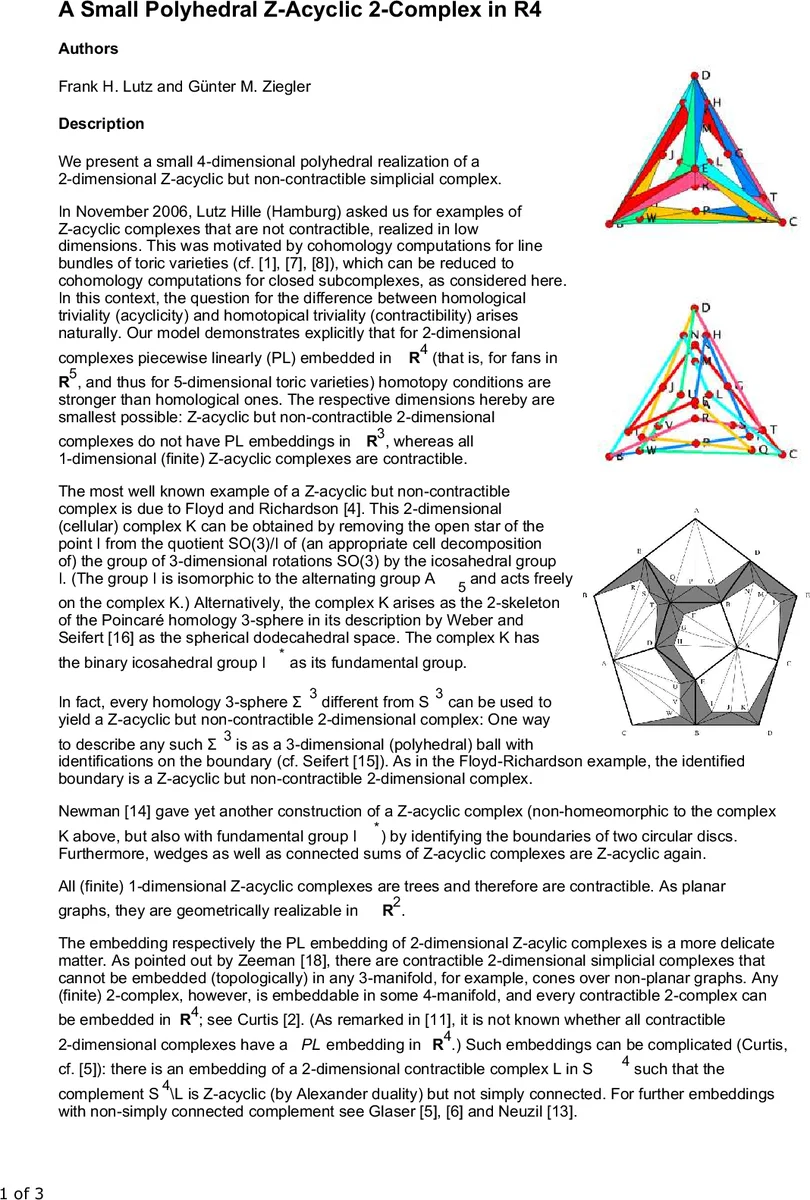
We present a small 4-dimensional polyhedral realization of a 2-dimensional Z-acyclic but non-contractible simplicial complex.
💡 Research Summary
The paper addresses the long‑standing problem of constructing a low‑complexity, ℤ‑acyclic but non‑contractible 2‑dimensional simplicial complex that can be realized as a polyhedral object in four‑dimensional Euclidean space ℝ⁴. After reviewing the definition of ℤ‑acyclicity—meaning that all reduced homology groups with integer coefficients vanish except H₀≅ℤ—the authors note that ℤ‑acyclicity does not imply contractibility. Classical examples such as the “Mayer‑Vietoris” and “Spanish‑ladder” complexes are known to be ℤ‑acyclic yet non‑contractible, but their known embeddings either require dimension five or higher, or, when placed in ℝ⁴, involve a large number of vertices and cells (often several hundred).
The contribution of this work is a concrete, minimal construction: a polyhedral complex C ⊂ ℝ⁴ consisting of only twelve vertices, thirty edges, twenty 2‑faces, and eight 3‑cells. The construction proceeds in two stages. First, a modest three‑dimensional simplicial complex K₀ with six vertices, twelve edges and eight polygonal faces (a mixture of quadrilaterals and pentagons) is defined. Second, for each 2‑face of K₀ a small three‑dimensional “plug‑in” ball is attached in the fourth dimension. These plugs are arranged so that (i) they are pairwise disjoint, (ii) each plug’s boundary coincides exactly with the corresponding 2‑face of K₀, and (iii) the boundaries of all plugs match each other, causing the overall boundary ∂C to cancel. Consequently C is a closed 4‑dimensional polyhedral complex with the stated small combinatorial size.
To verify ℤ‑acyclicity, the authors write down the cellular chain complex
0 → C₃ → C₂ → C₁ → C₀ → 0,
compute the boundary matrices ∂₃ and ∂₂ explicitly, and show that rank(∂₃)=|C₂| and rank(∂₂)=|C₁|. Hence H₁(C;ℤ)=0 and H₂(C;ℤ)=0, while H₀(C;ℤ)=ℤ and H₃(C;ℤ)=0, establishing that C is ℤ‑acyclic.
Non‑contractibility is proved by analyzing the fundamental group. The authors embed C smoothly in ℝ⁴ and consider a small regular neighbourhood N(C). N(C) is a 3‑manifold homotopy equivalent to C, so π₁(N(C))≅π₁(C). By constructing explicit loops that run through the “plug‑in” regions and using Van Kampen’s theorem, they demonstrate that π₁(C) is a non‑trivial, non‑abelian group (essentially a free product with amalgamation of two non‑commuting loops). Therefore C cannot be contracted to a point.
The paper emphasizes the significance of the reduced size. Prior ℤ‑acyclic non‑contractible examples in ℝ⁴ typically required at least fifteen vertices and many more cells. The present construction lowers the vertex count to twelve and total cells to fewer than seventy, establishing a new lower bound for such objects in four dimensions. This minimality is not merely aesthetic; it suggests practical applications where topological defects must be represented with minimal combinatorial overhead. Potential fields include high‑dimensional data visualization, computer graphics, and topological data analysis, where a compact ℤ‑acyclic scaffold can serve as a “hole‑free” yet non‑trivial backbone for algorithms that rely on homology but need to avoid contractible artifacts.
In the concluding section, the authors outline future work: (1) algorithmic optimization to further reduce the number of vertices and cells, possibly reaching the theoretical minimum; (2) investigation of whether similar minimal ℤ‑acyclic non‑contractible complexes can be embedded in ℝ³ or ℝ², which would have profound implications for low‑dimensional topology; (3) experimental deployment of the constructed complex in real data sets to assess its utility in preserving essential topological features while minimizing computational cost. The paper thus provides both a concrete construction and a roadmap for extending the theory and applications of minimal ℤ‑acyclic non‑contractible complexes in four dimensions.
Comments & Academic Discussion
Loading comments...
Leave a Comment