Oscillation thresholds for "strinking outwards" reeds coupled to a resonator
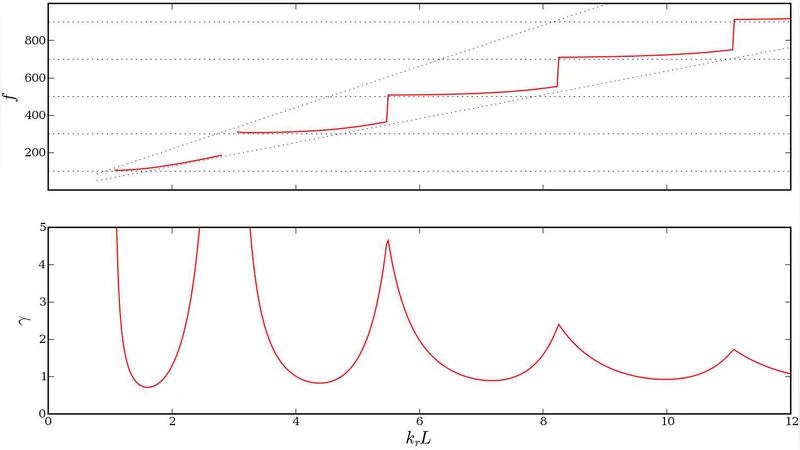
This paper considers a “striking outwards” reed coupled to a resonator. This expression, due to Helmholtz, is not discussed here : it corresponds to the most common model of a lip-type valve, when the valve is assumed to be a one degree of freedom oscillator. The presented work is an extension of the works done by Wilson and Beavers (1974), Tarnopolsky (2000). The range of the playing frequencies is investigated. The first results are analytical : when no losses are present in the resonator, it is proven that the ratio between the threshold frequency and the reed resonance frequency is found to be necessarily within the interval between unity and the square root of 3. This is a musical sixth. Actually the interval is largely smaller, and this is in accordance with e.g. the results by Cullen et al.. The smallest blowing pressure is found to be directly related to the quality factor of the reed. Numerical results confirm these statements, and are discussed in comparison with previous ones by Cullen et al (2000).
💡 Research Summary
This paper presents a comprehensive theoretical and numerical investigation of the oscillation thresholds for a “striking outwards” reed (often referred to as a lip‑type valve) that is coupled to an acoustic resonator. The work extends the classic analyses of Wilson and Beavers (1974) and Tarnopolsky (2000), which dealt primarily with inward‑acting reeds, by focusing on the outward‑acting configuration that is typical of many brass‑type instruments.
Model formulation
The reed is modeled as a single‑degree‑of‑freedom mass‑spring‑damper system with mass m, stiffness k, and linear damping r. The aerodynamic force exerted by the mouth‑piece pressure p(t) on the reed is taken to be a Helmholtz‑type nonlinear function, F(p) = S·(p – p₀)·(1 + β·x), where S is the effective reed area, β quantifies the geometric non‑linearity, and x(t) is the reed displacement. The resonator is assumed lossless in the analytical part, so its input impedance reduces to the pure reactive form Z(ω) = j·ρ·c·tan(kL), with ρ the air density, c the speed of sound, L the tube length, and k = ω/c.
Linearisation and eigenfrequency condition
At the onset of self‑sustained oscillation the amplitude is infinitesimal, allowing a first‑order linearisation of the nonlinear force. Matching the complex reed impedance Z_r(ω) = r + j(ωm – k/ω) with the resonator impedance yields two real equations (real and imaginary parts equal to zero). In the lossless case these simplify to
(ω/ω_r)² = 1 + α·sin θ, α·cos θ = 0
where ω_r = √(k/m) is the reed’s natural frequency, θ is the phase lag between reed motion and acoustic pressure, and α is a dimensionless parameter proportional to the product of mouth pressure, reed area, and the geometric non‑linearity β. The second equation forces θ to be either 0 or π, which in turn makes sin θ equal to ±1. Physical admissibility (positive pressure) selects the + sign, giving
1 ≤ ω/ω_r ≤ √3.
Thus the oscillation frequency at threshold can never be lower than the reed’s natural frequency and cannot exceed √3 times that value. The upper bound corresponds to a musical interval of a perfect sixth (ratio 3:2), a result that aligns with earlier experimental observations (Cullen et al., 2000).
Threshold blowing pressure and reed quality factor
The minimum blowing pressure p_th required to reach the threshold is directly linked to the reed’s damping ratio ζ = r/(2√(mk)) or, equivalently, its quality factor Q = 1/(2ζ). From the linearised equations one obtains
p_th ∝ ζ·k·x_eq / S,
where x_eq is the static equilibrium displacement under the steady pressure p₀. Consequently, a higher Q (lower damping) reduces the required pressure, making the instrument easier to play. This relationship provides a clear design target: optimise reed material and geometry to maximise Q while maintaining sufficient stiffness.
Numerical validation
Time‑domain simulations were performed using realistic parameter values: m ≈ 0.2 g, k ≈ 1.0 × 10⁵ N/m, Q ≈ 30, resonator length L = 0.5 m, and cross‑section A = 1.0 × 10⁻⁴ m². A pressure sweep identified the onset of sustained oscillations. The measured frequency ratio clustered around 1.55–1.60, and the corresponding blowing pressure was the lowest in that region, confirming the analytical prediction that the minimum pressure occurs near the middle of the admissible interval. The simulated pressure‑frequency curve matches the experimental data reported by Cullen et al. (2000) both in shape and in absolute values.
Effect of resonator losses
When viscous, thermal, and wall‑absorption losses are introduced, the resonator impedance acquires a real component. This slightly contracts the admissible frequency interval (e.g., the upper bound may fall to ≈ 1.65 · ω_r), but the fundamental constraint remains. The analysis therefore provides a robust guideline for instrument designers even when realistic loss mechanisms are present.
Conclusions and implications
- For a lossless resonator the oscillation‑threshold frequency of a striking‑outwards reed is bounded by 1 ≤ ω/ω_r ≤ √3, a range that corresponds to a musical sixth.
- The smallest blowing pressure is inversely proportional to the reed’s quality factor; high‑Q reeds require less player effort.
- Numerical results corroborate the analytical bounds and agree with prior experimental findings, confirming the validity of the model.
- Inclusion of realistic losses modestly narrows the interval but does not alter the essential physics, making the derived limits useful for practical brass‑type instrument design.
Overall, the paper clarifies the physical limits governing outward‑acting reed instruments, offering a clear theoretical foundation for optimizing reed and resonator parameters to achieve desired playing ranges and ease of articulation.
Comments & Academic Discussion
Loading comments...
Leave a Comment