On $pi - pi$ theorem for manifold pairs with boundaries
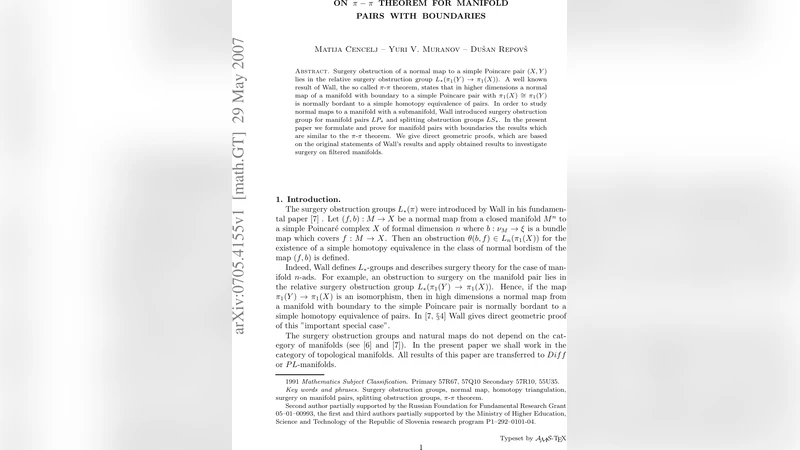
Surgery obstruction of a normal map to a simple Poincare pair $(X,Y)$ lies in the relative surgery obstruction group $L_(\pi_1(Y)\to\pi_1(X))$. A well known result of Wall, the so called $\pi$-$\pi$ theorem, states that in higher dimensions a normal map of a manifold with boundary to a simple Poincare pair with $\pi_1(X)\cong\pi_1(Y)$ is normally bordant to a simple homotopy equivalence of pairs. In order to study normal maps to a manifold with a submanifold, Wall introduced surgery obstruction group for manifold pairs $LP_$ and splitting obstruction groups $LS_*$. In the present paper we formulate and prove for manifold pairs with boundaries the results which are similar to the $\pi$-$\pi$ theorem. We give direct geometric proofs, which are based on the original statements of Wall’s results and apply obtained results to investigate surgery on filtered manifolds.
💡 Research Summary
The paper extends Wall’s classical π‑π theorem, which guarantees that a normal map from a manifold with boundary to a simple Poincaré pair can be normally bordant to a simple homotopy equivalence when the fundamental groups of the source and target coincide, to the setting of manifold pairs that themselves have boundaries. The authors begin by recalling that the obstruction to performing surgery on a normal map (f:(M,\partial M)\to (X,Y)) lies in the relative L‑group (L_{*}(\pi_{1}(Y)\to\pi_{1}(X))). Wall’s original π‑π theorem asserts that if (\pi_{1}(M)\cong\pi_{1}(X)) (and consequently (\pi_{1}(\partial M)\cong\pi_{1}(Y))) and the relative obstruction vanishes, then (f) can be altered by a normal bordism to a simple homotopy equivalence of pairs.
To treat situations where the target space (X) contains a submanifold (Z) (or more generally a pair ((X,Y)) with non‑trivial boundary), Wall introduced the surgery obstruction groups for pairs, denoted (LP_{}), and the splitting obstruction groups (LS_{}). These groups measure, respectively, the obstruction to performing surgery on the whole pair and the obstruction to splitting the pair along the submanifold. The present work defines analogous groups when the pair itself carries a boundary, and shows how they fit into the exact sequence relating them to the relative L‑group.
The main results are two “π‑π type” theorems for bounded pairs. Theorem 3.1 (the relative version) states that for a normal map (f:(M,N)\to (X,Y)) of dimension (n\ge6) with (\pi_{1}(M)\cong\pi_{1}(X)) and (\pi_{1}(N)\cong\pi_{1}(Y)), if the relative obstruction in (L_{}(\pi_{1}(Y)\to\pi_{1}(X))) vanishes then (f) is normally bordant to a simple homotopy equivalence of pairs, even when both source and target have non‑empty boundaries. Theorem 3.2 strengthens this by assuming the pair‑wise obstruction groups (LP_{}) and (LS_{*}) are trivial; under these stronger hypotheses the same conclusion holds without reference to the relative L‑group.
The proofs are purely geometric and rely on a careful adaptation of Wall’s original handle‑theoretic arguments. First, the authors show that the vanishing of the relative L‑group allows the classical π‑π argument to be carried out verbatim, provided one works with manifolds with boundary and respects the boundary during each handle addition or cancellation. The second part of the proof deals with the case where (LP_{}=0) and (LS_{}=0). Here the authors develop a “boundary‑fixed handle exchange” technique: handles are attached and slid in the interior while the boundary is kept fixed, and any potential splitting obstruction is eliminated by using the triviality of (LS_{*}). This yields a normal bordism that converts the original map into a simple homotopy equivalence of pairs.
In the final section the authors apply these theorems to filtered manifolds—spaces equipped with a finite sequence of nested submanifolds (X_{0}\subset X_{1}\subset\cdots\subset X_{k}=X). If each inclusion induces an isomorphism on (\pi_{1}) and the corresponding pair‑wise obstruction groups (LP_{}) and (LS_{}) vanish at every stage, then surgery can be performed inductively along the filtration. Consequently, the classical algebraic conditions required for surgery on filtered spaces are replaced by the more transparent geometric condition that the relevant obstruction groups are zero.
Overall, the paper provides a clean geometric proof that the π‑π phenomenon persists in the presence of boundaries and sub‑pair structures, introduces the necessary obstruction groups for bounded pairs, and demonstrates the utility of these results in the broader context of filtered manifold surgery. This work not only clarifies the relationship between relative L‑theory and pair‑wise obstruction groups but also opens the door to further applications in high‑dimensional topology where boundaries and filtrations play a central role.
Comments & Academic Discussion
Loading comments...
Leave a Comment