On the closure of the diagonal of a $T_1$-space
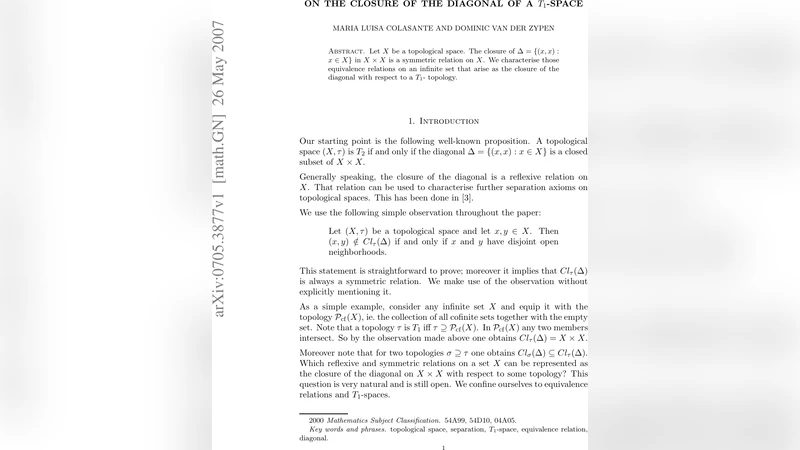
Let X be a topological space. The closure of \Delta = {(x, x) : x \in X} in X \times X is a symmetric relation on X. We characterise those equivalence relations on an infinite set that arise as the closure of the diagonal with respect to a T_1-topology.
💡 Research Summary
The paper investigates the relationship between the diagonal Δ = {(x,x) : x∈X} of a topological space X and the symmetric relation obtained by taking its closure in the product space X×X. In any space, the closure cl_{X×X}(Δ) consists exactly of those ordered pairs (x,y) that cannot be separated by disjoint open neighbourhoods; equivalently, x and y share every open neighbourhood. This relation is always symmetric and reflexive, and in many contexts it coincides with the Kolmogorov (T₀) quotient of X.
The authors focus on T₁ spaces, where each singleton {x} is closed. Under the T₁ assumption the condition “x and y share all open neighbourhoods” becomes a precise description of topological indistinguishability: two distinct points are indistinguishable precisely when they belong to the same equivalence class of cl_{X×X}(Δ). Consequently, cl_{X×X}(Δ) is an equivalence relation on X.
The central question addressed is: Which equivalence relations on an infinite set X can arise as cl_{τ×τ}(Δ) for some T₁ topology τ on X? The main theorem provides a complete answer:
Theorem. Let E be an equivalence relation on an infinite set X. There exists a T₁ topology τ on X such that E = cl_{τ×τ}(Δ) if and only if every equivalence class of E is either a singleton or an infinite set.
The necessity part is straightforward. Suppose τ is T₁ and E = cl_{τ×τ}(Δ). If a class C contains two distinct points a and b, then a and b must have exactly the same open neighbourhoods. Since T₁ implies each singleton is closed, the complement X{a} is an open set containing b but not a, contradicting the indistinguishability of a and b. Hence any non‑singleton class cannot be finite; it must be infinite.
The sufficiency part is constructive. Given an equivalence relation E satisfying the “singleton‑or‑infinite” condition, the authors build a T₁ topology τ as follows:
-
Infinite classes. For each infinite equivalence class C, endow C with the co‑finite topology (all non‑empty open sets have finite complement). In this topology any two points of C share exactly the same open sets, while singletons are not open, preserving T₁.
-
Singleton classes. For each singleton {x}, give the discrete topology (the only open set containing x is {x} itself). This guarantees that distinct singleton classes are topologically separable.
-
Sum topology. Take the topological sum (disjoint union) of all these subspaces. The resulting space X is T₁ because each point is closed in its own component, and the components are pairwise disjoint.
In this construction, two points lie in the same equivalence class precisely when they belong to the same component, and within a component they have identical neighbourhoods. Therefore (x,y) belongs to cl_{τ×τ}(Δ) iff x and y are in the same equivalence class, establishing E = cl_{τ×τ}(Δ).
The paper also discusses the non‑uniqueness of the topology τ. While the equivalence relation determines the partition of X, many distinct T₁ topologies can realize the same relation. For instance, one may replace the co‑finite topology on an infinite class by any T₁ topology that makes all points topologically indistinguishable (e.g., the particular point topology, or a topology generated by a filter of co‑finite sets). These variations affect additional properties such as compactness, metrizability, or separability, but leave the diagonal closure unchanged.
In the broader context, the result refines the classical understanding of the Kolmogorov quotient. In a T₀ space the closure of the diagonal already yields the T₀‑identification relation; adding the stronger T₁ axiom imposes the extra restriction that non‑trivial indistinguishability classes must be infinite. This observation bridges separation axioms with equivalence‑relation theory and clarifies how much “indistinguishability” a T₁ space can accommodate.
The authors conclude by suggesting further directions: investigating analogous characterisations for higher separation axioms (T₂, regular, normal), exploring minimal or maximal T₁ topologies that realize a given equivalence relation, and studying the interaction between the diagonal closure and other topological constructions such as quotients, products, and function spaces. The paper thus provides a complete and elegant classification of the diagonal‑closure phenomenon in T₁ spaces, opening avenues for deeper exploration of the interplay between topology and relational structures.
Comments & Academic Discussion
Loading comments...
Leave a Comment